Goodreads helps you follow your favorite authors. Be the first to learn about new releases!
Start by following Charles Dunst.

Showing 1-16 of 16
“Yet commentators in Berlin, London and Washington still argue hat autocracy is inherently brittle and that the regimes running China and Singapore will eventually crumble and give way to democracy. They remain convinced themselves that the tides of history are flowing their way, that they are simply pushing on an open door. They seem to forget that people everywhere increasingly consider autocracy ascendant and democracies impotent. They seem to forget that democracy is the anomaly and that we must fight to protect it. They seem to forget that most of human history has been made up of empires and despots – that autocracy is the norm and opposition to democracy is at the heart of Western civilisation: Plato’s Republic is an eloquent pitch for authoritarianism – for the rule of benevolent philosopher-kings. And while there were early proto-democratic expressions of government in Athens, Carthage, Vaishali, San Marino, the Netherlands and Britain, it was not until the Age of Reason that these governments took forms similar to contemporary democracy.
Even the West does not have a natural predisposition to democracy. It is something that we created, but it is also something that we must maintain.”
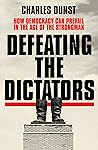
― Defeating the Dictators: How Democracy Can Prevail in the Age of the Strongman
Even the West does not have a natural predisposition to democracy. It is something that we created, but it is also something that we must maintain.”
― Defeating the Dictators: How Democracy Can Prevail in the Age of the Strongman
“Corruption and negligence both undermine the functionality of the state, but they also undermine faith in it, which is arguably more important for a non-democratic regime. If you don’t have democratic elections that allow populations to blow off steam by voting, you risk allowing anger to fester until it erupts in a potentially destabilising moment of mass protest. This is precisely why Singapore, the UAE, Vietnam and other autocracies focus so strongly on these two prongs of accountability.”
― Defeating the Dictators: How Democracy Can Prevail in the Age of the Strongman
― Defeating the Dictators: How Democracy Can Prevail in the Age of the Strongman
“Complacency in the face of popular pain breeds demagoguery.”
― Defeating the Dictators: How Democracy Can Prevail in the Age of the Strongman
― Defeating the Dictators: How Democracy Can Prevail in the Age of the Strongman
“And because democracies are inherently more free, open and equal than autocracies, our governments can hold people accountable in a way no autocracy ever could. Democracies can truly make the guilty and negligent reap the consequences of their failings – and they must do so, both for the health of our democracies at home and for our hopes of spreading democracy abroad.”
― Defeating the Dictators: How Democracy Can Prevail in the Age of the Strongman
― Defeating the Dictators: How Democracy Can Prevail in the Age of the Strongman
“Whether we like it or not, China, Russia and others see us and our success as a threat to their ambitions. That is the main reason why they interfere in our domestic politics by spreading disinformation to cause chaos. Our downfall is their victory; our success is a threat.
This all means that we will, at some point, be forced to respond. And it is better to do so ahead of schedule rather than behind.”
―
This all means that we will, at some point, be forced to respond. And it is better to do so ahead of schedule rather than behind.”
―
“Autocracies’ troubles are existential; ours are political.”
― Defeating the Dictators: How Democracy Can Prevail in the Age of the Strongman
― Defeating the Dictators: How Democracy Can Prevail in the Age of the Strongman
“China, Singapore, the Gulf States and others can lay claim to the future all they want, but the weary people of this world – those fleeing home only because home, as the Somali-British poet, Warsan Shire, has written, ‘is the mouth of a shark’ and the ‘barrel of a gun’ – give lie to these dreams. It is always those facing the most desperate straits who are most likely to speak the truth. And in their most dire moments, those brave people fleeing the jaws of poverty and violence continue, against all odds, to choose us. They continue to choose democracy.”
―
―
“Trust is the building block of effective governance, and especially of good governance within democracies. When people do not trust their government, they will not listen to, support or even engage with it. In democracies, this means that people will not vote. And when people in Muscle Shoals, Leeds and Gangwon are so disconnected from their governments in Washington, Westminster and Seoul that they don’t vote, the government will not provide for them effectively – because officials are not mind-readers; they cannot serve a population from which they have grown distant. So, when people don’t trust their government and thus opt out of civic participation, the result is a ‘mistrust loop’ in which a distrustful public is disengaged, resulting in a government even more disconnected from the public. This, in turn, leads only to the further deterioration of trust, which prompts people to look for solutions in new places and people – including in populists with authoritarian tendencies.”
― Defeating the Dictators: How Democracy Can Prevail in the Age of the Strongman
― Defeating the Dictators: How Democracy Can Prevail in the Age of the Strongman
“There is a reason why authoritarian leaders from Cambodia to Jordan and everywhere in between send their children to study in the West, mostly in the United States and the United Kingdom – because something about our system is better and, deep down, even the dictators seem to know it.”
― Defeating the Dictators: How Democracy Can Prevail in the Age of the Strongman
― Defeating the Dictators: How Democracy Can Prevail in the Age of the Strongman
“As history pressed on, the governments that ran the world increasingly fused democracy with meritocracy, moving from hereditary power and classes of favour-trading elites towards economic government and popular consent. When meritocracy works – when people understand that they can get ahead by working hard – citizens tend to bless the system.
But the fusion of meritocracy and democracy is neither necessary nor automatic. Both autocracies and democracies are at their best when they are most meritocratic, even if democracies are inherently more meritocratic, because in liberal societies everyone can aspire to lead their countries, unlike in autocracies, where that privilege is limited to a small, self-selecting cadre of party officials.”
― Defeating the Dictators: How Democracy Can Prevail in the Age of the Strongman
But the fusion of meritocracy and democracy is neither necessary nor automatic. Both autocracies and democracies are at their best when they are most meritocratic, even if democracies are inherently more meritocratic, because in liberal societies everyone can aspire to lead their countries, unlike in autocracies, where that privilege is limited to a small, self-selecting cadre of party officials.”
― Defeating the Dictators: How Democracy Can Prevail in the Age of the Strongman
“most of human history has been made up of empires and despots – that autocracy is the norm and opposition to democracy is at the heart of Western civilisation: Plato’s Republic is an eloquent pitch for authoritarianism – for the rule of benevolent philosopher-kings. And while there were early proto-democratic expressions of government in Athens, Carthage, Vaishali, San Marino, the Netherlands and Britain, it was not until the Age of Reason that these governments took forms similar to contemporary democracy.
Even the West does not have a natural predisposition to democracy. It is something that we created, but it is also something that we must maintain.”
― Defeating the Dictators: How Democracy Can Prevail in the Age of the Strongman
Even the West does not have a natural predisposition to democracy. It is something that we created, but it is also something that we must maintain.”
― Defeating the Dictators: How Democracy Can Prevail in the Age of the Strongman
“For all the attacks against meritocracy, there is no other way of organising society than through meritocratic means. And if you’re inclined to disagree, think for a moment about your personal life. Ultimately, when your back is up against the wall, you will want to be operated on by a surgeon or flown by a pilot who graduated at the top of their class and achieved renown in their field through genuine merit – not through a lottery or connections. At some point, particularly when it is a matter of life and death, the buck always stops, and meritocracy always triumphs.”
― Defeating the Dictators: How Democracy Can Prevail in the Age of the Strongman
― Defeating the Dictators: How Democracy Can Prevail in the Age of the Strongman
“What we need is a ‘no-bullshit’ approach to the future: we must commit not only to our values, but also to our practices and we must not buy into utopianism – into undue confidence in democracy’s inevitable success and the self-assurance that reason will save us. We must convince the world in practical terms why our organising principles remain preferable to those of autocracies, both at home and abroad.”
― Defeating the Dictators: How Democracy Can Prevail in the Age of the Strongman
― Defeating the Dictators: How Democracy Can Prevail in the Age of the Strongman
“Complacency will not only be damaging. It will be devastating.”
― Defeating the Dictators: How Democracy Can Prevail in the Age of the Strongman
― Defeating the Dictators: How Democracy Can Prevail in the Age of the Strongman
“American culture tolerates a unique combination of risk, failure and seemingly crazy ideas. The American drive for innovation is, it seems, directly tied to the country’s frontier-conquering past: Americans, more than other people, don’t just look at the horizon but look beyond it – we look for ways to seize whatever the newest frontier might be and make it ours.”
― Defeating the Dictators: How Democracy Can Prevail in the Age of the Strongman
― Defeating the Dictators: How Democracy Can Prevail in the Age of the Strongman
“Yet commentators in Berlin, London and Washington still argue that autocracy is inherently brittle and that the regimes running China and Singapore will eventually crumble and give way to democracy. They remain convinced themselves that the tides of history are flowing their way, that they are simply pushing on an open door. They seem to forget that people everywhere increasingly consider autocracy ascendant and democracies impotent. They seem to forget that democracy is the anomaly and that we must fight to protect it. They seem to forget that most of human history has been made up of empires and despots – that autocracy is the norm and opposition to democracy is at the heart of Western civilisation: Plato’s Republic is an eloquent pitch for authoritarianism – for the rule of benevolent philosopher-kings. And while there were early proto-democratic expressions of government in Athens, Carthage, Vaishali, San Marino, the Netherlands and Britain, it was not until the Age of Reason that these governments took forms similar to contemporary democracy.
Even the West does not have a natural predisposition to democracy. It is something that we created, but it is also something that we must maintain.”
―
Even the West does not have a natural predisposition to democracy. It is something that we created, but it is also something that we must maintain.”
―