Goodreads helps you follow your favorite authors. Be the first to learn about new releases!
Start by following T.K. Seung.

Showing 1-4 of 4
“This lovers quarrel is similar to the one between Shiva and his consort Parvati. When they play the game of dice, they always wind up in an acrimonious dispute, accusing each other of cheating and many other unfair tricks. Shiva's game of dice is another mythological account of how the world runs, although it is not so well known as the myth of his cosmic dance. The game illustrates the conflict between the individual and cosmic self. The game of dice is also Zarathustra's favorite metaphor along with the metaphor of dance. In 'Before Sunrise', he compares the world to a game of dice by calling the azure bell 'a divine table for divine dice and dice players.' In fact, he equates the cosmic game of dice with the cosmic dance of the world. He says to the azure bell, 'You are to me a dance floor for divine accidents. The dance of Life is the cosmic dance of the azure bell. Just like Shiva's dance, the cosmic dance of Life is a game of dice. That explains why Zarathustra cannot control it. By its nature, the game of dice is beyond control. Parvati gets into vicious arguments with Shiva because she is trying to control what is beyond control. For the same reason, Zarathustra cannot avoid fighting with Life. He cannot resist the temptation to control her.”
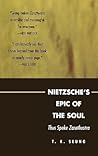
― Nietzsche's Epic of the Soul: Thus Spoke Zarathustra
― Nietzsche's Epic of the Soul: Thus Spoke Zarathustra
“In this book, I have tried to reveal her other Nietzsche as really the central Nietzsche in Zarathustra by firmly linking his mysticism to Spinoza’s pantheism.”
― Nietzsche's Epic of the Soul: Thus Spoke Zarathustra
― Nietzsche's Epic of the Soul: Thus Spoke Zarathustra
“When they [Shiva and Parvati] play the game of dice, they always wind up in an acrimonious dispute, accusing each other of cheating and many other unfair tricks. Shiva's game of dice is another mythological account of how the world runs, although it is not so well known as the myth of his cosmic dance. The game illustrates the conflict between the individual and cosmic self. The game of dice is also Zarathustra's favorite metaphor along with the metaphor of dance. In 'Before Sunrise', he compares the world to a game of dice by calling the azure bell 'a divine table for divine dice and dice players.' In fact, he equates the cosmic game of dice with the cosmic dance of the world. He says to the azure bell, 'You are to me a dance floor for divine accidents. The dance of Life is the cosmic dance of the azure bell. Just like Shiva's dance, the cosmic dance of Life is a game of dice. That explains why Zarathustra cannot control it. By its nature, the game of dice is beyond control. Parvati gets into vicious arguments with Shiva because she is trying to control what is beyond control. For the same reason, Zarathustra cannot avoid fighting with Life. He cannot resist the temptation to control her.”
―
―
“Robert Gooding-Williams says that his soul is envisioned as “an omnipresent, pantheistic deity” (Zarathustra’s Dionysian Modernism, 295). In fact, Zarathustra’s description of his soul in terms of cosmic attributes comes right out of Spinoza’s pantheism. In his theology, the mind of God is not separate from the individual minds. The thought of God is realized in the ideas of countless individual minds. The totality of these ideas constitutes a system of ideas, the infinite idea of God, whose scope is coextensive with the world.”
― Nietzsche's Epic of the Soul: Thus Spoke Zarathustra
― Nietzsche's Epic of the Soul: Thus Spoke Zarathustra