Goodreads helps you follow your favorite authors. Be the first to learn about new releases!
Start by following Gerald Stanley Lee.

Showing 1-12 of 12
“America is a tune. It must be sung together.”
―
―
“The third stage of education for which Dr. Thwing partitions off the human mind is the “stage in which a pupil becomes capable of original research, a discoverer of facts and relations” himself. In theory this means that when a man is thirty years old and all possible habits of originality have been trained out of him, he should be allowed to be original. In practice it means removing a man’s brain for thirty years and then telling him he can think. There never has been a live boy in a school as yet that would allow himself to be educated in this way if he could help it. All the daily habits of his mind resent it. It is a pessimistic, postponing way of educating him. It does not believe in him enough.”
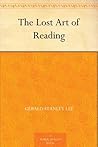
― The Lost Art of Reading
― The Lost Art of Reading
“I am merely contending for the principle that the extraordinary or inspired man is the normal man (at the point where he is inspired) and that the ordinary or uninspired boy can be made like him, must be educated like him, led out through his self-delight to truth, that, if anything, the ordinary or uninspired boy needs to be educated like a genius more than a genius does.”
― The Lost Art of Reading
― The Lost Art of Reading
“Early education,” says President Thwing, “occupies itself with description (geometry, space, arithmetic, time, science, the world of nature). Later education with comparison and relations.”
― The Lost Art of Reading
― The Lost Art of Reading
“The way a man feels in a library (if any one can get him”
― The Lost Art of Reading
― The Lost Art of Reading
“Early education,” says President Thwing, “occupies itself with description (geometry, space, arithmetic, time, science, the world of nature). Later education with comparison and relations.” If one asks, “Why not both together? Why learn facts at one time and their relations at another? Is it not the most vital possible way to learn facts to learn them in their relations?”—the answer that would be generally made reveals that most teachers are pessimists, that they have very small faith in what can be expected of the youngest pupils. The theory is that interpretative minds must not be expected of them. Some of us find it very hard to believe as little as this, in any child. Most children have such an incorrigible tendency for putting things together that they even put them together wrong rather than not put them together at all. Under existing educational conditions a child is more of a philosopher at six than he is at twenty-six.”
― The Lost Art of Reading
― The Lost Art of Reading
“I find no more satisfactory way of reading most books—the way one has to—through their backs, than reading the few books that one does read, through persons and for persons and with persons. It is a great waste of time to read a book alone.”
― The Lost Art of Reading
― The Lost Art of Reading
“Early education,” says President Thwing, “occupies itself with description (geometry, space, arithmetic, time, science, the world of nature). Later education with comparison and relations.” If one asks, “Why not both together? Why learn facts at one time and their relations at another? Is it not the most vital possible way to learn facts to learn them in their relations?”—the answer that would be generally made reveals that most teachers are pessimists, that they have very small faith in what can be expected of the youngest pupils. The theory is that interpretative minds must not be expected of them. Some of us find it very hard to believe as little as this, in any child. Most children have such an incorrigible tendency for putting things together that they even put them together wrong rather than not put them together at all. Under existing educational conditions a child is more of a philosopher at six than he is at twenty-six. The third stage of education for which Dr. Thwing partitions off the human mind is the “stage in which a pupil becomes capable of original research, a discoverer of facts and relations” himself. In theory this means that when a man is thirty years old and all possible habits of originality have been trained out of him, he should be allowed to be original. In practice it means removing a man’s brain for thirty years and then telling him he can think.”
― The Lost Art of Reading
― The Lost Art of Reading
“The making of a man, like the making of a work of art, consists in giving the nature of things a chance, keeping them open to the sun and air and the springs of thought.”
― The Lost Art of Reading
― The Lost Art of Reading
“I am merely contending for the principle that the extraordinary or inspired man is the normal man (at the point where he is inspired) and that the ordinary or uninspired boy can be made like him, must be educated like him, led out through his self-delight to truth, that, if anything, the ordinary or uninspired boy needs to be educated like a genius more than a genius does. I”
― The Lost Art of Reading
― The Lost Art of Reading
“The way a man feels in a library (if any one can get him to tell it) lets out more about a man than anything else in the world.”
― The Lost Art of Reading
― The Lost Art of Reading
“It is not unnatural to claim, therefore, that the most immediate and important short-cut in knowledge that the comprehensive or educated man can take comes to him through his human and personal relations. There is no better way of getting at the spirits of facts, of tracing out valuable and practical laws or generalisations, than the habit of trying things on to people in one’s mind.”
― The Lost Art of Reading
― The Lost Art of Reading