Goodreads helps you follow your favorite authors. Be the first to learn about new releases!
Start by following Ben Ratliff.

Showing 1-11 of 11
“I remember once I asked Wayne for the time," Miller told Mercer. "He started talking to me about the cosmos and how time is relative." Miller and [Wayne] Shorter were waiting somewhere -- an airport, a train station, a hotel. The band's keyboardist, Joe Zawinul, who took charge of such matters as what the road crew was supposed to do and when, set Miller straight. "You don't ask Wayne shit like that," he snapped. "It's 7:06 p.m." [p.1]”
― The Jazz Ear: Conversations Over Music
― The Jazz Ear: Conversations Over Music
“Speed in music is like a sweater on a dog: mostly for show.”
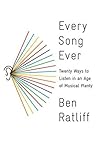
― Every Song Ever: Twenty Ways to Listen in an Age of Musical Plenty
― Every Song Ever: Twenty Ways to Listen in an Age of Musical Plenty
“We think of pieces of music from a distance as blocks of time, but can we hold more than a second or two in our minds? And are we—with all music, to some extent—waiting around for some pinpointed extraordinariness to happen? Not”
― Every Song Ever: Twenty Ways to Listen in an Age of Musical Plenty
― Every Song Ever: Twenty Ways to Listen in an Age of Musical Plenty
“I’d say, ‘Trane, man, why are you doing that, beating on your chest and howling in the microphone?’” Ali remembered in an interview. “He’d say, ‘Man, I can’t find nothing else to play on the horn.’ He exhausted the saxophone. He couldn’t find nothing else to play … he ran out of horn.”
― Coltrane: The Story of a Sound
― Coltrane: The Story of a Sound
“Infinite access, unused or misused, can lead to an atrophy of the desire to seek out new songs ourselves, and a hardening of taste, such that all you want to do is confirm what you already know. But there is possibly something very good, too, about the constant broadcast and the powers of the shuffle and recommendation effects. There is a possibility that hearing so much music without specifically asking for it develops in the listener a fresh kind of aural perception, an ability to size up a song and contextualize it in a new or personal way, rather than immediately rejecting it based on an external idea of genre or style. It’s what happens in the moment of contextualization that matters: what you can connect it to, how you make it relate to what you know.”
― Every Song Ever: Twenty Ways to Listen in an Age of Musical Plenty
― Every Song Ever: Twenty Ways to Listen in an Age of Musical Plenty
“Music coheres and resolves according to lots of intrinsic rules—so many that we tend to call it a "language." But natural languages [...] typically have many specific words to point toward specific commonplace ideas. This language doesn't, or at least resists being used quite in that way.”
― Every Song Ever: Twenty Ways to Listen in an Age of Musical Plenty
― Every Song Ever: Twenty Ways to Listen in an Age of Musical Plenty
“because genre is a construct for the purpose of commerce, not pleasure, and ultimately for the purpose of listening to less”
― Every Song Ever: Twenty Ways to Listen in an Age of Musical Plenty
― Every Song Ever: Twenty Ways to Listen in an Age of Musical Plenty
“When talking about writing, I often use the analogy of archaeology. There are these great tunes all around. Your skill as a musician allows you to pick them out without breaking them.”
― The Jazz Ear: Conversations Over Music
― The Jazz Ear: Conversations Over Music
“Algorithms are listening to us. At the very least we should try to listen better than we are being listened to.”
― Every Song Ever: Twenty Ways to Listen in an Age of Musical Plenty
― Every Song Ever: Twenty Ways to Listen in an Age of Musical Plenty
“Crucially, the effect of repetition depends [...] on a relative change moving against a relative constant, which is really the key to life's riddle of time and gratification.”
― Every Song Ever: Twenty Ways to Listen in an Age of Musical Plenty
― Every Song Ever: Twenty Ways to Listen in an Age of Musical Plenty
“Tone doesn't demonstrably exist in composed notes. It exists only in played ones. It's the most human part of music, the carrier of emotion.”
― Every Song Ever: Twenty Ways to Listen in an Age of Musical Plenty
― Every Song Ever: Twenty Ways to Listen in an Age of Musical Plenty