Goodreads helps you follow your favorite authors. Be the first to learn about new releases!
Start by following Moses I. Finley.
Showing 1-7 of 7
“The Greeks, or more correctly the Athenians, invented the idea of theatre, as they invented so many other social and cultural institutions which the west then came to take for granted. There is nothing self-evident about the idea of theatre, of plays and players through whom private individuals, lacking priestly or other authority, publicly examined man's fate and commented on it by a poetic play which, despite the many traditional elements, was in its essential qualities a creation of the playwright.”
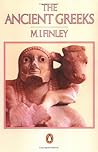
― The Ancient Greeks
― The Ancient Greeks
“It was fundamental to Plato, and to the mainstream of classical Greek philosophy after him, that men are created unequal; not merely in the superficial sense of inequality in physique, wealth or social position, but unequal in their souls, morally unequal. A few men are potentially capable of completely rational behaviour, and hence of correct moral judgment; most men are not.”
― The Ancient Greeks
― The Ancient Greeks
“The age of heroes, then, as Homer understood it, was a time in which men exceeded subsequent standards with respect to a specified and severely limited group of qualities. In a measure, these virtues, these values and capacities, were shared by many men of the period, for otherwise there could have been no distinct age of heroes between the bronze and the iron. Particularly in the Odyssey the word "hero" is a class term for the whole aristocracy, and at times it even seems to embrace all the free men. "Tomorrow," Athena instructed Telemachus, "summon the Achaean heroes to an assembly," by which she meant "call the regular assembly of Ithaca.”
― The World of Odysseus
― The World of Odysseus
“A remarkable example will be found in the first fifteen chapters of Thucydides. Here is a rapid review of the evolution of Greek society in which not a single trace of the mythic conception survives: the gods have disappeared completely, and with them fate and fortune and every other extra-human agency. In their place Thucydides put common-sense human causes and impulses, and the result looks so much like history that many people today, even historians who should know better, praise it as a great piece of historical writing.”
― The Portable Greek Historians
― The Portable Greek Historians
“Three conditions are necessary for a slave society: private, concentrated landownership, sufficient development of commodity production and markets, and unavailability of an internal labor supply.”
―
―
“Neither in Greek nor in Latin was there a word with which to express the general notion of 'labour' or the concept of labour 'as a general social function.' The nature and conditions of labour in antiquity precluded the emergence of such general ideas, as of the idea of a working class. 'Men never rest from toil and sorrow by day, and from perishing by night,' said Hesiod (Works and Days 176-8). That is a descriptive statement, a statement of fact, not of ideology; so is the conclusion, that it is therefore better to toil than to perish, and better still to turn to the labour of slaves if one can. But the world was not one of toil and sorrow for everybody, and there lay a difficulty. The expulsion from Eden had the saving feature that it embraced all mankind, and hence, though it linked work with sin and punishment, it did not degrade labour as such. A fate which is everyone's may be tragic, it cannot be shameful. Sin can be washed away, not natural moral inferiority. Aristotle's theory of natural slavery in the first book of the Politics was an extreme position, but those who did not accept it merely turned the doctrine round: men who engaged in the mean employments or in the slavish conditions of employment were made inferior by their work. Either way there was no consolation.
All this, it will be objected, is based on the views of the upper classes and their spokesmen among the intellectuals, not on the views of those who worked but were voiceless. But they were not wholly so. They expressed themselves in their cults, for example, and it is to be noted that though Hephaestus (the Roman Vulcan), the craftsman among the gods, was in a sense a patron of the crafts, and especially of the metallurgists, he was an inferior deity in heaven and he received little formal worship and few temples on earth. The most 'popular' classical cults were the ecstatic ones, particularly that of Dionysus/Bacchus, the god of intoxication (in more senses than one). Through Dionysus one did not celebrate toil, one obtained release from it. Those who worked also expressed their views in their demands for land, already noticed, and in their failure to ally themselves with the slaves on those relatively rare occasions when the latter revolted.”
― Ancient Economy
All this, it will be objected, is based on the views of the upper classes and their spokesmen among the intellectuals, not on the views of those who worked but were voiceless. But they were not wholly so. They expressed themselves in their cults, for example, and it is to be noted that though Hephaestus (the Roman Vulcan), the craftsman among the gods, was in a sense a patron of the crafts, and especially of the metallurgists, he was an inferior deity in heaven and he received little formal worship and few temples on earth. The most 'popular' classical cults were the ecstatic ones, particularly that of Dionysus/Bacchus, the god of intoxication (in more senses than one). Through Dionysus one did not celebrate toil, one obtained release from it. Those who worked also expressed their views in their demands for land, already noticed, and in their failure to ally themselves with the slaves on those relatively rare occasions when the latter revolted.”
― Ancient Economy
“A human society without myth has never been known, and indeed it is doubtful whether such a society is at all possible. One measure of man's advance from his most primitive beginnings to something we call civilization is the way in which he controls his myths, his ability to distinguish between the areas of behavior, the extent to which he can bring more and more of his activity under the rule of reason.”
― The World of Odysseus
― The World of Odysseus