Goodreads helps you follow your favorite authors. Be the first to learn about new releases!
Start by following Lev Shestov.

Showing 1-30 of 82
“If Darwin had seen in life what Dostoevsky saw, he would not have talked of the law of the preservation of species, but of its destruction.”
― In Job's Balances: On the Sources of the Eternal Truths
― In Job's Balances: On the Sources of the Eternal Truths
“The business of philosophy is to teach man to live in uncertainty... not to reassure him, but to upset him.”
― All Things are Possible
― All Things are Possible
“Suffering "buys" something, and this something possesses a certain value for all of us, for common consciousness; by suffering we buy the right to judge.”
― In Job's Balances: On the Sources of the Eternal Truths
― In Job's Balances: On the Sources of the Eternal Truths
“Moral people are the most revengeful of mankind, they employ their morality as the best and most subtle weapon of vengeance. They are not satisfied with simply despising and condemning their neighbour themselves, they want the condemnation to be universal and supreme: that is, that all men should rise as one against the condemned, and that even the offender's own conscience shall be against him. Then only are they fully satisfied and reassured. Nothing on earth but morality could lead to such wonderful results.”
― All Things are Possible
― All Things are Possible
“Practical advice.—People who read much must always keep it in mind that life is one thing, literature another. Not that authors invariably lie. I declare that there are writers who rarely and most reluctantly lie. But one must know how to read, and that isn't easy. Out of a hundred bookreaders ninety-nine have no idea what they are reading about. It is a common belief, for example, that any writer who sings of suffering must be ready at all times to open his arms to the weary and heavy-laden. This is what his readers feel when they read his books. Then when they approach him with their woes, and find that he runs away without looking back at them, they are filled with indignation and talk of the discrepancy between word and deed. Whereas the fact is, the singer has more than enough woes of his own, and he sings them because he can't get rid of them. L’uccello canta nella gabbia, non di gioia ma di rabbia, says the Italian proverb: "The bird sings in the cage, not from joy but from rage." It is impossible to love sufferers, particularly hopeless sufferers, and whoever says otherwise is a deliberate liar. "Come unto Me all ye that labour and are heavy laden, and I will give you rest." But you remember what the Jews said about Him: "He speaks as one having authority!" And if Jesus had been unable, or had not possessed the right, to answer this skeptical taunt, He would have had to renounce His words. We common mortals have neither divine powers nor divine rights, we can only love our neighbours whilst they still have hope, and any pretence of going beyond this is empty swagger. Ask him who sings of suffering for nothing but his songs. Rather think of alleviating his burden than of requiring alleviation from him. Surely not—for ever should we ask any poet to sob and look upon tears. I will end with another Italian saying: Non è un si triste cane che non meni la coda... "No dog so wretched that doesn't wag his tail sometimes.”
― All Things Are Possible and Penultimates Words and Other Essays
― All Things Are Possible and Penultimates Words and Other Essays
“One must not ask for sincere autobiographies from writers. Fiction was invented precisely to give men the possibility of expressing themselves freely.”
― In Job's Balances: On the Sources of the Eternal Truths
― In Job's Balances: On the Sources of the Eternal Truths
“The man of science, whether he knows it or not (most often, obviously, he does know it), whether he wishes it or not (ordinarily he does not wish it), cannot help but be a realist in the medieval sense of the term. He is distinguished from the philosopher only by the fact that the philosopher must, in addition, explain and justify the realism practiced by science”
― Athens and Jerusalem
― Athens and Jerusalem
“Even Pushkin, who could understand everything, did not grasp the real significance of Dead Souls. He thought that the author was grieving for Russia, ignorant, savage, and outdistanced by the other nations. But it is not only in Russia that Gogol discovers "dead souls." All men, great and small, seem to him lunatics, lifeless, automata which obediently and mechanically carry out commandments imposed on them from without. They eat, they drink, they sin, they multiply; with stammering tongue they pronounce meaningless words. No trace of free will, no sparkle of understanding, not the slightest wish to awake from their thousand-year sleep.”
― In Job's Balances: On the Sources of the Eternal Truths
― In Job's Balances: On the Sources of the Eternal Truths
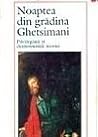
“It is obvious that he has set himself an impossible task; slow and gradual transformations are possible, they even happen quite frequently, but they do not lead us to a new life; they only take us from one old life to another old life. The new life always makes itself known abruptly, without any approach or preparation, and it keeps its strange enigmatical character in the midst of events whose course has been determined by the old laws.”
― Noaptea din gradina Ghetsimani
― Noaptea din gradina Ghetsimani
“He did not want to be original; he made superhuman efforts to be like everybody else: but there is no escaping one's destiny.”
― All Things Are Possible and Penultimates Words and Other Essays
― All Things Are Possible and Penultimates Words and Other Essays
“They certified that I was sane; but I know that I am mad." This confession gives us the key to what is most important and significant in Tolstoy's hidden life.”
― In Job's Balances: On the Sources of the Eternal Truths
― In Job's Balances: On the Sources of the Eternal Truths
“Plato would hardly need to change a single word of his myth of the cave. Our knowledge would not be able to furnish an answer to his anxiety, his disquietude, his "premonitions." The world would remain for him, "in the light" of our "positive" sciences, what it was - a dark and sorrowful subterranean region - and we would seem to him like chained prisoners. Life would again have to make superhuman efforts, "as in a battle," to break open for himself a path through the truths created by the sciences which "dream of being but cannot see it in waking reality." [1] In brief, Aristotle would bless our knowledge while Plato would curse it.”
― Athens and Jerusalem
― Athens and Jerusalem
“St. Augustine hated the Stoics, Dostoevsky hated the Russian Liberals. At first sight this seems a quite inexplicable peculiarity. Both were convinced Christians, both spoke so much of love, and suddenly - such hate! And against whom? Against the Stoics, who preached self-abnegation, who esteemed virtue above all things in the world, and against the Liberals who also exalted virtue above all things! But the fact remains: Dostoevsky spoke in rage of Stassyulevitch and Gradovsky; Augustine could not be calm when he spoke the names of those pre-Stoic Stoics, Regulus and Mutius Scaevola, and even Socrates, the idol of the ancient world, appeared to him a bogey. Obviously Augustine and Dostoevsky were terrified and appalled by the mere thought of the possibility of such men as Scaevola and Gradovsky - men capable of loving virtue for its own sake, of seeing virtue as an end in itself. Dostoevsky says openly in the Diary of a Writer that the only idea capable of inspiring a man is that of the immortality of the soul.”
― In Job's Balances: On the Sources of the Eternal Truths
― In Job's Balances: On the Sources of the Eternal Truths
“Herein lies the supreme wisdom, human and divine; and the task of philosophy consists in teaching men to submit joyously to Necessity which hears nothing and is indifferent to all.”
― Athens and Jerusalem
― Athens and Jerusalem
“(...)on earth "everything has a beginning and nothing has an end.”
― In Job's Balances: On the Sources of the Eternal Truths
― In Job's Balances: On the Sources of the Eternal Truths
“After a tragedy, a farce. Philosophy enters into her power, and the earth returns under one's feet.”
― All Things are Possible
― All Things are Possible
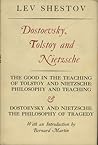
“Dostoevsky does not believe his own words, and he is trying to replace a lack of faith with "feeling" and eloquence.”
― Dostoevsky, Tolstoy and Nietzsche: The Good in the Teaching of Tolstoy and Nietzsche: Philosophy and Preaching, & Dostoevsky and Nietzsche: The Philosophy of Tragedy
― Dostoevsky, Tolstoy and Nietzsche: The Good in the Teaching of Tolstoy and Nietzsche: Philosophy and Preaching, & Dostoevsky and Nietzsche: The Philosophy of Tragedy
“But strange though it may seem, the more he judged, and the more he realized that men feared and acknowledged his right to judge, the more his innermost soul questioned man's right to judgment of any kind.”
― In Job's Balances: On the Sources of the Eternal Truths
― In Job's Balances: On the Sources of the Eternal Truths
“It is necessary to choose: if you wish to be an empiricist, you must abandon the hope of founding scientific knowledge on a solid and certain basis; if you wish to have a solidly established science, you must place it under the protection of the idea of Necessity and, in addition, recognize this idea as primordial, original, having no beginning and consequently no end - that is to say, you must endow it with the superiorities and qualities that men generally accord to the S”
― Athens and Jerusalem
― Athens and Jerusalem
“To praise oneself is considered improper, immodest; to praise one’s own sect, one’s own philosophy, is considered the highest duty.”
―
―
“Dostoevsky's nature was two-fold, like Spinoza's, and like that of nearly all those who try to awaken humanity from its torpor.”
― In Job's Balances: On the Sources of the Eternal Truths
― In Job's Balances: On the Sources of the Eternal Truths
“But Dostoevsky does allow himself to ask just this very question: whether our reason has any right to judge between the possible and the impossible.”
― In Job's Balances: On the Sources of the Eternal Truths
― In Job's Balances: On the Sources of the Eternal Truths
“Whether I am believed or not, I will repeat that Vladimir Soloviov, who held that Dostoevsky was a prophet, is wrong, and that N. K. Mikhailovsky, who calls him a cruel talent and a grubber after buried treasure, is right. Dostoevsky grubs after buried treasure no doubt about that. And, therefore, it would be more becoming in the younger generation that still marches under the flag of pious idealism if, instead of choosing him as a spiritual leader, they avoided the old sorcerer, in whom only those gifted with great shortsightedness or lack of experience in life could fail to see the dangerous man.”
―
―
“Once an idea is there, the gates must be opened to it.”
― All Things Are Possible
― All Things Are Possible
“Furthermore, as long as the world shall last, there will always be people who, either for the sake of peace or from an unquiet conscience, will build up sublime lies for their neighbours. And these people have always been and will always be the masters of human thought.”
― In Job's Balances: On the Sources of the Eternal Truths
― In Job's Balances: On the Sources of the Eternal Truths
“The thing to do is to go on, in the same suave tone, from uttering a series of banalities to expressing a new and dangerous thought, without any break. If you succeed in this, the business is done. The reader will not forget - the new words will plague and torment him until he has accepted them.”
―
―
“If he tells the truth, it is because the most reeking lie no longer intoxicates him, even though he swallow it not in the modest doses that idealism offers, but in immoderate quantities, thousand-gallon-barrel gulps. He would taste the bitterness, but it would not make his head turn, as it does Schiller's, or Dostoevsky's, or even Socrates’, whose head, as we know, could stand any quantity of wine, but went spinning with the most commonplace lie.”
― All Things are Possible
― All Things are Possible
“If Aristotle and his pupil Alexander the Great were brought back to life today, they would believe themselves in the country of the gods and not of men. Ten lives would not suffice Aristotle to assimilate all the knowledge that has been accumulated on earth since his death, and Alexander would perhaps be able to realize his dream and conquer the world.”
― Athens and Jerusalem
― Athens and Jerusalem
“Whilst stay-at-home persons are searching for truth, the apple will stay on the tree.”
― All Things are Possible
― All Things are Possible
“And many a time, towards the end of life, does the genius repent of his choice. "It would be better not to startle the world, but to live at one with it," says Ibsen in his last drama. Genius is a wretched, blind maniac, whose eccentricities are condoned because of what is got from him.”
― All Things are Possible
― All Things are Possible