Goodreads helps you follow your favorite authors. Be the first to learn about new releases!
Start by following David Givot.

Showing 1-14 of 14
“First, I am thrilled that paramedics are finally getting the respect they deserve for being the professionals they can be. The scope of practice is expanding, and patient care modalities are improving, seemingly by the minute. Patient outcomes are also improving as a result, and EMS is passing through puberty and forging into adulthood. On the other hand, autonomy in the hands of the “lesser-motivated,” can be a very dangerous thing. You know as well as I do that there are still plenty of providers who operate from a subjective, complacent, and downright lazy place. Combined with the ever-expanding autonomy, that provider just became more dangerous than he or she ever has been – to the patients and to you. Autonomy in patient care places more pressure for excellence on the provider charged with delivering it, and also on the partner and crew members on scene. Since the base hospital is not involved like it once was, they are likewise less responsible for the errors and omissions of the medics on the scene. Now more than ever, crew members are being held to answer for the mistakes and follies of their coworkers; now more than ever, EMS providers are working without a net. What’s next? I predict (and hope) emergency medical Darwinism is going to force some painful and necessary changes. First, increasing autonomy is going to result in the better and best providing superior patient care. More personal ownership of the results is going to manifest in outcomes such as increased cardiac arrest survival rates, faster and more complete stroke recovery, and significantly better outcomes for STEMI patients, all leading to the brass ring: EMS as a profession, not just a job. On the flip side of that coin, you will see consequences for the not-so-good and completely awful providers. There will be higher instances of licensure action, internal discipline, and wash-out. Unfortunately, all those things will stem from generally preventable negative patient outcomes. The danger for the better provider will be in the penumbra; the murky, gray area of time when providers are self-categorizing. Specifically, the better provider who is aware of the dangerously poor provider but does nothing to fix or flush him or her, is almost certain to be caught up in a bad situation caused by sloppy, complacent, or ultimately negligent patient care that should have been corrected or stopped. The answer is as simple as it is difficult. If you are reading this, it is more likely because you are one of the better, more committed, more professional providers. This transition is up to you. You must dig deep and find the strength necessary to face the issue and force the change; you have to demand more from yourself and from those around you. You must have the willingness to help those providers who want it – and respond to those who need it, but don’t want it – with tough love by showing them the door. In the end, EMS will only ever be as good as you make it. If you lay silent through its evolution, you forfeit the right to complain when it crumbles around you.”
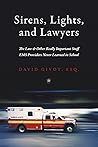
― Sirens, Lights, and Lawyers: The Law & Other Really Important Stuff EMS Providers Never Learned in School
― Sirens, Lights, and Lawyers: The Law & Other Really Important Stuff EMS Providers Never Learned in School
“EMS is not a job for the weak. The stressors exceed most anything that ordinary civilians could possibly understand. However, EMS is a community of humans and humans are affected by the stress, whether they recognize it or not, whether they acknowledge it or not, whether they accept it or not, and recognizing, acknowledging, and accepting that the effects are real does not make one weak. In fact, recognizing, acknowledging, and accepting the realities of EMS could save your sanity and your life.”
― Sirens, Lights, and Lawyers: The Law & Other Really Important Stuff EMS Providers Never Learned in School
― Sirens, Lights, and Lawyers: The Law & Other Really Important Stuff EMS Providers Never Learned in School
“Check boxes, drop-down menus, fill in the blanks, are all important in their own way and for their own reasons, but they are not the lifeblood of your patient care report (PCR/ePCR). Ultimately, it is the narrative documentation that is going to refresh your recollection. Your recollection will never be refreshed, and your life is never going to be saved or ruined by a drop-down box or a menu choice or a fill-in-the-blank. Your legal exposure – and your actual care for the patient – lives or dies in your narrative documentation. That’s what we’re talking about.”
― Sirens, Lights, and Lawyers: The Law & Other Really Important Stuff EMS Providers Never Learned in School
― Sirens, Lights, and Lawyers: The Law & Other Really Important Stuff EMS Providers Never Learned in School
“As it has always been in EMS, if nobody around you talks about the shitty provider in the bunch and you are left to believe that there are no shitty providers where you work…it is because you are the shitty provider and nobody has told you…because you’re a shitty provider. However, if you are reading this, it is highly unlikely that you are a shitty provider. Shitty providers don’t usually read books on how to be better providers…they just stay shitty, thinking they are great. You know him or her.”
― Sirens, Lights, and Lawyers: The Law & Other Really Important Stuff EMS Providers Never Learned in School
― Sirens, Lights, and Lawyers: The Law & Other Really Important Stuff EMS Providers Never Learned in School
“The solution should be simple if you just S.T.O.P.: Settle. Think. Organize. Present. As a true EMS leader, when confronted with any possible, potential, or perceived difficulty: S.T.O.P. before you impose any long-term action or do any irreversible damage. Settle Let the dust settle before taking long-term action. For some reason – maybe it’s the age of instant everything – any brief pause in our action causes anxiety and consternation that we are not responding properly. Get over it. Take the time necessary and available to see each situation for the facts, not the perception. Learn the truth and get the whole story in context first. That is the only way you can actually fix any situation before you exacerbate it; it’s what will prevent you from trying to extinguish a grease fire with water. Think Take the time necessary and available to process the facts as they are, not as they are perceived to be by the public or you. Certain perceptions may be ugly in the moment, but at the end of the day (sorry for the cliché), the public will judge your operation and you on how the story ends. Organize With a clear view of the facts in context, and after careful consideration of them, take the time necessary and available to organize a plan for solving, resolving, fixing, or preventing whatever issue is at hand. Cogitate on the rationality of your response, the cause and effect of that which you are trying to manage. Does your proposed response actually answer the question, or are you simply painting over cracks to make someone else feel better? Present Take the time necessary and available to present the question in proper context, the answer in proper context, and the rationale to those who will be charged with carrying it out. Including the rationale with the conclusion is what professionals do. When you include the “why” with the “what,” you will be far more likely to see success in the implementation of progress and where there is progress, EMS takes another step closer to being professional. In the end, nothing good or productive has ever come from a knee-jerk reaction in EMS or anywhere else. As they say, “Somehow, there’s never enough time to do it right, but there’s always enough time to do it over.”
― Sirens, Lights, and Lawyers: The Law & Other Really Important Stuff EMS Providers Never Learned in School
― Sirens, Lights, and Lawyers: The Law & Other Really Important Stuff EMS Providers Never Learned in School
“He was a constant reminder to me – and everyone – that Paramedics exist for one essential reason: to be there for whoever needs us, whenever they need us, without question and without judgement. You can hate [the patient] later, but for now, on the call, we are responsible for them, and they are going to get everything we have to give.”
― Sirens, Lights, and Lawyers: The Law & Other Really Important Stuff EMS Providers Never Learned in School
― Sirens, Lights, and Lawyers: The Law & Other Really Important Stuff EMS Providers Never Learned in School
“I was not perpetually sad – that’s not what depression is. More than ever before, I was tired all the time. I had lost interest in most activities. I was eating whatever, whenever, drinking more and more. I was easily irritated. Despite wanting to do not much more than sleep, I couldn’t sleep. I had developed chronic back pain that even an MRI could not diagnose. These were the individual signs and symptoms of depression I had battled for decades, and now I was experiencing them all at the same time and they were not going away. I was no longer able to hide what I was dealing with from my family and those closest to me. More than anyone, my wife knew that, if she couldn’t find me in my home office, my work for the day was done and I was in our room binge-watching something on the television, anything to get away from the noise of life. On stage, in court, in public and on social media, I remained in character: high energy and high efficiency, just another terrific day. Backstage, away from where you could see me, where only my family and closest friends could see, nothing: an empty shell. That’s no way to exist and it certainly is not living.”
― Sirens, Lights, and Lawyers: The Law & Other Really Important Stuff EMS Providers Never Learned in School
― Sirens, Lights, and Lawyers: The Law & Other Really Important Stuff EMS Providers Never Learned in School
“Years ago, I received a call from a paramedic I had known for a long, long time. He was a true believer; a provider in it to do good more than to do well. By the tone of his voice, I could tell he was in some serious trouble. His voice did not lie. He was. It seemed that some years earlier he had suffered an injury off the job. The injury resulted in several surgeries and months of painful recovery, physical rehabilitation, and pain medicine. It started as an as-needed remedy for intense pain but before long became a physical necessity. When the actual pain no longer necessitated the monthly refills, the feigned pain took over. When that excuse had run its course, new injuries and favors from friends took over. The cycle had begun. Back at work, he became adept at leading his double life; on the job he was clean, sober, and clear-headed, but off-duty the pills took over. The decline was slow, but steady. It would not be long before he would lose all control. One day, on a call with the entire crew, he found himself in the home of a patient whose medicine cupboard was a veritable treasure trove of pain killing goodies. Jackpot! While logging all of the medicines, it was easy to drop a full bottle of a certain pain killer into his pocket, and he did…completely undetected. The patient was transported, and the scene was cleared, and his addiction would be fed for a little while longer. Nobody would ever know. However, as he exited the scene with his supervisor, he was struck with a blunt and harsh realization: This is not who I am and it’s not who I want to be! While still at the curbside, in front of the patient’s home, he pulled the bottle from his pocket, handed it to his supervisor, and admitted sincerely: “I have a problem. I need help.” His supervisor considered the heartfelt and painfully honest plea for help, but the paramedic was summarily fired from a job where he had an impeccable record of exemplary service for nearly two decades. He was stripped of his Paramedic license and reported to local authorities and was charged with multiple felonies by the District Attorney. That was the response from his supervisor and the rest of the morally superior lemmings up the chain of command. He asked for help, and they fucked him…because they were afraid of what actually helping him might look like to the outside world. Not once was he offered treatment or an ounce of compassion. He asked for help; now he was looking at serious prison time. This brings us to the frightened and helpless tone in his voice when he called me. Thankfully, his story ends with the proper treatment: A new career and the entire criminal case being dismissed (he had a great lawyer). Unfortunately, similar stories continue to play out in agencies, both public and private, all across America and they do not, or will not, end so well.”
― Sirens, Lights, and Lawyers: The Law & Other Really Important Stuff EMS Providers Never Learned in School
― Sirens, Lights, and Lawyers: The Law & Other Really Important Stuff EMS Providers Never Learned in School
“More and more, providers are being held to higher (legal) standards of care without the appropriate support from their employers. That is, medics are being investigated and sanctioned at a more aggressive rate than ever before over smaller and smaller clinical infractions. To get with the times, agencies need to spend much more of their allotted training time on skills like 12 lead EKG application and interpretation, assessment algorithms, and intubation or advanced parenteral route access, for example. The list of available and important topics is as long and diverse as the national, state, and local scopes of practice. On the other hand, agencies that resist this reality cannot be surprised to discover that their care is generally substandard, for which there can be grave legal consequences. They can’t throw their bottles on the floor and cry because they don’t have them. I predict that any agency that emphasizes drilling on patient care as much as or even more than firefighting will very quickly see a dramatic shift in the culture from EMS apathy to EMS advocacy. That culture shift should be a welcome bonus; the key benefit being finally providing the superior care about which they already brag. Yes, there will be some resistance at first and that is great. Resistance is the surest way to quickly identify those who are not committed, because they will whine and complain the most and they will require the most work. If they are not willing to do the work, then maybe they don’t belong.”
― Sirens, Lights, and Lawyers: The Law & Other Really Important Stuff EMS Providers Never Learned in School
― Sirens, Lights, and Lawyers: The Law & Other Really Important Stuff EMS Providers Never Learned in School
“Years ago, I represented a client, a firefighter/paramedic, in an administrative trial after he had been terminated for allegedly providing patient care that was below the department’s established standards. One central issue was the ongoing, on-the-job training firefighters/paramedics receive. Throughout the trial, senior officers of the department, including the Chief himself, preached and bloviated on and on about how the department is committed to providing only the best patient care and how their paramedics are held to a higher standard; how they are committed to serving the community with the highest level of blah, blah, blah. On cross examination, however, I asked each of them about how many hours a day each provider spends drilling or practicing firefighting technique and equipment. Each of them answered proudly that every firefighter/EMT and firefighter/paramedic, regardless of assignment, spends at least three hours each day practicing firefighting skills and/or rehearsing the use of various firefighting equipment; hoses, ladders, saws, and other firefighter equipment. Ok, that’s great. Through testimony, we determined that, based on a 10-shift work month, each firefighter/paramedic, regardless of assignment, spends at least 30 hours per month drilling, practicing, and/or rehearsing firefighting skills & equipment. That’s at a minimum of 360 hours per year of ongoing, on-the-job firefighter training. Outstanding. When the smoke is showing and the flames are roiling, they will be ready. They all displayed the same proud grin at how well trained their people are. For each of them, however, that smug grin quickly turned when I then asked about the number of hours per day each firefighter/paramedic spends drilling on or practicing patient care related techniques, skills, and tools. Every one of them squirmed as they responded with the truth that the department only offers three hours of patient care related education per month. That’s roughly a maximum of 36 hours of paramedic training for the entire year. It got worse when further testimony showed that patient care related calls account for more than 80 percent of their call volume and fire related calls less than 20 percent, I could see each of them deflate on the witness stand when I asked how they could truthfully say they were committed to providing the best patient care when barely 10 percent of their training addresses patient care, which constitutes over 80 percent of your department’s calls. The answers were more disjointed and nonsensical than a White House press briefing. Of course, across America the 10:1 ratio of ongoing firefighting training to EMS training is pretty consistent, which begs the question: Don’t they get it? Excellence is the product of practice. How can any rational person look at a 10:1 training ratio and declare themselves committed to the highest level of care? How can an agency neglect training on the most significant aspect of the business and then be surprised when issues of negligence and liability arise? Once again, it seems that old-school culture leaves EMS stuck in the mud and the law is not going to wait for agencies to figure out that living in the past compromises the future.”
― Sirens, Lights, and Lawyers: The Law & Other Really Important Stuff EMS Providers Never Learned in School
― Sirens, Lights, and Lawyers: The Law & Other Really Important Stuff EMS Providers Never Learned in School
“In my training programs, I use redacted local ePCRs as examples. When I identify ePCRs, like those above, to members of the agency that created them, the audience, who were laughing and enjoying the class just a minute ago, falls silent. Every time. After a few seconds of them pondering their feet like children who were just caught ditching class, I point out that these obviously substandard providers are their peers, their coworkers. As far as the public and the law are concerned, if they know about it and do nothing, these substandard providers are them.”
― Sirens, Lights, and Lawyers: The Law & Other Really Important Stuff EMS Providers Never Learned in School
― Sirens, Lights, and Lawyers: The Law & Other Really Important Stuff EMS Providers Never Learned in School
“EMS is a duty of disproportionate importance to most others in society; nevertheless, it is a duty owed to all others in society. The difficulty of what providers face is only compounded by the environment in which providers face it. However, difficulty and environment should never take away from the humanity with which care must be delivered.”
― Sirens, Lights, and Lawyers: The Law & Other Really Important Stuff EMS Providers Never Learned in School
― Sirens, Lights, and Lawyers: The Law & Other Really Important Stuff EMS Providers Never Learned in School
“Self-Care is not Selfish Another characteristic common among EMS providers is the desire (sometimes need) to be there for others; to be known as the clutch player, the go-to. More often than not, it means doing for others to the exclusion of doing for yourself. That shit ends right here. The idea of self-care is not just some new age sales technique designed to get people to buy crap they don’t need for problems that don’t exist. Self-care, self-love (not the dirty kind), and self-improvement have become vital to the health and wellbeing, mental, physical, emotional, and even spiritual of everyone living in an ever-crazier world, filed with stressors we could not have imagined just a decade ago. Self-care is not a singular idea and there is no one-size-fits-all approach. Each of us must find and employ the kinds of self-care activities and processes that fit our lifestyles, abilities, and issues.”
― Sirens, Lights, and Lawyers: The Law & Other Really Important Stuff EMS Providers Never Learned in School
― Sirens, Lights, and Lawyers: The Law & Other Really Important Stuff EMS Providers Never Learned in School
“Oh, one last thing, if you were hoping or expecting a stale, boring, politically correct clinical treatise on EMS law, this ain’t it. If you are easily offended, this may not be the book for you. I write like I talk – one EMS provider to another, like normal fucking people. Enjoy.”
― Sirens, Lights, and Lawyers: The Law & Other Really Important Stuff EMS Providers Never Learned in School
― Sirens, Lights, and Lawyers: The Law & Other Really Important Stuff EMS Providers Never Learned in School