Goodreads helps you follow your favorite authors. Be the first to learn about new releases!
Start by following Thomas Kochman.

Showing 1-6 of 6
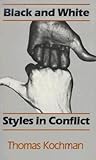
“Page 126: [The greater capacity of blacks to express themselves forcefully and to receive and manipulate the forceful assertions of others] applies not only to classroom debate but to argument generally. One black woman remarked that she was always surprised at the difficulty her white college roommate had in contending with her when they had a difference of opinion. This observation has often been made by blacks, who consider whites as a result interpersonally weak as well as seeming to be “forever demanding an apology over nothing.” The basis for the last remark has already been established: whites consider an assault on the sensibilities of others a social offense.”
― Black and White Styles in Conflict
― Black and White Styles in Conflict
“Page 21: Present-day whites relate to their material as spokesmen, not advocates. This is because they believe that the truth or other merits of an idea are intrinsic to the idea itself. How deeply a person cares about or believes in the idea is considered irrelevant to its fundamental value. The truth of the matter is in the matter. This view—the separation of truth and belief—is heavily influenced by what whites understand of the scientific method, where the goal is to achieve a stance of neutral objectivity with regard to the truth that is “out there”: a truth that is not the be possessed or created but, rather, discovered.”
― Black and White Styles in Conflict
― Black and White Styles in Conflict
“Page 92: The black view that people who feel accused are guilty is based on the cultural belief that “only the truth hurts.” When whites (or blacks) issue a vigorous and defensive denial—the kind that whites often use when they feel falsely accused—blacks consider this is a confirmation of guilt since they believe that only the truth would have been able to produce a protest of such intensity.”
― Black and White Styles in Conflict
― Black and White Styles in Conflict
“Page 12: The Bilingual Education Act expanded the idea of students’ right to their own language to their right to be educated in their own language, if their command of English was insufficient for them to learn on a par with native English-speaking students in classrooms where only English was spoken. While obviously conceived as a transition to an English program, in effect, bilingual education also strengthens students’ abilities to communicate in their own language, if that is the language in which it has been determined that they can learn more effectively. The social significance of this development, however unintentional, is that public schools—perhaps for the first time on a national scale—have become actively engaged in maintaining the native language of ethnic minority groups.”
― Black and White Styles in Conflict
― Black and White Styles in Conflict
“Page 119: Of course McCarty did not consider her laughter inconsiderate of other people’s sensibilities, since in black culture, feelings and emotions are seen as primary and independent forces. They are primary in that they are seen principally to motivate and guide black action and to serve as a reference to explain why individuals behave in the way that they do. They are independent in that blacks relinquish to feelings the freedom to exert their own will on their behavior, and consequently, on whatever proceedings they happen to be engaging in at the time.”
― Black and White Styles in Conflict
― Black and White Styles in Conflict
“Page 125: What is of greater concern to blacks, and what they regard as a more serious violation of the rights of others—but what whites consider hardly a violation at all—is to be in a situation where for compelling social reasons (such as keeping a job at a bank) they are not free to act in accordance with the force of their feelings. Blacks call this constraining mode of behavior fronting, and they generally regard negatively situations in which it is necessary to front. Whites do not typically notice when blacks front, since the mode—emotionally subdued—is one that whites consider normal, achieved as a matter of course in their cultural development through the habitual exercise of emotional self-restraint and repression. Consequently, they are not aware of the conscious effort that blacks must make on a day-to-day basis to contain their emotions when working in what they regard as a racially hostile environment.”
― Black and White Styles in Conflict
― Black and White Styles in Conflict