Goodreads helps you follow your favorite authors. Be the first to learn about new releases!
Start by following Gretchen A. Adams.

Showing 1-10 of 10
“sworn testimony to her possession of puppets by witnesses in the Salem trials provided enough empirical evidence for any witchcraft charge.”
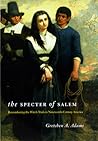
― The Specter of Salem: Remembering the Witch Trials in Nineteenth-Century America
― The Specter of Salem: Remembering the Witch Trials in Nineteenth-Century America
“Perhaps Hawthorne himself best summed up the fraught relationship between the nineteenth-century American and the historical Puritan in a frequently quoted line: "Let us thank God for having given us such ancestors; and let each successive generation thank him, not less fervently, for being one step further from them in the march of ages."58”
― The Specter of Salem: Remembering the Witch Trials in Nineteenth-Century America
― The Specter of Salem: Remembering the Witch Trials in Nineteenth-Century America
“When anxiety about the course of a new cultural movement or political controversy arose, the average American did not have far to go to find a handy historical parallel to express quickly and completely the nature of his fears. If the concern threatened his sense of himself as part of a new nation that was moving forward, the metaphor of Salem witchcraft functioned well as a universally familiar shorthand for the social and political costs of sliding backward into a colonial world of irrationality, tyranny, and superstition.”
― The Specter of Salem: Remembering the Witch Trials in Nineteenth-Century America
― The Specter of Salem: Remembering the Witch Trials in Nineteenth-Century America
“Southern use of the Salem metaphor ensured that when citizens read about the recent national election results in DeBow's Review in December 186o, they needed no further explanation of the message: "The North, who, having begun with burning witches, will end by burning us!"109”
― The Specter of Salem: Remembering the Witch Trials in Nineteenth-Century America
― The Specter of Salem: Remembering the Witch Trials in Nineteenth-Century America
“The Specter of Salem reveals how the cultural memory of an event, like the episode of witch-hunting in 1692 Massachusetts, often has a longer-lasting effect than the event itself.”
― The Specter of Salem: Remembering the Witch Trials in Nineteenth-Century America
― The Specter of Salem: Remembering the Witch Trials in Nineteenth-Century America
“In the nineteenth-century American imagination hanging involved the "rule of law"-the culmination of an orderly legal process where the guilty just might indeed be guilty. "Burning," on the other hand, hinted at extralegal proceedings (or even the Roman Catholic Inquisition) and intensified what Salem's metaphor had invoked so successfully for years: conduct that was dangerously foreign, irrational, and barbaric.7”
― The Specter of Salem: Remembering the Witch Trials in Nineteenth-Century America
― The Specter of Salem: Remembering the Witch Trials in Nineteenth-Century America
“Let us thank God for having given us such ancestors; and let each successive generation thank him, not less fervently, for being one step further from them in the march of ages."58”
― The Specter of Salem: Remembering the Witch Trials in Nineteenth-Century America
― The Specter of Salem: Remembering the Witch Trials in Nineteenth-Century America
“Noah Webster's statement that "the virtues of men are of more consequence to society than their abilities" reflected a mind-set that dominated not only late eighteenth-century
political ideology but the resultant nineteenth-century American theory of education.25”
― The Specter of Salem: Remembering the Witch Trials in Nineteenth-Century America
political ideology but the resultant nineteenth-century American theory of education.25”
― The Specter of Salem: Remembering the Witch Trials in Nineteenth-Century America
“those who pled innocent were executed while those who confessed their guilt lived;”
― The Specter of Salem: Remembering the Witch Trials in Nineteenth-Century America
― The Specter of Salem: Remembering the Witch Trials in Nineteenth-Century America
“In that search for the foundations of national character, many would find the memory of Salem's witch hunt a useful symbol to mark the cultural boundary between the virtuous national present and the superstitious, disorderly, and even brutal colonial past.62”
― The Specter of Salem: Remembering the Witch Trials in Nineteenth-Century America
― The Specter of Salem: Remembering the Witch Trials in Nineteenth-Century America