Goodreads helps you follow your favorite authors. Be the first to learn about new releases!
Start by following Craig A. Carter.

Showing 1-16 of 16
“The rationalistic faith of the Enlightenment has a view of God (Deism), revelation (general, not special), truth (known by reason alone), sin (Pelagianism), Christ (teacher of morality and example of love), atonement (via subjective theories only), salvation (through education and technology), the church (the scientific community), and eschatology (utopia on earth through progress). But most modern people who live their lives as though this set of beliefs were true dislike admitting that they follow a religion. They would rather it was a choice between religion and reason, which is why the myth of the warfare between science and religion was invented in the nineteenth century.”
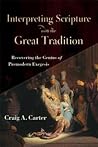
― Interpreting Scripture with the Great Tradition: Recovering the Genius of Premodern Exegesis
― Interpreting Scripture with the Great Tradition: Recovering the Genius of Premodern Exegesis
“The irrational bias of the myth of progress can be seen in the tendency to criticize orthodox church fathers for reading Greek metaphysics into the text, while overlooking Baruch Spinoza's rationalism and Bruno Bauer's Hegelianism on their own biblical interpretation. Is this because "Greek" metaphysics is bad, but "German" metaphysics is good? According to the history of hermeneutics as told from an Enlightenment perspective, if it were not for the pagan Enlightenment, Christians would still be reading Greek metaphysics into the Bible like Augustine and making it say whatever they pleased like Origen. Is it not rather bizarre that this narrative asks us to believe that it took the pagan Epicureanism of the Enlightenment to rescue us from the "subjectivism" of the Nicene fathers, medieval schoolmen, and Protestant Reformers?”
― Interpreting Scripture with the Great Tradition: Recovering the Genius of Premodern Exegesis
― Interpreting Scripture with the Great Tradition: Recovering the Genius of Premodern Exegesis
“Although [the Old Testament] writings predate the incarnation, they do not predate the preexistent Christ, who pervades them with his power and presence as the Word and Wisdom of the Father.”
― Interpreting Scripture with the Great Tradition: Recovering the Genius of Premodern Exegesis
― Interpreting Scripture with the Great Tradition: Recovering the Genius of Premodern Exegesis
“The problem of these “tenured radicals” is the problem that the Marxists always have after they win power. Stripped of their only remaining claim to superior virtue—their powerlessness—they are exposed as mirror”
― Interpreting Scripture with the Great Tradition: Recovering the Genius of Premodern Exegesis
― Interpreting Scripture with the Great Tradition: Recovering the Genius of Premodern Exegesis
“Modern historical criticism views “history” as hypothetical reconstructions of the extrabiblical reality in which the author of the text functioned.”
― Interpreting Scripture with the Great Tradition: Recovering the Genius of Premodern Exegesis
― Interpreting Scripture with the Great Tradition: Recovering the Genius of Premodern Exegesis
“For the Great Tradition of Christian orthodoxy, the ‘literal sense’ refers to the meaning of the biblical text, whether that meaning is conveyed through literal statements or through some sort of figural language and whether that meaning is what the human author consciously intended or is an extension of the human author’s intention implanted in the text by the Holy Spirit through inspiration.”
― Interpreting Scripture with the Great Tradition
― Interpreting Scripture with the Great Tradition
“Scripture participates in the sacramental reality of the spiritual realm as well as the material realm and is a suitable revelation to us creatures, who, made up of both bodies and souls, inhabit both the material and spiritual realms. So biblical interpretation involves both a vertical and a horizontal dimension.”
― Interpreting Scripture with the Great Tradition
― Interpreting Scripture with the Great Tradition
“the Old Testament is Jesus predicted; the Gospels are Jesus revealed; Acts is Jesus preached; the Epistles, Jesus explained; and the Revelation, Jesus expected.”
― Interpreting Scripture with the Great Tradition: Recovering the Genius of Premodern Exegesis
― Interpreting Scripture with the Great Tradition: Recovering the Genius of Premodern Exegesis
“The reason why the apostles taught that Christ fulfills the Old Testament is because they received this teaching directly from the Lord himself." (Luke 24:25-27)”
― Interpreting Scripture with the Great Tradition
― Interpreting Scripture with the Great Tradition
“A sensus plenior is possible providing that it grows organically out of the literal or plain sense.”
― Interpreting Scripture with the Great Tradition
― Interpreting Scripture with the Great Tradition
“The Bible is not an end in itself; it is a means to a greater end, the knowledge of God. Insofar as biblical study leads one to God, it is dealing with the true and proper end of theology.”
― Interpreting Scripture with the Great Tradition: Recovering the Genius of Premodern Exegesis
― Interpreting Scripture with the Great Tradition: Recovering the Genius of Premodern Exegesis
“Scripture for these second-century writers is still very much the Old Testament, while the gospel is still very much a proclamation.”
― Interpreting Scripture with the Great Tradition: Recovering the Genius of Premodern Exegesis
― Interpreting Scripture with the Great Tradition: Recovering the Genius of Premodern Exegesis
“It is the divine authorship of the Bible that makes it not just a library of books, but also one book. It is the divine authorship of the Bible that makes it not just the words of Moses, Isaiah, John, and Paul but also the Word of God. It is the divine authorship of the Bible that is the basis for one of the most basic of all hermeneutical rules—namely, that the Bible does not contradict itself—and therefore any interpretation of a text that contradicts the plain meaning of other texts in the Bible cannot be right. The Bible does not contradict itself because God inspired the Holy Scriptures, and God does not contradict himself.”
― Interpreting Scripture with the Great Tradition
― Interpreting Scripture with the Great Tradition
“The Bible is not an end in itself; it is a means to a greater end, the knowledge of God. Insofar as biblical study leads on to God, it is dealing with the true and proper end of theology.”
― Interpreting Scripture with the Great Tradition
― Interpreting Scripture with the Great Tradition
“The literal sense of Scripture has a broader and more robust character in the Great Tradition. It cannot be detached from either history or the intention of the human author; neither can it be fully grasped apart from consideration of the intention of the primary author, the God who inspires, preserves, and illumines the text.”
― Interpreting Scripture with the Great Tradition
― Interpreting Scripture with the Great Tradition
“Jesus Christ, His passion and resurrection is, for Ignatius, the only complete revelation of God; this alone is salvific. . . . When Ignatius states that “To me the archives [i.e., the books of the Old Testament] are Jesus Christ,” he is not implying that Jesus Christ is a different, higher authority than Scripture; rather, for Ignatius, the Old Testament simply is Jesus Christ—the Word made flesh. All Scripture pertaining to the revelation of God is identical with the revelation of God given in Christ as preached by the apostles; and, in reverse, all that the Gospel proclaims has already been written down as Scripture.”
― Interpreting Scripture with the Great Tradition: Recovering the Genius of Premodern Exegesis
― Interpreting Scripture with the Great Tradition: Recovering the Genius of Premodern Exegesis