Goodreads helps you follow your favorite authors. Be the first to learn about new releases!
Start by following Herman E. Daly.

Showing 1-18 of 18
“Reproduction is more pleasurable than death.”
―
―
“The economy is a wholly owned subsidiary of the environment, not the reverse.”
―
―
“There is something fundamentally wrong in treating the Earth as if it were a business in liquidation.”
―
―
“Even if we could grow our way out of the crisis and delay the inevitable and painful reconciliation of virtual and real wealth, there is the question of whether this would be a wise thing to do. Marginal costs of additional growth in rich countries, such as global warming, biodiversity loss and roadways choked with cars, now likely exceed marginal benefits of a little extra consumption. The end result is that promoting further economic growth makes us poorer, not richer.”
― For the Common Good: Redirecting the Economy toward Community, the Environment, and a Sustainable Future
― For the Common Good: Redirecting the Economy toward Community, the Environment, and a Sustainable Future
“While the invisible hand looks after the private sector, the invisible foot kicks the public sector to pieces.”
―
―
“If nonsatiety were the natural state of human nature then aggressive want-stimulating advertising would not be necessary, nor would the barrage of novelty aimed at promoting dissatisfaction with last year's model. The system attempts to remake people to fit its own presuppositions. If people's wants are not naturally insatiable we must make them so, in order to keep the system going.”
― For the Common Good: Redirecting the Economy toward Community, the Environment, and a Sustainable Future
― For the Common Good: Redirecting the Economy toward Community, the Environment, and a Sustainable Future
“The individualism of current economic theory is manifest in the purely self-interested behavior it generally assumes. It has no real place for fairness, malevolence, and benevolence, nor for the preservation of human life or any other moral concern.”
― For the Common Good: Redirecting the Economy toward Community, the Environment, and a Sustainable Future
― For the Common Good: Redirecting the Economy toward Community, the Environment, and a Sustainable Future
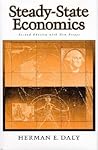
“Malthus has been buried many times, and Malthusian scarcity with him. But as Garrett Hardin remarked, anyone who has to be reburied so often cannot be entirely dead.”
― Steady-State Economics: The Economics of Biophysical Equilibrium and Moral Growth
― Steady-State Economics: The Economics of Biophysical Equilibrium and Moral Growth
“Environmental degradation is an iatrogenic disease induced by economic physicians who treat the basic malady of unlimited wants by prescribing unlimited growth.... Yet one certainly does not cure a treatment-induced disease by increasing the treatment dosage.”
― Steady-State Economics
― Steady-State Economics
“The problem with the World Bank has to do with development - the spreading of Western over-consumption worldwide.”
―
―
“We are running this planet like a business in liquidation.”
―
―
“Future progress simply must be made in terms of the things that really count rather than the things that are merely countable.”
― Steady-State Economics
― Steady-State Economics
“The economy has gotten bigger, the ecosystem has not. How big has the economy become relative to the ecosystem?”
― Beyond Growth: The Economics of Sustainable Development
― Beyond Growth: The Economics of Sustainable Development
“Ise went on to suggest a general principle of resource pricing: that nonrenewable resources be priced at the cost of the nearest renewable substitute. Therefore, virgin timber should cost at least as much per board foot as replanted timber; petroleum should be priced at its Btu equivalent of sugar or wood alcohol, assuming they are the closest renewable alternatives. In the absence of any renewable substitutes, the price would merely reflect the purely ethical judgment of how fast the resources should be used up—that is, the importance of the wants of future people relative to the wants of present people. Renewable resources are assumed to be exploited on a sustained-yield basis and to be priced accordingly.”
― Steady-State Economics
― Steady-State Economics
“Only in the last 200 years have we become dependent on nonrenewable minerals. Modern industry runs on the scarcest of the available forms of low entropy. Traditional technology (windmills, waterwheels, etc.) runs on the more abundant solar source. How ironic, therefore, to be told by technological optimists that modern technology is freeing man from dependence on resources (Barnett and Morse, 1963, p. 11). The very opposite is true.”
― Steady-State Economics
― Steady-State Economics
“Boundary-oriented stability tends to minimize future regrets rather than maximize present satisfaction.”
― Steady-State Economics
― Steady-State Economics
“Growth economics gave technology free rein. Steady-state economics channels technical progress in the socially benign directions of small scale, decentralization, increased durability of products, and increased long-run efficiency in the use of scarce resources.”
― Steady-State Economics
― Steady-State Economics
“The terrestrial stock consists of two kinds of resources: those renewable on a human time scale and those renewable only over geologic time and which, for human purposes, must be treated as nonrenewable. Terrestrial low-entropy stocks may also be classified into energy and material. Both sources, the terrestrial and the solar, are limited. Terrestrial nonrenewables are limited in total amount available. Terrestrial renewables are also limited in total amount available and, if exploited to exhaustion, become just like nonrenewables. If exploited on a sustained-yield basis, then they are limited in rate of use, though practically unlimited in terms of the total amount eventually harvestable over time. Likewise, the solar source is practically unlimited in total amount but strictly limited in its rate and pattern of arrival to earth. Thus both sources of low entropy are limited.”
― Steady-State Economics
― Steady-State Economics