Goodreads helps you follow your favorite authors. Be the first to learn about new releases!
Start by following Jason Morgan Ward.

Showing 1-10 of 10
“Racial fear, like the river itself, occasionally overflowed. Just as concrete piers and steel beams kept the Hanging Bridge's rotting deck from collapsing into the muddy Chickasawhay, terror propped up Mississippi's caste system.”
― Hanging Bridge: Racial Violence and America's Civil Rights Century
― Hanging Bridge: Racial Violence and America's Civil Rights Century
“To acknowledge the role of violence in shaping our racial past is no guarantee that we can face honestly the ways in which it informs our racial present, but it is a place to start. In the history of lynching, place is often difficult to pin down with precision - hanging trees long since felled, killing fields reclaimed by nature, rivers and bayous that hide the dead. Yet one of America's most evocative and bloodstained lynching sites still spans a muddy river, and it still casts a shadow.”
― Hanging Bridge: Racial Violence and America's Civil Rights Century
― Hanging Bridge: Racial Violence and America's Civil Rights Century
“The bridge boasted a history as gory as any lynching site in America, but its symbolic power outlasted the atrocities that occurred there.”
― Hanging Bridge: Racial Violence and America's Civil Rights Century
― Hanging Bridge: Racial Violence and America's Civil Rights Century
“By his own admission, Waters was ill prepared for his venture into Mississippi. The son of Maryland migrants, the Philadelphia native had attended Virginia's Hampton University and started his career at the Norfolk Journal and Guide. Farther south - in what he deemed "the most vicious part" - Waters discovered a world quite different from his college days. 'My awareness of law-enforced segregation was academic,' he recalled, 'and didn't prepare me for the gradual realization that it would inhibit my ability to perform my job.' While critics blasted the black press for sensationalism, shoddy reporting, and a lack of patriotism, they overlooked the obstacles to Jim Crow journalism. Waters quickly discovered that he lacked access to the basic amenities - from hotels and restaurants to pay phones and public libraries - that he had come to expect in his years as a globetrotting reporter.”
― Hanging Bridge: Racial Violence and America's Civil Rights Century
― Hanging Bridge: Racial Violence and America's Civil Rights Century
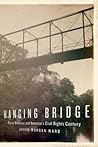
“The steel-framed span loomed thirty feet above the muddy water. At the far end of the hundred-foot deck, the forest swallowed up a dirt road that used to lead somewhere. Years of traffic rumbling across the bridge had worn parallel streaks into the deck, and heavy runner boards covered holes in rotted planks. Metal rails sagged in spots. Still, the reddish-brown truss beams on either side stood stiff and straight, and overhead braces cast shadows on the deck below. On that rusty frame, between lines of vertical rivets, someone had painted a skull and crossbones and scribbled: 'Danger, This Is You.”
― Hanging Bridge: Racial Violence and America's Civil Rights Century
― Hanging Bridge: Racial Violence and America's Civil Rights Century
“Across three generations, at three pivotal moments, a lonely river bridge became a symbol of a town's racial struggles and a nation's civil rights century.”
― Hanging Bridge: Racial Violence and America's Civil Rights Century
― Hanging Bridge: Racial Violence and America's Civil Rights Century
“My old Louise, I’d had her ten years, has stopped now because her son’s sending her money,” a white woman in southern Mississippi complained. “It’s just horrible now.” 9”
― Hanging Bridge: Racial Violence and America's Civil Rights Century
― Hanging Bridge: Racial Violence and America's Civil Rights Century
“The most durable memorial to Shubuta's lynching victims still hovers over the Chickasawhay, two miles upriver from their unmarked graves. The Hanging Bridge, like so many of Mississippi's more bloodstained historical sites, enjoys no official recognition. The best way to forget, many have concluded, is to have nothing to remember. Indeed, the urge to glorify the past and gloss over its 'ugly' moments has pervaded state politics and culture.”
― Hanging Bridge: Racial Violence and America's Civil Rights Century
― Hanging Bridge: Racial Violence and America's Civil Rights Century
“The generations that followed Mississippi's civil rights era inherited an incomplete revolution and echoes of a bloody past. Though abandoned and avoided, the Hanging Bridge still looms as a memorial to a story longer and more complex than many realize. The last lynchings there took place more than seventy years ago, and it is tempting to fill in the decades between then and now with an arc of inevitable progress. Yet the violence, in its various forms, did not end, whether we choose to remember it or not. When we put that forgotten violence at the heart of the story, we find a narrative more complicated than a steady march toward freedom. That story allows us to see more clearly black protect across generations, the connection between racial terrorism and subtler forms of repression, and a more truthful, if less triumphant, narrative.”
― Hanging Bridge: Racial Violence and America's Civil Rights Century
― Hanging Bridge: Racial Violence and America's Civil Rights Century
“Before the gate blocked access to the bridge, a more expensive proposition - demolition - went nowhere. For those who shared the sentiment of one local official, who argued that 'people don't need to see that,' a padlocked barrier seemed sufficient to keep the historically inclined at bay. Yet even if it eventually collapses into the river below, the rusty bridge - like the deteriorating downtown just two miles away - will not take its history with it when it goes. That story was made, and told, by people who passed down glimpses of a past that continues to echo in our remembering and our forgetting. That this story will not be buried is a testament to a freedom struggle that left its mark on the tiniest hamlets and farthest reaches of the rural South. If not for a gory landmark and the generations of violence that occurred in its shadow, Shubuta's racial history might simply fade into a nameless pile of past wrongs. 'Its only distinction' from other Mississippi towns, as a black journalist noted after a 1942 visit, was its 'impressive lynch record.' Yet to isolate this place is to miss a larger point - that the Hanging Bridge repeatedly fixed attention on Jim Crow's brutal excesses and unresolved legacies. That the landmark is largely forgotten, and intentionally obscured, reminds us that heritage is a poor substitute for history. And that retreat - from the past and its echoes in the present - does not bring redemption.”
―
―