Goodreads helps you follow your favorite authors. Be the first to learn about new releases!
Start by following Frank Ruda.

Showing 1-9 of 9
“I do not know that I am not willing freely (I do not know what I do), but I nonetheless do it.”
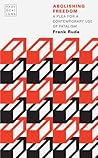
― Abolishing Freedom: A Plea for a Contemporary Use of Fatalism
― Abolishing Freedom: A Plea for a Contemporary Use of Fatalism
“The first imperative of true belief is thus the following: Love only someone who makes you anxious!”
― Abolishing Freedom: A Plea for a Contemporary Use of Fatalism
― Abolishing Freedom: A Plea for a Contemporary Use of Fatalism
“Through fatalism one affirms the impossible possibility that true freedom is possible, although
there is no objective guarantee (neither in me nor in the world) for it. Simply put, only a fatalist can be free. This is because there is nothing to hope for, there is nothing to rely on, and there
is nothing in our power. But this helps us avoid falling for the trap of acting as if we were free. What we can thus derive from Descartes is a second principle of a contemporary provisional morality: Act as if you were not free!”
― Abolishing Freedom: A Plea for a Contemporary Use of Fatalism
there is no objective guarantee (neither in me nor in the world) for it. Simply put, only a fatalist can be free. This is because there is nothing to hope for, there is nothing to rely on, and there
is nothing in our power. But this helps us avoid falling for the trap of acting as if we were free. What we can thus derive from Descartes is a second principle of a contemporary provisional morality: Act as if you were not free!”
― Abolishing Freedom: A Plea for a Contemporary Use of Fatalism
“If I accept that even if I do my best I might nonetheless suffer evil, I cannot blame either fortune or myself.”
― Abolishing Freedom: A Plea for a Contemporary Use of Fatalism
― Abolishing Freedom: A Plea for a Contemporary Use of Fatalism
“Not believing in fortune, abolishing the idea of hope and good luck, and believing in divine providence necessarily imply assuming the worst. Providence necessarily implies fatalism.”
― Abolishing Freedom: A Plea for a Contemporary Use of Fatalism
― Abolishing Freedom: A Plea for a Contemporary Use of Fatalism
“And it affirms that if freedom is not a capacity, it must be something else: a result. It results from something contingent happening to me, from something so contingent that it is conceptually unthinkable. There needs to be something that makes freedom possible. I am free only when I am contingently forced to be. This is what it means to be forced to move from thinking the cogito to thinking what I can think only as unthinkable, namely God. This in turn compels me to think of freedom as something beyond a simple thought that I have. Rather this very shift that makes me think freedom as that which I cannot think forces me to be free. It not only liberates me from Aristotelianism but also forces me to think what I cannot think. And this means that the very form of this thought is freedom. Freedom is thereby not the content of my thought but its form.”
― Abolishing Freedom: A Plea for a Contemporary Use of Fatalism
― Abolishing Freedom: A Plea for a Contemporary Use of Fatalism
“We thereby realize that the hidden part of God must even be in excess of this excess—a meta-excess without measure, hence Luther’s excessive rhetoric. We can only “fear and adore” his will since “who are we that we should inquire into the cause of the divine will?” In other, more profane words, the only thing to do with regard to the will of God is to not give a fuck about it. We can relate to his will only as it is revealed to us, which is, in short, “the will of Christ.” This is what it means to let God be God. The true believer thus acts with a proto-Kantian “will that is disinterested in seeking any reward . . . being ready to do good even if—an impossible supposition—there were neither kingdom nor hell.” True belief implies disinterest in one’s own salvation, which has to be considered impossible (to be attained by us) anyhow.”
― Abolishing Freedom: A Plea for a Contemporary Use of Fatalism
― Abolishing Freedom: A Plea for a Contemporary Use of Fatalism
“Through despair and anxiety we come close to know what we do not know that we know.”
― Abolishing Freedom: A Plea for a Contemporary Use of Fatalism
― Abolishing Freedom: A Plea for a Contemporary Use of Fatalism
“Without despair there will never be salvation.”
― Abolishing Freedom: A Plea for a Contemporary Use of Fatalism
― Abolishing Freedom: A Plea for a Contemporary Use of Fatalism