Goodreads helps you follow your favorite authors. Be the first to learn about new releases!
Start by following Martin J. Rees.

Showing 1-30 of 43
“I'd like to widen people's awareness of the tremendous timespan lying ahead--for our planet, and for life itself. Most educated people are aware that we're the outcome of nearly 4bn years of Darwinian selection, but many tend to think that humans are somehow the culmination. Our sun, however, is less than halfway through its lifespan. It will not be humans who watch the sun's demise, 6bn years from now. Any creatures that then exist will be as different from us as we are from bacteria or amoebae.”
―
―
“In the beginning there were only probabilities. The universe could only come into existence if someone observed it. It does not matter that the observers turned up several billion years later. The universe exists because we are aware of it.”
―
―
“I suspect there could be life and intelligence out there in forms that we can't conceive. And there could, of course, be forms of intelligence beyond human capacity – beyond as much as we are beyond a chimpanzee”
― Our Cosmic Habitat
― Our Cosmic Habitat
“God invented space so that not everything had to happen in Princeton.”
― Our Cosmic Habitat
― Our Cosmic Habitat
“We’re not aware of the “big picture,” any more than a plankton whose universe was a liter of water would be aware of the world’s topography and biosphere.”
―
―
“The science done by the young Einstein will continue as long as our civilization, but for civilization to survive, we'll need the wisdom of the old Einstein -- humane, global and farseeing. And whatever happens in this uniquely crucial century will resonate into the remote future and perhaps far beyond the Earth, far beyond the Earth”
―
―
“It's better to read first rate science fiction than second rate science -- it's a lot more fun, and no more likely to be wrong," joked Lord Rees, Astronomer Royal and the former president of the Royal Society, at Wired 2013.”
―
―
“The global village will have its village idiots and they’ll have global range.”
― On the Future: Prospects for Humanity
― On the Future: Prospects for Humanity
“Our universe, extending immensely far beyond our present horizon, may itself be just one member of a possibly infinite ensemble. This ‘multiverse’ concept, though speculative, is a natural extension of current cosmological theories, which gain credence because they account for things that we do observe. The physical laws and geometry could be different in other universes, and this offers a new perspective on the seemingly special values that the six numbers take in ours.”
― Just Six Numbers: The Deep Forces That Shape The Universe
― Just Six Numbers: The Deep Forces That Shape The Universe
“More energy is needed to rise a millimetre above a neutron star's surface than to break completely free of Earth's gravity. A pen dropped from a height of one metre would impact with the energy of a ton of TNT (although the intense gravity on a neutron star's surface would actually, of course, squash any such objects instantly). A projectile would need to attain half the speed of light to escape its gravity; conversely, anything that fell freely onto a neutron star from a great height would impact at more than half the speed of light.”
― Just Six Numbers: The Deep Forces That Shape The Universe
― Just Six Numbers: The Deep Forces That Shape The Universe
“The Sun contains about a thousand times more mass than Jupiter. If it were cold, gravity would squeeze it a million times denser than an ordinary solid: it would be a 'white dwarf' about the size of the Earth but 330,000 times more massive. But the Sun's core actually has a temperature of fifteen million degrees-thousands of time hotter than its glowing surface, and the pressure of this immensely hot gas 'puffs up' the Sun and holds it in equilibrium.”
― Just Six Numbers: The Deep Forces That Shape The Universe
― Just Six Numbers: The Deep Forces That Shape The Universe
“[The fine structure constant] ... defines how firmly atomic nuclei bind together and how all the atoms on Earth were made. Its value controls the power from the Sun and, more sensitively, how stars transmute hydrogen into all the atoms of the periodic table.”
― Just Six Numbers
― Just Six Numbers
“In this perspective, it looks surprising that our universe was initiated with a very finely tuned impetus, almost exactly enough to balance the decelerating tendency of gravity. It's like sitting at the bottom of a well and throwing a stone up so that it just comes to a halt exactly at the top-the required precision is astonishing: at one second after the Big Bang, Omega cannot have differed from unity by more than one part in a million billion (one in 10^15) in order that the universe should now, after ten billion years, be still expanding and with a value of Omega that has certainly not departed wildly from unity.”
―
―
“We, and the visible universe around us, may exist only because of a difference in the ninth decimal place between the numbers of quarks and of antiquarks.”
―
―
“Inside every black hole that collapses may lie the seeds of a new expanding universe.”
―
―
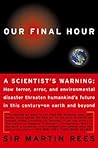
“It may not be absurd hyperbole—indeed, it may not even be an overstatement—to assert that the most crucial location in space and time (apart from the big bang itself) could be here and now. I think the odds are no better than fifty–fifty that our present civilisation on Earth will survive to the end of the present century. Our choices and actions could ensure the perpetual future of life (not just on Earth, but perhaps far beyond it, too). Or in contrast, through malign intent, or through misadventure, twenty-first century technology could jeopardise life’s potential, foreclosing its human and posthuman future. What happens here on Earth, in this century, could conceivably make the difference between a near eternity filled with ever more complex and subtle forms of life and one filled with nothing but base matter. 2”
― Our Final Hour: A Scientist's Warning
― Our Final Hour: A Scientist's Warning
“Some innovations just don’t attract enough economic or social demand: just as supersonic flight and manned space flight stagnated after the 1970s, today (in 2002) the potentialities of broadband (G3) technology are being taken up rather slowly because few people want to surf the Internet or watch movies from their mobile phones.”
― Our Final Hour: A Scientist's Warning
― Our Final Hour: A Scientist's Warning
“The atoms that comprise our bodies and that make all visible stars and galaxies, are mere trace-constituents of a universe whose large-scale structure is controlled by some quite different (and invisible) substance. We see, as it were, just the white foam on the wave-crests, not the massive waves themselves. We must envisage our cosmic habitat as a dark place, made mainly of quite unknown material.”
―
―
“A measure of the strength of a body's gravity is the speed with which a projectile must be fired to escape its grasp. It takes 11.2 kilometers per second to escape from the Earth. This speed is tiny compared with that of light, 300,000 kilometers per second, but it challenges rocket engineers constrained to use chemical fuel, which converts only a billionth of its so-called mass 'rest-mass energy' (Einstein's mc^2) into effective power. The escape velocity from the sun's surface is 600 kilometers per second-still only one fifth of one percent of the speed of light.”
― Just Six Numbers: The Deep Forces That Shape The Universe
― Just Six Numbers: The Deep Forces That Shape The Universe
“The other naturally occurring viruses, like ebola, are not durable enough to generate a runaway epidemic.”
― Our Final Hour: A Scientist's Warning
― Our Final Hour: A Scientist's Warning
“The Internet offers access, in principle, to an unprecedented variety of opinions and information. Nonetheless, it could narrow understanding and sympathies rather than broaden them: some people may choose to stay closeted within a cybercommunity of the likeminded.”
― Our Final Hour: A Scientist's Warning
― Our Final Hour: A Scientist's Warning
“The sun has adjusted its structure so that nuclear power is generated in the core, and diffuses outward, at just the rate needed to balance the heat lost from the surface-heat that is the basis for life on Earth.”
― Just Six Numbers: The Deep Forces That Shape The Universe
― Just Six Numbers: The Deep Forces That Shape The Universe
“But it remains a fundamental challenge to understand the very beginning-this must await a 'final' theory, perhaps some variant of superstrings. Such a theory would signal the end of an intellectual quest that started with Newton, and continued through Maxwell, Einstein, and their successors. It would deepen our understanding of space, time, and the basic forces, as well as elucidating the ultra-early universe and the centres of black holes.”
―
―
“A feature of science is that as the frontiers of our knowledge are extended, new mysteries, just beyond the frontiers, come into sharper focus”
― On the Future: Prospects for Humanity
― On the Future: Prospects for Humanity
“Incidentally, if any signs of life were found elsewhere in our solar system – and (an important proviso) if we could be sure that it was based on a different kind of DNA, implying that it had a separate origin from terrestrial life – then we could immediately conclude that life was widespread in the universe. Something that had happened twice around a single star must have happened on millions of planets elsewhere in the Galaxy.”
― From Here to Infinity: Scientific Horizons
― From Here to Infinity: Scientific Horizons
“Over the last decade, we’ve experienced astonishing advances in communication and in access to information. Our lives have been hugely enriched by consumer electronics and web-based services that we would willingly pay far more for, and which surpass any expectations we had a decade ago. And the impact on the developing world has been dramatic: there are more mobile phones than toilets in India. Mobile”
― From Here to Infinity: Scientific Horizons
― From Here to Infinity: Scientific Horizons
“Humanity’s long-term impact on Earth depends both on population and on lifestyle. WWF, a conservation group, has published estimates of the land area, or “footprint,” needed to support each person: it concludes that an area equivalent to “almost three planets” would be required to support the world population with the lifestyle and consumption pattern that it predicts for 2050. This particular calculation is controversial and perhaps somewhat tendentious: for instance, the “footprint” includes the area of forest needed to soak up the carbon dioxide arising from each person’s energy use, making no allowance for a shift to renewable energy sources, nor for the tenable viewpoint that modest rises in carbon dioxide levels are tolerable. Nonetheless, the world plainly could not perpetually support its entire population in the present style of middle-class Europeans and North Americans.”
― Our Final Hour: A Scientist's Warning
― Our Final Hour: A Scientist's Warning
“A cosmic perspective actually strengthens our concerns about what happens here and now, because it offers a vision of just how prodigious life’s future potential could be. Earth’s biosphere is the outcome of more than four billion years of Darwinian selection: the stupendous time spans of the evolutionary past are now part of common culture. But life’s future could be more prolonged than its past. In the aeons that lie ahead, even more marvellous diversity could emerge, on and beyond Earth. The unfolding of intelligence and complexity could still be near its cosmic beginnings.”
― Our Final Hour: A Scientist's Warning
― Our Final Hour: A Scientist's Warning
“To confront the overwhelming mystery of what banged and why it banged, Einstein’s theory isn’t enough because it treats space and time as smooth and continuous. Success will require new insights into what might seem the simplest entity of all: ‘mere’ empty space. We know that no material can be chopped into arbitrarily small pieces: eventually you get down to discrete atoms. Likewise, even space and time can’t be divided up indefinitely. There are powerful reasons to suspect that space has a grainy and ‘atomic’ structure – but on a scale a trillion trillion times smaller than atoms. This is key ‘unfinished business’ for twenty-first-century science. According to the most”
― From Here to Infinity: Scientific Horizons
― From Here to Infinity: Scientific Horizons
“(And it’s often better to read first-rate science fiction than second-rate science – it’s far more stimulating, and perhaps no more likely to be wrong.) Indeed”
― From Here to Infinity: Scientific Horizons
― From Here to Infinity: Scientific Horizons