Goodreads helps you follow your favorite authors. Be the first to learn about new releases!
Start by following Steven H. Strogatz.

Showing 1-30 of 210
“Looking at numbers as groups of rocks may seem unusual, but actually it's as old as math itself. The word "calculate" reflects that legacy -- it comes from the Latin word calculus, meaning a pebble used for counting. To enjoy working with numbers you don't have to be Einstein (German for "one stone"), but it might help to have rocks in your head.”
― The Joy of X: A Guided Tour of Math, from One to Infinity
― The Joy of X: A Guided Tour of Math, from One to Infinity
“Yet in another way, calculus is fundamentally naive, almost childish in its optimism. Experience teaches us that change can be sudden, discontinuous, and wrenching. Calculus draws its power by refusing to see that. It insists on a world without accidents, where one thing leads logically to another. Give me the initial conditions and the law of motion, and with calculus I can predict the future -- or better yet, reconstruct the past. I wish I could do that now.
”
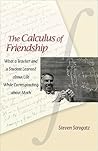
― The Calculus of Friendship: What a Teacher and a Student Learned about Life while Corresponding about Math
”
― The Calculus of Friendship: What a Teacher and a Student Learned about Life while Corresponding about Math
“To grasp how different a million is from a billion, think about it like this: A million seconds is a little under two weeks; a billion seconds is about thirty-two years.”
― Infinite Powers: How Calculus Reveals the Secrets of the Universe – A Revolutionary History from Ancient Greece to Modern Technology
― Infinite Powers: How Calculus Reveals the Secrets of the Universe – A Revolutionary History from Ancient Greece to Modern Technology
“(Actually, languages can be very tricky in this respect. The eminent linguistic philosopher J. L. Austin of Oxford once gave a lecture in which he asserted that there are many languages in which a double negative makes a positive but none in which a double positive makes a negative—to which the Columbia philosopher Sidney Morgenbesser, sitting in the audience, sarcastically replied, “Yeah, yeah.”
― The Joy Of X: A Guided Tour of Math, from One to Infinity
― The Joy Of X: A Guided Tour of Math, from One to Infinity
“In mathematical modeling, as in all of science, we always have to make choices about what to stress and what to ignore. The art of abstraction lies in knowing what is essential and what is minutia, what is signal and what is noise, what is trend and what is wiggle. It's an art because such choices always involve an element of danger; they come close to wishful thinking and intellectual dishonesty.”
― Infinite Powers: How Calculus Reveals the Secrets of the Universe
― Infinite Powers: How Calculus Reveals the Secrets of the Universe
“let’s begin with the word “vector.” It comes from the Latin root vehere, “to carry,” which also gives us words like “vehicle” and “conveyor belt.” To an epidemiologist, a vector is the carrier of a pathogen, like the mosquito that conveys malaria to your bloodstream. To a mathematician, a vector (at least in its simplest form) is a step that carries you from one place to another.”
― The Joy Of X: A Guided Tour of Math, from One to Infinity
― The Joy Of X: A Guided Tour of Math, from One to Infinity
“In the early part of the ninth century, Muhammad ibn Musa al-Khwarizmi, a mathematician working in Baghdad, wrote a seminal textbook in which he highlighted the usefulness of restoring a quantity being subtracted (like 2, above) by adding it to the other side of an equation. He called this process al-jabr (Arabic for “restoring”), which later morphed into “algebra.” Then, long after his death, he hit the etymological jackpot again. His own name, al-Khwarizmi, lives on today in the word “algorithm.”
― The Joy Of X: A Guided Tour of Math, from One to Infinity
― The Joy Of X: A Guided Tour of Math, from One to Infinity
“Calculus succeeds by breaking complicated problems down into simpler parts. That strategy, of course, is not unique to calculus. All good problem-solvers know that hard problems become easier when they’re split into chunks. The truly radical and distinctive move of calculus is that it takes this divide-and-conquer strategy to its utmost extreme — all the way out to infinity.”
― Infinite Powers: The Story of Calculus - The Most Important Discovery in Mathematics
― Infinite Powers: The Story of Calculus - The Most Important Discovery in Mathematics
“Those of us who teach math should try to turn this bug into a feature. We should be up front about the fact that word problems force us to make simplifying assumptions. That’s a valuable skill—it’s called mathematical modeling.”
― The Joy Of X: A Guided Tour of Math, from One to Infinity
― The Joy Of X: A Guided Tour of Math, from One to Infinity
“Infinity lies at the heart of so many of our dreams and fears and unanswerable questions: How big is the universe? How long is forever? How powerful is God? In every branch of human thought, from religion and philosophy to science and mathematics, infinity has befuddled the world’s finest minds for thousands of years. It has been banished, outlawed, and shunned. It’s always been a dangerous idea.”
― Infinite Powers: The Story of Calculus - The Language of the Universe
― Infinite Powers: The Story of Calculus - The Language of the Universe
“—things that seem hopelessly random and unpredictable when viewed in isolation often turn out to be lawful and predictable when viewed in aggregate.”
― The Joy Of X: A Guided Tour of Math, from One to Infinity
― The Joy Of X: A Guided Tour of Math, from One to Infinity
“For reasons we don't yet understand, the tendency to synchronize is one of the most pervasive drives in the universe, extending from atoms to animals, from people to planets. Female friends or coworkers who spend a great deal of time together often find that their menstrual periods tend to start around the same day. Sperm swimming side by side en route to the egg beat their tails in unison, in a primordial display of synchronized swimming. Sometimes sync can be pernicious: Epilepsy is caused by millions of brain cells discharging in pathological lockstep, causing the rhythmic convulsions associated with seizures. Even lifeless things can synchronize. The astounding coherence of a laser beam comes from trillions of atoms pulsing in concert, all emitting photons of the same phase and frequency. Over the course of millennia, the incessant effects of the tides have locked the moon's spin to its orbit. It now turns on its axis at precisely the same rate as it circles the earth, which is why we always see the man in the moon and never its dark side.”
― Sync: The Emerging Science of Spontaneous Order
― Sync: The Emerging Science of Spontaneous Order
“Whenever the whole is different from the sum of the parts—whenever there’s cooperation or competition going on—the governing equations must be nonlinear.”
― Sync: How Order Emerges From Chaos In the Universe, Nature, and Daily Life
― Sync: How Order Emerges From Chaos In the Universe, Nature, and Daily Life
“For reasons nobody understands, the universe is deeply mathematical. Maybe God made it that way. Or maybe it’s the only way a universe with us in it could be, because nonmathematical universes can’t harbor life intelligent enough to ask the question. In any case, it’s a mysterious and marvelous fact that our universe obeys laws of nature that always turn out to be expressible in the language of calculus as sentences called differential equations.”
― Infinite Powers: How Calculus Reveals the Secrets of the Universe
― Infinite Powers: How Calculus Reveals the Secrets of the Universe
“When a guitar string is plucked or when children jiggle a jump rope, the shape that appears is a sine wave. The ripples on a pond, the ridges of sand dunes, the stripes of a zebra—all are manifestations of nature’s most basic mechanism of pattern formation: the emergence of sinusoidal structure from a background of bland uniformity.”
― The Joy Of X: A Guided Tour of Math, from One to Infinity
― The Joy Of X: A Guided Tour of Math, from One to Infinity
“a big, messy linear problem can always be broken into smaller, more manageable parts. Then each part can be solved separately, and all the little answers can be recombined to solve the bigger problem. So it’s literally true that in a linear problem, the whole is exactly equal to the sum of the parts.”
― Sync: How Order Emerges From Chaos In the Universe, Nature, and Daily Life
― Sync: How Order Emerges From Chaos In the Universe, Nature, and Daily Life
“Simulation is no substitute for math—it could never provide a proof—but if Peskin’s conjecture was false, this approach would save me a lot of time by revealing a counterexample. This sort of evidence is extremely valuable in math. When you’re trying to prove something, it helps to know it’s true. That gives you the confidence you need to keep searching for a rigorous”
― Sync: How Order Emerges from Chaos In the Universe, Nature, and Daily Life
― Sync: How Order Emerges from Chaos In the Universe, Nature, and Daily Life
“...nothing cements a friendship like hating the same person.”
―
―
“Nature—cue the theme from The Twilight Zone—somehow knows calculus.”
― The Joy Of X: A Guided Tour of Math, from One to Infinity
― The Joy Of X: A Guided Tour of Math, from One to Infinity
“The study of algebra in its own right, as a symbolic system apart from its applications, began to flourish in Renaissance Europe. It reached its pinnacle in the 1500s, when it started to look like what we know today, with letters used to represent numbers. In France in 1591, François Viète designated unknown quantities with vowels, like A and E, and used consonants, like B and G, for constants. (Today’s use of x, y, z for unknowns and a, b, c for constants came from the work of René Descartes about fifty years later.) Replacing words with letters and symbols made it much easier to manipulate equations and find solutions.”
― Infinite Powers: How Calculus Reveals the Secrets of the Universe – A Revolutionary History from Ancient Greece to Modern Technology
― Infinite Powers: How Calculus Reveals the Secrets of the Universe – A Revolutionary History from Ancient Greece to Modern Technology
“We're accustomed to thinking in terms of centralized control, clear chains of command, the straightforward logic of cause and effect. But in huge, interconnected systems, where every player ultimately affects every other, our standard ways of thinking fall apart. Simple pictures and verbal arguments are too feeble, too myopic. That's what plagues us in economics when we try to anticipate the effect of a tax cut or a change in interest rates, or in ecology, when a new pesticide backfires and produces dire, unintended consequences that propagate through the food chain.”
― Sync: The Emerging Science of Spontaneous Order
― Sync: The Emerging Science of Spontaneous Order
“And because the PageRanks are defined as proportions, they have to add up to 1 when summed over the whole network. This conservation law suggests another, perhaps more palpable, way to visualize PageRank. Picture it as a fluid, a watery substance that flows through the network, draining away from bad pages and pooling at good ones. The algorithm seeks to determine how this fluid distributes itself across the network in the long run.”
― The Joy Of X: A Guided Tour of Math, from One to Infinity
― The Joy Of X: A Guided Tour of Math, from One to Infinity
“Beyond serving as an inspiration to engineers, the group behavior of fireflies has broader significance for science as a whole. It represents one of the few tractable instances of a complex, self-organizing system, where millions of interactions occur simultaneously—when everyone changes the state of everyone else. Virtually all the major unsolved problems in science today have this intricate character. Consider the cascade of biochemical reactions in a single cell and their disruption when the cell turns cancerous; the booms and crashes of the stock market; the emergence of consciousness from the interplay of trillions of neurons in the brain; the origin of life from a meshwork of chemical reactions in the primordial soup. All these involve enormous numbers of players linked in complex webs. In every case, astonishing patterns emerge spontaneously. The richness of the world around us is due, in large part, to the miracle of self-organization.”
― Sync: How Order Emerges From Chaos In the Universe, Nature, and Daily Life
― Sync: How Order Emerges From Chaos In the Universe, Nature, and Daily Life
“First comes intuition. Rigor comes later.”
― Infinite Powers: The Story of Calculus - The Most Important Discovery in Mathematics
― Infinite Powers: The Story of Calculus - The Most Important Discovery in Mathematics
“Simulation is no substitute for math—it could never provide a proof—but if Peskin’s conjecture was false, this approach would save me a lot of time by revealing a counterexample. This sort of evidence is extremely valuable in math. When you’re trying to prove something, it helps to know it’s true. That gives you the confidence you need to keep searching for a rigorous proof. Programming”
― Sync: How Order Emerges from Chaos In the Universe, Nature, and Daily Life
― Sync: How Order Emerges from Chaos In the Universe, Nature, and Daily Life
“Naturally, the place to start is at infinity.”
― Infinite Powers: How Calculus Reveals the Secrets of the Universe – A Revolutionary History from Ancient Greece to Modern Technology
― Infinite Powers: How Calculus Reveals the Secrets of the Universe – A Revolutionary History from Ancient Greece to Modern Technology
“we’ve come to realize that most systems of differential equations are unsolvable, in that same sense; it’s impossible to find a formula for the answer. There is, however, one spectacular exception. Linear differential equations are solvable.”
― Sync: How Order Emerges From Chaos In the Universe, Nature, and Daily Life
― Sync: How Order Emerges From Chaos In the Universe, Nature, and Daily Life
“It’s hard to blame Representative Petri for missing the point. The value of studying fireflies is endlessly surprising. For example, before 1994, Internet engineers were vexed by spontaneous pulsations in the traffic between computers called routers, until they realized that the machines were behaving like fireflies, exchanging periodic messages that were inadvertently synchronizing them. Once the cause was identified, it became clear how to relieve the congestion. Electrical engineers devised a decentralized architecture for clocking computer circuits more efficiently, by mimicking the fireflies’ strategy for achieving synchrony at low cost and high reliability.”
― Sync: How Order Emerges From Chaos In the Universe, Nature, and Daily Life
― Sync: How Order Emerges From Chaos In the Universe, Nature, and Daily Life
“This synergistic character of nonlinear systems is precisely what makes them so difficult to analyze. They can’t be taken apart. The whole system has to be examined all at once, as a coherent entity. As we’ve seen earlier, this necessity for global thinking is the greatest challenge in understanding how large systems of oscillators can spontaneously synchronize themselves. More generally, all problems about self-organization are fundamentally nonlinear. So the study of sync has always been entwined with the study of nonlinearity.”
― Sync: How Order Emerges From Chaos In the Universe, Nature, and Daily Life
― Sync: How Order Emerges From Chaos In the Universe, Nature, and Daily Life
“When you’re trying to prove something, it helps to know it’s true.”
― Sync: How Order Emerges From Chaos In the Universe, Nature, and Daily Life
― Sync: How Order Emerges From Chaos In the Universe, Nature, and Daily Life