Goodreads helps you follow your favorite authors. Be the first to learn about new releases!
Start by following Arend Heyting.

Showing 1-9 of 9
“[Brouwer’s] construction of intuitionist mathematics is nothing more nor less than an investigation of the utmost limits which the intellect can attain in its self-unfolding.”
―
―
“A mathematical proposition expresses a certain expectation. For example, the proposition, “Euler constant C is rational” expresses the expectation that we could find two integers a and b such that C = a/b. Perhaps, the word “intention”, coined by the phenomenologists, expresses even better what is meant here.”
―
―
“[T]he only admissible notion of truth is one directly connected with our capacity for recognising a statement as true: the supposition that a statement is true is the supposition that there is a mathematical construction constituting a proof of that statement.”
―
―
“Intuitionistic mathematics consists in mental constructions; a mathematical theorem expresses a purely empirical fact, namely the success of a certain construction.”
―
―
“The process by which [a logical theorem] is deduced shows us that it does not differ essentially from mathematical theorems; it is only more general, e.g. in the same sense that “addition of integers is commutative” is a more general statement than “2 + 3 = 3 + 2”. This is the case for every logical theorem: it is but a mathematical theorem of extreme generality; that is to say, logic is a part of mathematics, and can by no means serve as a foundation for it.”
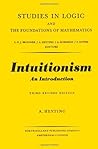
― Intuitionism: An introduction
― Intuitionism: An introduction
“The only philosophical thesis of mathematical intuitionism is that no philosophy is needed to understand mathematics.”
―
―
“Intuitionist mathematics is nothing more nor less than an investigation of the utmost limits which the intellect can attain in its self-unfolding.”
―
―
“The intuitionist mathematician proposes to do mathematics as a natural function of his intellect, as a free, vital activity of thought. For him, mathematics is a production of the human mind. He uses language, both natural and formalized, only for communicating thoughts, i.e., to get others or himself to follow his own mathematical ideas. Such a linguistic accompaniment is not a representation of mathematics; still less is it mathematics itself.”
―
―
“If really the formalization of language is the trend of science, then intuitionistic mathematics does not belong to science in this sense of the word. It is rather a phenomenon of life, a natural activity of man, which itself is open to study by scientific methods; it has actually been studied by such methods, namely that of formalizing intuitionistic reasoning and the signific method, but it is obvious that this study does not belong to intuitionistic mathematics, nor do its results. That such a scientific examination of intuitionistic mathematics will never produce a complete and definite description of it, no more than a complete theory of other phenomena is attainable, is clearly to be seen.”
― Intuitionism: An introduction
― Intuitionism: An introduction