Goodreads helps you follow your favorite authors. Be the first to learn about new releases!
Start by following George Packer.

Showing 1-30 of 68
“At the heart of the matter is a battle between wish and fear. Fear generally proves stronger than a wish, but it leaves a taste of disappointment on the tongue.”
―
―
“Ideology knows the answer before the question has been asked.
Principles are something different: a set of values that have to be adapted to circumstances but not compromised away.”
―
Principles are something different: a set of values that have to be adapted to circumstances but not compromised away.”
―
“[T]he enduring problem for liberals, as for everyone else, is not whether history will judge them wise or foolish regarding the war on terrorism; it is, rather, the way that the past decade has splintered them away from other Americans. This fracture comes with a steep price: in today's toxic atmosphere, liberals are no less cynical, shortsighted, and parochial than anyone else, and they understand their fellow-Americans just as badly as they themselves are understood. When liberals look at red-state voters, they see either a mob of pious know-nothings or the insensible victims of militarism and class warfare. Yet.... [such people] defy fixed categories, which means that they have to be figured out the hard way--on their own terms.”
―
―
“Before the nineteen-seventies, most Republicans in Washington accepted the institutions of the welfare state, and most Democrats agreed with the logic of the Cold War. Despite the passions over various issues, government functioned pretty well. Legislators routinely crossed party lines when they voted, and when they drank; filibusters in the Senate were reserved for the biggest bills; think tanks produced independent research, not partisan talking points. The "D." or "R." after a politician's name did not tell you what he thought about everything, or everything you thought about him.”
―
―
“Nowhere was the complacency of the establishment, with its blind faith in progress, more evident than in its attitude toward an elite degree: as long as my child goes to the right schools, upward mobility will continue. A university education had become the equivalent of a very expensive insurance policy, like owning a gun.”
― The Unwinding: An Inner History of the New America
― The Unwinding: An Inner History of the New America
“This isn't to deny that there were fierce arguments, at the time and ever since, about the causes and goals of both the Civil War and the Second World War. But 1861 and 1941 each created a common national narrative (which happened to be the victors' narrative): both wars were about the country's survival and the expansion of the freedoms on which it was founded. Nothing like this consensus has formed around September 11th.... Indeed, the decade since the attacks has destroyed the very possibility of a common national narrative in this country.”
―
―
“Some nights he sat up late on his front porch with a glass of Jack and listened to the trucks heading south on 220, carrying crates of live chickens to the slaughterhouses—always under cover of darkness, like a vast and shameful trafficking—chickens pumped full of hormones that left them too big to walk—and he thought how these same chickens might return from their destination as pieces of meat to the floodlit Bojangles’ up the hill from his house, and that meat would be drowned in the bubbling fryers by employees whose hatred of the job would leak into the cooked food, and that food would be served up and eaten by customers who would grow obese and end up in the hospital in Greensboro with diabetes or heart failure, a burden to the public, and later Dean would see them riding around the Mayodan Wal-Mart in electric carts because they were too heavy to walk the aisles of a Supercenter, just like hormone-fed chickens.”
― The Unwinding: An Inner History of the New America
― The Unwinding: An Inner History of the New America
“This malignant persistence since September 11th is the biggest surprise of all. In previous decades, sneak attacks, stock-market crashes, and other great crises became hinges on which American history swung in dramatically new directions. But events on the same scale, or nearly so, no longer seem to have that power; moneyed interests may have become too entrenched, elites too self-seeking, institutions too feeble, and the public too polarized and passive for the country to be shocked into fundamental change.”
―
―
“The attacks of 9/11 were the biggest surprise in American history, and for the past ten years we haven't stopped being surprised. The war on terror has had no discernible trajectory, and, unlike other military conflicts, it's almost impossible to define victory. You can't document the war's progress on a world map or chart it on a historical timetable in a way that makes any sense. A country used to a feeling of being in command and control has been whipsawed into a state of perpetual reaction, swinging wildly between passive fear and fevered, often thoughtless, activity, at a high cost to its self-confidence.”
―
―
“His mind filled with visions of a decadent kleptocracy in rapid decline, abetted by both political parties. America's masses, fed on processed poison bought with a food stamp swipe card. Low-skill workers, structurally unable to ever contribute again and too dumb to know their old jobs weren't coming back. The banks in Gotham leaching the last drops of wealth out of the country. Corporations unrestrained by any notion of national interest. The system of property law in shambles. The world drowning in debt.”
― The Unwinding: An Inner History of the New America
― The Unwinding: An Inner History of the New America
“The problem came down to this: Americans, who had invented the modern assembly line, the skyscraper, the airplane, and the integrated circuit, no longer believed in the future.”
― The Unwinding: An Inner History of the New America
― The Unwinding: An Inner History of the New America
“The creation of virtual worlds had taken the place of advances in the physical world. “You can say the whole Internet has something very escapist to it,”
― The Unwinding: An Inner History of the New America
― The Unwinding: An Inner History of the New America
“[O]nce demagogy and falsehoods become routine, there isn’t much for the political journalist to do except handicap the race and report on the candidate’s mood.”
―
―
“If you look close enough and are in a bad mood, public service seems to be composed of paperwork and personal feuds.”
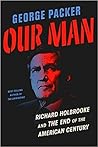
― Our Man: Richard Holbrooke and the End of the American Century
― Our Man: Richard Holbrooke and the End of the American Century
“The first big step is to repair the safety net so that workers and families are no longer at perpetual risk of falling through and drowning, as millions have in the pandemic. This means essentially extending the New Deal to more Americans in more areas of their lives: universal health care, child care, paid family and sick leave, stronger workplace safety protections, unemployment insurance that doesn’t fail in a crisis, a living minimum wage. These are the basis for any decent life, for any American to do more than survive just below the misery line.”
― Last Best Hope: America in Crisis and Renewal
― Last Best Hope: America in Crisis and Renewal
“If you were born in 1950 and were in the top ten percent, everything got better for twenty years automatically. Then, after the late sixties, you went to a good grad school, and you got a good job on Wall Street in the late seventies, and then you hit the boom. Your story has been one of incredible, unrelenting progress for sixty years. Most people who are sixty years old in the U.S.—not their story at all.” The establishment had been coasting for a long time and was out of answers. Its failure pointed to new directions, maybe Marxist, maybe libertarian, along a volatile trajectory that it could no longer control.”
― The Unwinding: An Inner History of the New America
― The Unwinding: An Inner History of the New America
“This much freedom leaves you on your own. More Americans than ever before live alone, but even a family can exist in isolation, just managing to survive in the shadow of a huge military base without a soul to lend a hand. A shiny new community can spring up overnight miles from anywhere, then fade away just as fast. An old city can lose its industrial foundation and two-thirds of its people, while all its mainstays—churches, government, businesses, charities, unions—fall like building flats in a strong wind, hardly making a sound.”
― The Unwinding: An Inner History of the New America
― The Unwinding: An Inner History of the New America
“By the end he was living in each chapter of his life simultaneously—Kennedy and Obama, Vietnam and Bosnia and Afghanistan—as if he were floating in a single body of water whose temperature varied from place to place and depth to depth. All that accumulated experience—we Americans don’t want it. We’re almost embarrassed by it, except when we’re burying it.”
― Our Man: Richard Holbrooke and the End of the American Century
― Our Man: Richard Holbrooke and the End of the American Century
“Anybody who thinks factory jobs were good jobs needs to go visit somebody on a line,” she said. “Most people wouldn’t survive in a factory. Mitt Romney would die in a week.”
― The Unwinding: An Inner History of the New America
― The Unwinding: An Inner History of the New America
“The companies that hauled the oil away were called renderers. Besides restaurant oil, renderers also collected animal carcasses—pigs and sheep and cows from slaughterhouses, offal thrown out by butcher shops and restaurants, euthanized cats and dogs from the pound, dead pets from veterinary clinics, deceased zoo animals, roadkill. Mounds of animals were trucked to the rendering plant and bulldozed into large pots for grinding and shredding; then the raw meat product was dumped into pressure cookers, where fat separated from meat and bones at high heat. The meat and bones were pulverized into protein meal for canned pet food. The animal fat became yellow grease, which was recycled for lipstick, soap, chemicals, and livestock feed. So cows ate cow, pigs ate pig, dogs ate dog, cats ate cat, and human beings ate the meat fed on dead meat, or smeared it over their faces and hands. Rendering was one of the oldest industries in the country, going back to the age of tallow, lard, and candlelight, and one of the most secretive.”
― The Unwinding: An Inner History of the New America
― The Unwinding: An Inner History of the New America
“Both Obama and Romney ended up in the wrong place: the former thought American exceptionalism was no longer true and should be given up while the latter thought it was still true. Neither was willing to tell Americans that they were no longer exceptional but should try to be again.”
― The Unwinding: An Inner History of the New America
― The Unwinding: An Inner History of the New America
“The unwinding brings freedom, more than the world has ever granted, and to more kinds of people than ever before—freedom to go away, freedom to return, freedom to change your story, get your facts, get hired, get fired, get high, marry, divorce, go broke, begin again, start a business, have it both ways, take it to the limit, walk away from the ruins, succeed beyond your dreams and boast about it, fail abjectly and try again.”
― The Unwinding: An Inner History of the New America
― The Unwinding: An Inner History of the New America
“When the norms that made the old institutions useful began to unwind, and the leaders abandoned their posts, the Roosevelt Republic that had reigned for almost half a century came undone. The void was filled by the default force in American life, organized money.”
― The Unwinding: An Inner History of the New America
― The Unwinding: An Inner History of the New America
“In other words, Foxx represented what Sarah Palin (speaking at a campaign fundraiser in Greensboro three weeks before the election) called “the real America,” by which she did not mean fallow farms and disability checks and crack.”
― The Unwinding: An Inner History of the New America
― The Unwinding: An Inner History of the New America
“Between my generation and that of my students is an entire cohort of writers in their 30s and 40s. I think they’ve suffered most from the climate I’m describing. They prepared for their trade in the traditional way, by reading literature, learning something about history or foreign countries, training as reporters, and developing the habit of thinking in complexity. And now that they’ve reached their prime, these writers must wonder: Who’s the audience for all this? Where did the broad and persuadable public that I always had in mind go? What’s the point of preparation and knowledge and painstaking craft, when what the internet wants is volume and speed and the loudest voices? Who still reads books?
Some give in to the prevailing current, and they might enjoy their reward. Those who don’t are likely to withdraw. The greatest enemy of writing today might be despair.
From a speech made in January 2020 on receipt of the 2019 Hitchens Prize, also printed as an essay in The Atlantic.”
―
Some give in to the prevailing current, and they might enjoy their reward. Those who don’t are likely to withdraw. The greatest enemy of writing today might be despair.
From a speech made in January 2020 on receipt of the 2019 Hitchens Prize, also printed as an essay in The Atlantic.”
―
“To believe that Trump showed us who we really are is no different from believing that Obama showed us who we really are. Narcissism is expressed in extremes of self-contempt as well as self-adoration. Both are paralyzing.”
― Last Best Hope: America in Crisis and Renewal
― Last Best Hope: America in Crisis and Renewal
“There are times in everyone’s life when something constructive is born out of adversity. There are times when things seem so bad that you’ve got to grab your fate by the shoulders and shake it.”
― The Unwinding: An Inner History of the New America
― The Unwinding: An Inner History of the New America
“So these two classes, rising professionals and sinking workers, which a couple of generations ago were close in income and not so far apart in mores, no longer believe they belong to the same country. But they can’t escape each other, and their coexistence breeds condescension, resentment, and shame.”
―
―
“And he began to understand how power worked in the White House. People didn’t have it—they made it. If you wanted to be included in a meeting, you didn’t wait for an invitation; you just showed up. He told Mikva, “If you don’t use your power, you won’t have any power.”
― The Unwinding: An Inner History of the New America
― The Unwinding: An Inner History of the New America
“All that accumulated experience—we Americans don’t want it. We’re almost embarrassed by it, except when we’re burying it. So we forget our mistakes or recoil from them, we swing wildly between superhuman exertion and sullen withdrawal, always looking for the answers in our own goodness and wisdom instead of where they lie, out in the world, and in history. I’m amazed we came through our half century on top as well as we did. Now it’s over.”
― Our Man: Richard Holbrooke and the End of the American Century
― Our Man: Richard Holbrooke and the End of the American Century