Goodreads helps you follow your favorite authors. Be the first to learn about new releases!
Start by following Roberta M. Gilbert.

Showing 1-27 of 27
“It takes two to have a fight.”
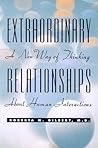
― Extraordinary Relationships: A New Way of Thinking About Human Interactions
― Extraordinary Relationships: A New Way of Thinking About Human Interactions
“People frequently point to communication as a problem, because its easy to notice, but usually it is a symptom of an underlying problem with a relationship posture.”
― Extraordinary Relationships: A New Way of Thinking About Human Interactions
― Extraordinary Relationships: A New Way of Thinking About Human Interactions
“What is making contact? It is hard to define, but people do know when they have or have not made contact… Sometimes it seems that humans have lost the art. The range of possibilities for contact open to human beings is extremely large, ranging from conversations that can last hours to something as brief as a pull on a pigtail. However, just a small attempt to make contact with the other person on a regular basis can put a distant relationship back on track.”
― Extraordinary Relationships: A New Way of Thinking About Human Interactions
― Extraordinary Relationships: A New Way of Thinking About Human Interactions
“The emotional intensity of a significant relationship is a stimulus that intensifies the drive toward togetherness. As each partner finds personal meaning in the relationship, the togetherness force becomes more intense, as though some sort of gravitational force were operating.”
― Extraordinary Relationships
― Extraordinary Relationships
“The eight concepts of Bowen theory, in the logical progression that builds on the family as the emotional unit, are: Nuclear Family Emotional System The Differentiation of Self Scale Triangles Cutoff Family Projection Process Multigenerational Transmission Process Sibling Position Societal Emotional Process.”
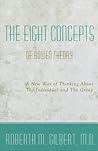
― The Eight Concepts of Bowen Theory
― The Eight Concepts of Bowen Theory
“He had an idea that the basic unit of emotional functioning might not be the individual, as previously thought, but the nuclear family.”
― Extraordinary Relationships
― Extraordinary Relationships
“Usually what people do in a relationship crisis is more of the same thing they have been doing, only more intensely and more anxiously.”
― Extraordinary Relationships
― Extraordinary Relationships
“The last concept to be added to Bowen theory is that of societal regression. It notes that, periodically, as anxiety begins to run higher in society, regressed behavior can be noted on a massive scale. A hallmark of such an anxious period is the unwillingness of families or other institutions of society (such as the court system) to take responsibility when behavior breaks down.”
― Extraordinary Relationships
― Extraordinary Relationships
“觀察一個家庭的情緒歷程並非為了定罪,反過來,人們確實可以透過觀察自己如何參與其中,進而讓同一代的人有更多的選擇,進而留給他們後代子孫不同的傳奇故事。”
― The Eight Concepts of Bowen Theory
― The Eight Concepts of Bowen Theory
“Family systems theory tells us that each partner in a relationship is exactly as differentiated or emotionally mature as the other; otherwise the two wouldn’t attract.”
― Extraordinary Relationships
― Extraordinary Relationships
“The most common and important triangle that people find when they begin to examine their patterns is the one that was formed between themselves and their two parents or caregivers at birth.”
― Extraordinary Relationships
― Extraordinary Relationships
“Sometimes relationships are an attempt to complete the self the same way it was completed in the original family system.”
― Extraordinary Relationships
― Extraordinary Relationships
“The five familiar and well-defined relationship patterns, as described by Bowen, are: Conflict Distance Cutoff Dysfunctional spouse (also called over/underfunctioning reciprocity) Dysfunctional child (also called triangling)”
― Extraordinary Relationships
― Extraordinary Relationships
“In summary, people at lower levels on the scale have difficulty with decision-making; because they have less choice between thinking and feeling, more of their choices are emotionally driven.”
― Extraordinary Relationships
― Extraordinary Relationships
“The basic pattern in conflictual marriages is one in which neither gives in to the other or in which neither is capable of an adaptive role.... The relationship cycles through periods of intense closeness, conflict that provides a period of emotional distance, and making up, which starts another cycle of intense closeness.”
― Extraordinary Relationships
― Extraordinary Relationships
“It is simplistic to advocate that if you stop worrying about your children, they’ll automatically have no problems. To be alive is to have problems. But it is certain that, if children don’t have their parents’ concern about them added to their ordinary difficulties, they will do better. Worrying about a child does not solve the lack of differentiation of self that leads to it.”
― Extraordinary Relationships
― Extraordinary Relationships
“The human dyad is so unstable that when two people who are important to each other develop a problem, which they invariably do, they automatically look around for a third person to include in the anxious situation in some way. The third person is brought into participation in the anxiety of the original twosome, and thus anxiety flows around the triangle.”
― Extraordinary Relationships
― Extraordinary Relationships
“Triangles are ubiquitous and automatic in emotional systems. They are considered, in Bowen family systems theory, to be the molecule, or basic building block of any system of people—be it the family, an organization, or society itself. The goal is not how to get out of them, however, but rather how to manage oneself in and through them.”
― Extraordinary Relationships
― Extraordinary Relationships
“The real problem is, to some degree, that the partners in a difficult relations are “no-selfs.” Too much of each self has been absorbed into the relationship.”
― Extraordinary Relationships
― Extraordinary Relationships
“So if there is one most important gift we can give to the next generation it is that of a solid and satisfying marriage relationship.”
― Connecting With Our Children: Guiding Principles for Parents in a Troubled World
― Connecting With Our Children: Guiding Principles for Parents in a Troubled World
“When a family becomes anxious, one of the automatic postures is that of the triangle, or focused child. Let’s take a look at it.”
― The Eight Concepts of Bowen Theory
― The Eight Concepts of Bowen Theory
“People with low levels of emotional maturity or differentiation attract other people with low maturity levels, and people with higher levels attract higher level people.”
― Extraordinary Relationships
― Extraordinary Relationships
“To begin the work of changing a relationship of overfunctioning/ underfunctioning reciprocity, one must not ask, “How can I change this troublesome partner of mine?” Instead the question is, “What is my contribution to this relationship pattern?”
― Extraordinary Relationships
― Extraordinary Relationships
“The central dilemma in managing the individuality/togetherness force for each person is how to keep the focus on one’s own life and life direction but still stay in open, clear communication with the other significant people in that life.”
― Extraordinary Relationships
― Extraordinary Relationships
“If two partners in a relationship work on their own levels of differentiation, their relationship will automatically improve. If even one of the partners works to raise his or her level of differentiation, the relationship will do better over the long term.”
― Extraordinary Relationships
― Extraordinary Relationships
“One important difference is the insistence of the new theory upon seeing the big picture. Where Freudian theory concerned itself with the delineation of ever more refined detail in the life of an individual, Bowen theory pursues an ever-broadening scope that incorporates an entire relationship system.”
― Extraordinary Relationships
― Extraordinary Relationships
“altruism is accomplished as a thoughtful choice and is guided by inner principles, not as an automatic, adaptive, or accommodative response.”
― Extraordinary Relationships
― Extraordinary Relationships