Goodreads helps you follow your favorite authors. Be the first to learn about new releases!
Start by following Daniel P. Horan.

Showing 1-18 of 18
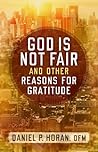
“If God’s message to us in Jesus Christ was easy or comfortable, chances are he wouldn’t have been seen as the threat that he was to the status quo and therefore executed. To be a Christian is to be a radical like Christ. Radical here does not mean a fanatic or self-righteous individual, but radical in the original sense of the term from the Latin radix, which means “root.” Christians believe that God entered the world as one of us to teach us what it means to be fully human, to challenge us to return to the roots of authentic human life and society, and to show us the way to love one another as God loves us.”
― God Is Not Fair, and Other Reasons for Gratitude
― God Is Not Fair, and Other Reasons for Gratitude
“What makes us “a whole lot like Jesus” is when we address the causes and not just the effects of systemic sin in our world, like poverty or violence, when we embrace community rather than succumb to the temptation to care only for ourselves, and when we actively choose weakness and humility rather than defending our desire for control, power, and security.”
― God Is Not Fair, and Other Reasons for Gratitude
― God Is Not Fair, and Other Reasons for Gratitude
“Francis might rightly be regarded as the patron saint of fools. He offers us a surprising, if uneasy, Christian virtue between two foolish vices. The very core of Christianity appears foolish to the world. Take, for instance, the idea that God would become human. At the heart of Christian faith stands the radical idea that the all-powerful God would bow low to enter creation as a vulnerable infant. Or take the doctrine of the Trinity; mathematically, the claim that God is at the same time one and yet three divine persons appears laughable to many.”
― God Is Not Fair, and Other Reasons for Gratitude
― God Is Not Fair, and Other Reasons for Gratitude
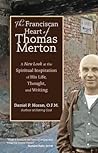
“One of the things rooted in our nature which constitutes us in God’s image, is our innate liberty. God is infinitely free, because He is infinitely powerful and beyond any other determination except that of His own love; and love is, of its essence, free. The freedom that is in our nature is our ability to love something, someone besides ourselves, and for the sake, not of ourselves, but of the one we love. There is in the human will an innate tendency, an inborn capacity for disinterested love. This power to love another for his own sake is one of the things that makes us like God, because this power is the one thing in us that is free from all determination. It is a power which transcends and escapes the inevitability of self-love.”
― The Franciscan Heart of Thomas Merton: A New Look at the Spiritual Inspiration of His Life, Thought, and Writing
― The Franciscan Heart of Thomas Merton: A New Look at the Spiritual Inspiration of His Life, Thought, and Writing
“what sort of culture do we tolerate or even promote in our neighborhoods and country that allows us to bypass another human person sprawled on a sidewalk without even the slightest expectation to see if he or she is in need of help?”
― The Last Words of Jesus: A Meditation on Love and Suffering
― The Last Words of Jesus: A Meditation on Love and Suffering
“I am convinced, especially after spending some intense time in reflecting on Jesus’s final earthly words to us as he suffered and died, that if there was ever a collection of New Testament passages that should challenge us to live more for others as God has lived for us, it is the Seven Last Words of Christ. His parting words from this life should be the founding words of my life.”
― The Last Words of Jesus: A Meditation on Love and Suffering
― The Last Words of Jesus: A Meditation on Love and Suffering
“That God is not fair is actually one among many reasons for gratitude, albeit in a way counterintuitive to our usual thinking. The simple premise here is that God’s way is not our way, God’s love is not conditioned like our love, God’s mercy is not bound as ours is, and God does not discriminate or reward a person according to the standards of a given society, no matter how widespread such criteria may be. (Thank God!)”
― God Is Not Fair, and Other Reasons for Gratitude
― God Is Not Fair, and Other Reasons for Gratitude
“Hauerwas explains, “It is my conviction that explanations, that is, the attempt to make Jesus conform to our understanding of things, cannot help but domesticate and tame the wildness of the God”
― The Last Words of Jesus: A Meditation on Love and Suffering
― The Last Words of Jesus: A Meditation on Love and Suffering
“the counterintuitive and gratuitous foolishness of God’s love revealed in the healing of the broken and brokenhearted, forgiving the unforgiveable, and loving the unlovable. So becoming a fool for God’s sake isn’t something to avoid out of fear or exploit for personal gain, but a vocation to embrace in revealing the love of God in our lives. I challenge you—and remind myself all the time—to consider why, where, and how to be a fool for Christ.”
― God Is Not Fair, and Other Reasons for Gratitude
― God Is Not Fair, and Other Reasons for Gratitude
“we must not be as concerned about our time as we are about God’s time. In God’s time beginnings and endings are one in the same, because God’s time is not so much a matter of minutes, hours, and days as it is about a way of living in the world. The way we mark the passage of our life is not the same way that God marks our time.”
― The Last Words of Jesus: A Meditation on Love and Suffering
― The Last Words of Jesus: A Meditation on Love and Suffering
“the ethical implications of the words and deeds of Jesus for those disciples that would follow him were not always in step with the standard practices and behaviors of their day, just as they aren’t always easily compatible with those of our time. This is where evangelical foolishness comes into play. Francis earned the title because of his allegiance to the Gospel over the culture of his rearing. He refused to accept money in the newly emerging merchant society because he saw how this nascent economic and social system began valuing people according to their wealth. He refused in other ways to participate in the power imbalances of his day because he recognized that following in the footprints of Christ meant prioritizing solidarity and relationships with all people rather than pursuing the accumulation of personal wealth and power.”
― God Is Not Fair, and Other Reasons for Gratitude
― God Is Not Fair, and Other Reasons for Gratitude
“Words have a history and a meaning, an origin and tradition of usage, a way of implying complex ideas and concepts that can often elude us when we only think about the way we use words in our native languages, especially if that language is modern American English.”
― The Last Words of Jesus: A Meditation on Love and Suffering
― The Last Words of Jesus: A Meditation on Love and Suffering
“I have often heard some of my Franciscan brothers say, “If Francis had applied to religious life today, he’d never make it beyond the psychological exam!” How true that is! (You should see that exam.) Even retrospectively, Francis is dismissed as a madman. The risk of appearing foolish never stopped him from embracing the Gospel as best he could, protesting the injustices of certain social systems, and letting nothing get in the way of his relationship with others. The virtue between the two foolish vices of avoidance and exploitation is the embrace of evangelical foolishness to become one of God’s fools.”
― God Is Not Fair, and Other Reasons for Gratitude
― God Is Not Fair, and Other Reasons for Gratitude
“that ignorance in many cases is not bliss, but is in fact sin; and what we don’t know may still not hurt us, but it might very well hurt others.”
― The Last Words of Jesus: A Meditation on Love and Suffering
― The Last Words of Jesus: A Meditation on Love and Suffering
“God is the Creator who is head over heels in love with humanity and seeks what is best for creation out of that love and concern.”
― The Last Words of Jesus: A Meditation on Love and Suffering
― The Last Words of Jesus: A Meditation on Love and Suffering
“Can the words from the cross offer us a framework by which we can better appreciate the disparity between the love of popular culture and the Christian love of self-surrender? Can the power of these words rightfully shock us into compassion—which literally means “to suffer with”—for those whose pain and sorrow is unknown to us, ignored by us, or made possible by our actions or omissions? Can we drink from the same cup from which Christ drank?”
― The Last Words of Jesus: A Meditation on Love and Suffering
― The Last Words of Jesus: A Meditation on Love and Suffering
“How often is the first criminal’s question our own? If you are really there, God, then let me find a job...then save my dying father...then help me!”
― The Last Words of Jesus: A Meditation on Love and Suffering
― The Last Words of Jesus: A Meditation on Love and Suffering
“Not only do the zombies reveal us at our worst, but the behavior of the surviving humans do as well. What is interesting about World War Z is that both of these characteristics are eventually reversed. The story focuses on the quest to find the cause of this outbreak, which leads the protagonist around the world. In addressing the root of the problem, a violent defense proves useless, and weakness saves the lives of those who survive. Religion News Service blogger Jana Reiss recognized something Christlike here: “Weakness becomes strength. Actively choosing weakness—especially when every cell of your body is screaming to cling to power instead—leads to life. Huh. That sounds a whole lot like Jesus.”5”
― God Is Not Fair, and Other Reasons for Gratitude
― God Is Not Fair, and Other Reasons for Gratitude