Goodreads helps you follow your favorite authors. Be the first to learn about new releases!
Start by following Stephen Nachmanovitch.

Showing 1-18 of 18
“The most potent muse of all is our own inner child”
―
―
“We can depend on the world being a perpetual surprise in perpetual motion.”
― Free Play: Improvisation in Life and Art
― Free Play: Improvisation in Life and Art
“Structure ignites spontaneity.”
― Free Play: Improvisation in Life and Art
― Free Play: Improvisation in Life and Art
“But somehow, even when we are grown up and “adjusted,” everything we do and are—our handwriting, the vibrato of our voice, the way we handle the bow or breathe into the instrument, our way of using language, the look in our eyes, the pattern of whorling fingerprints on our hand—all these things are symptomatic of our original nature.”
― Free Play: Improvisation in Life and Art
― Free Play: Improvisation in Life and Art
“When we are totally faithful to our own individuality, we are actually following a very intricate design.”
― Free Play: Improvisation in Life and Art
― Free Play: Improvisation in Life and Art
“If we know that the inevitable setbacks and frustrations are phases of the natural cycle of creative processes, if we know that our obstacles can become our ornaments, we can persevere and bring our desires to fruition. Such perseverance can be a real test, but there are ways through, there are guideposts. And the struggle, which is guaranteed to take a lifetime, is worth it. It is a struggle that generates incredible pleasure and joy. Every attempt we make is imperfect; yet each one of those imperfect attempts is an occasion for a delight unlike anything else on Earth”
―
―
“For art to appear, we have to disappear”
― Free Play: Improvisation in Life and Art
― Free Play: Improvisation in Life and Art
“The noun of self becomes a verb. This flashpoint of creation in the present moment is where work and play merge.”
―
―
“If your mind is empty, it is open to everything. In the beginner’s mind there are many possibilities; in the expert’s mind there are few.”
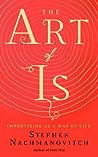
― The Art of Is: Improvising as a Way of Life
― The Art of Is: Improvising as a Way of Life
“These interreflecting themes, the prerequisites of creation, are playfulness, love, concentration, practice, skill, using the power of limits, using the power of mistakes, risk, surrender, patience, courage, and trust. Creativity is a harmony of opposite tensions, as encapsulated in our opening idea of lila, or divine play.”
― Free Play: Improvisation in Life and Art
― Free Play: Improvisation in Life and Art
“Ultimately, the only techniques that can help us are those we invent ourselves.”
― Free Play: Improvisation in Life and Art
― Free Play: Improvisation in Life and Art
“In contemporary culture, we are concerned that everything we do be useful for something. [...] we find ourselves in the land of half-baked pseudoscience like the “Mozart makes you smart” fad. The fact that Mozart’s fantastic play has value in itself is not sufficient because in order to justify financial and other kinds of support for the arts, we have to demonstrate that Mozart will raise a fetus’s IQ, which will make the fetus grow into a productive unit in the economy.”
―
―
“The harder we press on a violin string, the less we can feel it. The louder we play, the less we hear. . . . If I 'try' to play, I fail; if I race, I trip. The only road to strength is vulnerability.”
―
―
“Questo libro è un vero e proprio viaggio all'interno di se stessi, alla ricerca delle sorgenti della propria creatività. E' un libro sull'arte nel senso più profondo del termine, sul perchè facciamo arte e su cosa apprendiamo quando la facciamo. Il gioco libero della vita è rivolto a tutti coloro che vogliono entrare in contatto con la propria energia spirituale e accrescere la propria creatività. Per raggiungere questi obiettivi, l'autore integra i più svariati materiali provenienti da molteplici campi disciplinari: arti, scienze e tradizioni spirituali dell'intera umanità. Nell'utilizzare aneddoti e storie illuminanti, ci mostra con chiarezza come la creatività sgorghi effettivamente da noi, ma anche quanto facilmente l'ispirazione possa essere bloccata o deviata dagli inevitabili accadimenti della vita. Ma questi blocchi possono essere rimossi - e questo libro ci insegna come - per finalmente creare esprimendo la nostra vera voce.”
― Il gioco libero della vita: Trovare la voce del cuore con l'improvvisazione
― Il gioco libero della vita: Trovare la voce del cuore con l'improvvisazione
“I play with my partner; we listen to each other; we mirror each other; we connect with what we hear. He doesn’t know where I’m going, I don’t know where he’s going, yet we anticipate, sense, lead, and follow each other. There is no agreed-on structure or measure, but once we have played for five seconds there is a structure, because we’ve started something. We open each other’s minds like an infinite series of Chinese boxes. A mysterious kind of information flows back and forth, quicker than any signal we might give by sight or sound. The work comes from neither one artist nor the other, even though our own idiosyncrasies and styles, the symptoms of our original natures, still exert their natural pull. Nor does the work come from a compromise or halfway point (averages are always boring!), but from a third place that isn’t necessarily like what either one of us would do individually. What comes is a revelation to both of us. There is a third, totally new style that pulls on us. It is as though we have become a group organism that has its own nature and its own way of being, from a unique and unpredictable place which is the group personality or group brain.”
― Free Play: Improvisation in Life and Art
― Free Play: Improvisation in Life and Art
“One advantage of collaboration is that it's much easier to learn from someone else than from yourself. And inertia, which is often a major block in solitary work, hardly exists at all here: A releases B's energy, B releases A's energy. Information flows and multiplies easily. Learning becomes many-sided, a refreshing and vitalizing force.”
―
―
“The most potent muse of all is our own inner child.”
―
―
“We continue to conceive of the universe as consisting of things and forces that act on things.
My son’s ninth grade English class were given an essay question that instructed them to name the “qualities” “in” a certain character in a novel. We say that a person “has” courage, or pride, or arrogance, or “a” temper—as though these were substances like salt. Innumerable students are asked to write about “historical forces” or “movements.” Was Blake or Beethoven “a romantic”? Such is our deeply ingrained linguistic habit of reifying relationships and activities into things that you can “have.”
[...] “It is nonsense to talk about ‘dependency’ or ‘aggressiveness’ or ‘pride,’ and so on. All such words have their roots in what happens between persons, not in some something-or-other inside a person.” (Bateson, 1979)”
―
My son’s ninth grade English class were given an essay question that instructed them to name the “qualities” “in” a certain character in a novel. We say that a person “has” courage, or pride, or arrogance, or “a” temper—as though these were substances like salt. Innumerable students are asked to write about “historical forces” or “movements.” Was Blake or Beethoven “a romantic”? Such is our deeply ingrained linguistic habit of reifying relationships and activities into things that you can “have.”
[...] “It is nonsense to talk about ‘dependency’ or ‘aggressiveness’ or ‘pride,’ and so on. All such words have their roots in what happens between persons, not in some something-or-other inside a person.” (Bateson, 1979)”
―