Goodreads helps you follow your favorite authors. Be the first to learn about new releases!
Start by following Alexandra David-Néel.

Showing 1-30 of 30
“Suffering rises up those souls that are truly great; it is only small souls that are made mean-spirited by it.”
―
―
“Voyager, c'est, de même qu'étudier, faire un long bail avec la jeunesse. Il n'existe pas, je crois, de plus efficace fontaine de jouvence que ces deux choses: voyage et activité intellectuelle.”
―
―
“« Il ne faut pas vouloir du bien aux gens en dépit d’eux et contre leur volonté. Chacun sait, mieux que personne, ce qu’il lui convient. »”
― La Lampe de sagesse
― La Lampe de sagesse
“Il fait froid et triste quand on demande aux êtres de vous être un soutient, de vous réchauffer, d'alléger le fardeau de misère inhérente à toute existence. Nul d'eux n'a réellement le souci de le faire, nul d'eux ne le peut vraiment. C'est en soi qu'il faut cultiver la flamme qui réchauffe, c'est sur soi qu'il faut s'appuyer.”
― Journal de voyage, 1 - 11 août 1904 - 26 décembre 1917
― Journal de voyage, 1 - 11 août 1904 - 26 décembre 1917
“I craved to go beyond the garden gate, to follow the road that passed it by, and to set out for the Unknown.”
―
―
“Two exercises are especially prescribed by the adepts of the mystic path. The first consists in observing with great attention the workings of the mind without attempting to stop it. Seated in a quiet place, the disciple refrains as much as he can from consciously pointing his thoughts in a definite direction. He marks the spontaneous arising of ideas, memories, desires, etc., and considers how, superseded by new ones, they sink into the dark recesses of the mind. He watches also the subjective image which, apparently unconnected with any thoughts or sensations, appears while his eyes are closed: men, animals, landscapes, moving crowds, etc. During that exercise, he avoids making reflections about the spectacle which he beholds, looking passively at the continual, swift, flowing stream of thoughts and mental images that whirl, jostle, fight and pass away. It is said that the disciple is about to gather the fruit of this practice when he loosens the firm footing he had kept, till then, in his quality of spectator. He too — so he must understand — is an actor on the tumultuous stage. His present introspection, all his acts and thoughts, and the very sum of them all which he calls his self, are but ephemeral bubbles in a whirlpool made of an infinite quantity of bubbles which congregate for a moment, separate, burst, and form again, following a giddy rhythm. The second exercise is intended to stop the roaming of the mind in order that one may concentrate it on one single object. Training which tends to develop a perfect concentration of mind is generally deemed necessary for all students without distinction. As to observing the mind's activity it is only recommended to the most intellectual disciples. Training the mind to "one-pointedness" is practiced in all Buddhist sects. In Southern Buddhist countries — Ceylon, Siam, Burma — an apparatus called kasinas, which consists of clay discs variously coloured, or a round surface covered by water, or a fire at which one gazes through a screen in which a round hole is pierced — are used for this purpose. Any of these circles is stared at until it is seen as clearly when the eyes are shut, as when they are open and actually looking at it. The process does not aim at producing an hypnotic state, as some Western scholars have said, but it accustoms one to concentrating the mind. The fact that the subjective image has become as vivid as the objective, indicates — according”
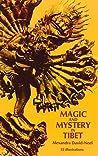
― Magic and Mystery in Tibet
― Magic and Mystery in Tibet
“between virtue and vice, honourable and shameful, good and evil. Being neither afflicted, nor repenting whatever one may have done and, on the other hand, never being elated nor proud on account of what one has accomplished. 5. To consider with perfect equanimity and detachment the conflicting opinions and the various manifestations of the activity of beings. To understand that such is the nature of things, the inevitable mode of action of each entity and to remain always serene. To look at the world as a man standing on the highest mountain of the country looks at the valleys and the lesser summits spread out below him.”
― Magic and Mystery in Tibet
― Magic and Mystery in Tibet
“MYSTIC THEORIES AND SPIRITUAL TRAINING THE religious world in Tibet, generally speaking, is divided into two sections. The first includes those who advocate the strict observance of moral precepts and monastic rules as the means of salvation, the second is formed of those who prefer an intellectual method which frees its followers from”
― Magic and Mystery in Tibet
― Magic and Mystery in Tibet
“The discipline on the "Short Path"is to avoid imagining things. When imagination is prescribed, in contemplative meditation, it is to demonstrate by that conscious creation of perceptions or sensations, the illusory nature of those perceptions and sensations which we accept as real though they too rest on imagination; the only difference being that, in their case, the creation is unconsciously effected. The Tibetan reformer, Tsong Khapa, defines meditation as "the means (The word used by the author is khungs, which means the "source," the "origin." The quotation is taken from the work called The Lamp of the Way. A similar definition is found in the Yoga sûtras of Patanjali) of enabling oneself to reject all imaginative thoughts together with their seed." It is this uprooting of the present "imaginative thoughts," and the burning of their "seed," so that no fanciful ideas may arise in the future, that constitutes the "clearing" which I have just mentioned.”
― Magic and Mystery in Tibet
― Magic and Mystery in Tibet
“The secret of the psychic training, as Tibetans conceive it, consists in developing a power of concentration of mind greatly surpassing even that of men who are, by nature, the most gifted in this respect. Mystic”
― Magic and Mystery in Tibet
― Magic and Mystery in Tibet
“Some lamas have told me that the aim of these practices can hardly be explained, because those who have not felt their effects could not understand the explanations. One attains, by the means of these strange drills, psychic states entirely different from those habitual to us. They cause us to pass beyond the fictitious limits which we assign to the self. The result being that we grow to realize that the self is compound, impermanent; and that the self, as self, does not exist. One of these lamas seized upon a remark I had made as an”
― Magic and Mystery in Tibet
― Magic and Mystery in Tibet
“Then he began the ritualistic dance, turning successively towards the four quarters, reciting "I trample down the demon of pride, the demon of anger, the demon of lust, the demon of stupidity.”
― Magic and Mystery in Tibet
― Magic and Mystery in Tibet
“habits and innate tendencies, which are part of his present mind, and have been developed in the course of successive lives whose origin is lost in the night of time. On the other hand, the master must warn his disciple to be on his guard against accepting new beliefs, ideas and habits as groundless and irrational as those which he shakes off.”
― Magic and Mystery in Tibet
― Magic and Mystery in Tibet
“all laws whatsoever. Nevertheless there exists no rigid division between these two categories. Though their respective theories are always a favourite subject of controversy between the followers of the two schools, it seldom happens that one stands in the position of a harsh, pugnacious adversary towards those in the opposite camp. Even the monks attached to morality acknowledge that a virtuous life and the monastic discipline, though of great value and advisable for the many, are but a mere preparation to a higher”
― Magic and Mystery in Tibet
― Magic and Mystery in Tibet
“But the “hut” turnedout to be a passage between two great rocks. At last utterexhaustion compelled us to rest. The site was not in the leastfit for camping; the exceedingly narrow trail skirted a stony,natural wall, and, on the other side, ended perpendicularly.We lay down on a rocky mattress whose roughness we unpleas-antly felt through our clothes and endeavoured to remembereven in our sleep that we were perched on the edge of a preci-pice whose depth was unfathomable in the night. In such wise we spent the second happy night of our wonder-ful adventure. Day had not yet broken when Yongden and1 loaded our burdens on our backs and continued the trampthrough the forest. More than twenty-four hours had nowelapsed since we had eaten and drunk. We had not yet becomeaccustomed to prolonged fasts, and this first one was hard tobear.”
― My Journey to Lhasa: The Classic Story of the Only Western Woman Who Succeeded in Entering the Forbidden City
― My Journey to Lhasa: The Classic Story of the Only Western Woman Who Succeeded in Entering the Forbidden City
“L'egoisme est necessaire pour accomplir de grandes choses. Les grands destins sont toujours des destins de grands egoistes. Et quand ces destins sont accomplis, ils se changent en phares puissants qui nous eclairent.
Alexandra repousse, rejette la mediocrite: Je n'ai que peu de gout pour les choses mediocres, le confort mediocre, les situations mediocres, le succes mediocres.
Cette Vagabonde a peu de gout aussi pour ce qu'elle appelle "les destins d'huitre", autrement dit, les sedentaires, ceux qui confondent la vie et l'habitude.
Fuis l'ostentation. Ne fais donc pas comme les petits esprits qui n'ont point de repos tant qu'ils n'ont pas parle avec de grands airs de ce qu'ils ont appris la veille.
Evite donc de mettre, de toi-meme, la conversation sur des sujets ou ta vanite se complaise. Ne parle point de toi. Attends qu'on te demande ton opinion pour la donner.
Sachons renoncer sans lachete a une faiblesse qui cause notre malheur.
Une ame elevee se rejouit peu, ne s'afflige jamais et, dans toute chose, ne laisse paraitre aucun signe de joie ou de tristesse. Quand ton ame est triste et accablee, lis une page d'un philosophe, reflechis sur la cause de ta peine, le plus souvent tu trouveras que ce n'est que bagatelle.
Ne dis pas: Si je vivais de telle maniere, je pourrai faire ceci ou cela; puisque tu ne fais pas tout ce que ton genre actuel de vie te permet de faire. Si tu ne profites pas du temps que tu as du libre, tu n'en profiterais pas davantage quand ce temps serait dix fois plus considerable.
Prends garde de ne pas manger par sensualite mais, seulement, pour reparer tes forces. Le manger alourdit l'esprit et rend incapable de travailler.
Tous les cultes degenerent en pitreries ridicules quand les masses y accedent. De beaux symboles, de beaux gestes ne peuvent etre que le privilege d'une elite.
Des que la moindre parcelle de sagesse est entree dans l'esprit d'un homme, il aspire a la solitude.”
― La Lampe de sagesse
Alexandra repousse, rejette la mediocrite: Je n'ai que peu de gout pour les choses mediocres, le confort mediocre, les situations mediocres, le succes mediocres.
Cette Vagabonde a peu de gout aussi pour ce qu'elle appelle "les destins d'huitre", autrement dit, les sedentaires, ceux qui confondent la vie et l'habitude.
Fuis l'ostentation. Ne fais donc pas comme les petits esprits qui n'ont point de repos tant qu'ils n'ont pas parle avec de grands airs de ce qu'ils ont appris la veille.
Evite donc de mettre, de toi-meme, la conversation sur des sujets ou ta vanite se complaise. Ne parle point de toi. Attends qu'on te demande ton opinion pour la donner.
Sachons renoncer sans lachete a une faiblesse qui cause notre malheur.
Une ame elevee se rejouit peu, ne s'afflige jamais et, dans toute chose, ne laisse paraitre aucun signe de joie ou de tristesse. Quand ton ame est triste et accablee, lis une page d'un philosophe, reflechis sur la cause de ta peine, le plus souvent tu trouveras que ce n'est que bagatelle.
Ne dis pas: Si je vivais de telle maniere, je pourrai faire ceci ou cela; puisque tu ne fais pas tout ce que ton genre actuel de vie te permet de faire. Si tu ne profites pas du temps que tu as du libre, tu n'en profiterais pas davantage quand ce temps serait dix fois plus considerable.
Prends garde de ne pas manger par sensualite mais, seulement, pour reparer tes forces. Le manger alourdit l'esprit et rend incapable de travailler.
Tous les cultes degenerent en pitreries ridicules quand les masses y accedent. De beaux symboles, de beaux gestes ne peuvent etre que le privilege d'une elite.
Des que la moindre parcelle de sagesse est entree dans l'esprit d'un homme, il aspire a la solitude.”
― La Lampe de sagesse
“En ce temps-là, le musée Guimet était un temple. C’est ainsi qu’il se dresse, maintenant, au fond de ma mémoire.
Je vois un large escalier de pierre s’élevant entre des murs couverts de fresques. Tout en gravissant les degrés, l’on rencontre successivement un brahmine altier versant une offrande dans le feu sacré ; des moines bouddhistes vêtus de toges jaunes s’en allant quêter, bol en main, leur nourriture quotidienne ; un temple japonais posé sur un promontoire auquel conduit, par-delà un torii rouge, une allée bordée de cerisiers en fleur. D’autres figures, d’autres paysages de l’Asie sollicitent encore l’attention du pèlerin montant vers le mystère de l’Orient [...].
A droite, est une toute petite salle de lecture où les fervents de l’orientalisme s’absorbent en de studieuses recherches, oublieux de Paris dont les bruits heurtent en vain les murs du musée-temple, sans parvenir à troubler l’atmosphère de quiétude et de rêve qu’ils enclosent.
Dans cette petite chambre, des appels muets s’échappent des pages que l’on feuillette. L’Inde, la Chine, le Japon, tous les points de ce monde qui commence au-delà de Suez sollicitent les lecteurs... Des vocations naissent... la mienne y est née.
Tel était le musée Guimet quand j’avais vingt ans".”
― L'Inde où j'ai vécu
Je vois un large escalier de pierre s’élevant entre des murs couverts de fresques. Tout en gravissant les degrés, l’on rencontre successivement un brahmine altier versant une offrande dans le feu sacré ; des moines bouddhistes vêtus de toges jaunes s’en allant quêter, bol en main, leur nourriture quotidienne ; un temple japonais posé sur un promontoire auquel conduit, par-delà un torii rouge, une allée bordée de cerisiers en fleur. D’autres figures, d’autres paysages de l’Asie sollicitent encore l’attention du pèlerin montant vers le mystère de l’Orient [...].
A droite, est une toute petite salle de lecture où les fervents de l’orientalisme s’absorbent en de studieuses recherches, oublieux de Paris dont les bruits heurtent en vain les murs du musée-temple, sans parvenir à troubler l’atmosphère de quiétude et de rêve qu’ils enclosent.
Dans cette petite chambre, des appels muets s’échappent des pages que l’on feuillette. L’Inde, la Chine, le Japon, tous les points de ce monde qui commence au-delà de Suez sollicitent les lecteurs... Des vocations naissent... la mienne y est née.
Tel était le musée Guimet quand j’avais vingt ans".”
― L'Inde où j'ai vécu
“Era giusto? [...] Non lo potevo sapere e mi sembrava assurdo elevarmi a giudice presuntuoso nel nostro caotico mondo. La morale migliore, per noi poveri uomini, è di farci l'elemosina di una reciproca pietà.”
― Au pays des brigands gentilshommes
― Au pays des brigands gentilshommes
“En Inde, la realite, c'est sauvagerie, brutalite, egoisme sans aucune retenue, mepris complet de l'homme pour l'homme et salete inexprimable.
Tout est tragique ici, en Inde, l'art, la religion, les imaginations, les consciences, la vie journaliere ou les plus simples faits ou gestes, il y a un reflet de la terreur sacree dont parlent les anciens.
L'idee des incarnations donne l'habitude de mourir. On se dit qu'on est mort tant de fois deja que cette formalite a remplir perd de son epouvante.
Il fait froid et triste quand on demande aux etres de vous etre un soutien, de vous rechauffer, d'alleger le fardeau de misere inherente a toute existence. C'est en soi qu'il faut cultiver la flamme qui rechauffe.
Ce que nous aimons, ce sont nos sensations, la satisfaction de nos desirs.
Quand les hommes ont peur, ils se tournent vers les dieux, vers le surnaturel, comme les enfants qui s'accrochent aux jupes de leur mere.
Une tradition et une chaine de pensees millenaires sont une force, une energie aussi reelle dans le domaine mental que l'electricite sur le plan physique.
Parfois je fais ce qu'on l'on appelle en tibetain: tsam. C'est a dire que, pendant plusieurs jours, je ne vois personne ni ne parle a personne. C'est tres reposant, ces jours de solitude complete.
Les peuples primitifs restent bien pres de l'animal; leur plus grande joie est de manger. Pas mal de civilises leur ressemblent.
Les voyages ne fouettent pas seulement le sang, comme un sport hygienique, ils fouettent l'esprit et lui communiquent de la vigueur. Voyager, c'est de meme qu'etudier, faire un long bail avec la jeunesse. Il n'existe pas, je crois, de plus efficace fontaine de jouvence que ces deux choses combinees: voyage et activite intellectuelle.
A ceux qui sentent autrement que le public vulgaire, le superflue est plus indispensable que le pretendu necessaire.
Quand on voyage, le voyage lui-meme tient lieu de tout, mais lorsque l'on devient sedentaire, l'on aime bien vivre dans un decor agreable.”
― Correspondance avec son mari Edition intégrale 1904-1941
Tout est tragique ici, en Inde, l'art, la religion, les imaginations, les consciences, la vie journaliere ou les plus simples faits ou gestes, il y a un reflet de la terreur sacree dont parlent les anciens.
L'idee des incarnations donne l'habitude de mourir. On se dit qu'on est mort tant de fois deja que cette formalite a remplir perd de son epouvante.
Il fait froid et triste quand on demande aux etres de vous etre un soutien, de vous rechauffer, d'alleger le fardeau de misere inherente a toute existence. C'est en soi qu'il faut cultiver la flamme qui rechauffe.
Ce que nous aimons, ce sont nos sensations, la satisfaction de nos desirs.
Quand les hommes ont peur, ils se tournent vers les dieux, vers le surnaturel, comme les enfants qui s'accrochent aux jupes de leur mere.
Une tradition et une chaine de pensees millenaires sont une force, une energie aussi reelle dans le domaine mental que l'electricite sur le plan physique.
Parfois je fais ce qu'on l'on appelle en tibetain: tsam. C'est a dire que, pendant plusieurs jours, je ne vois personne ni ne parle a personne. C'est tres reposant, ces jours de solitude complete.
Les peuples primitifs restent bien pres de l'animal; leur plus grande joie est de manger. Pas mal de civilises leur ressemblent.
Les voyages ne fouettent pas seulement le sang, comme un sport hygienique, ils fouettent l'esprit et lui communiquent de la vigueur. Voyager, c'est de meme qu'etudier, faire un long bail avec la jeunesse. Il n'existe pas, je crois, de plus efficace fontaine de jouvence que ces deux choses combinees: voyage et activite intellectuelle.
A ceux qui sentent autrement que le public vulgaire, le superflue est plus indispensable que le pretendu necessaire.
Quand on voyage, le voyage lui-meme tient lieu de tout, mais lorsque l'on devient sedentaire, l'on aime bien vivre dans un decor agreable.”
― Correspondance avec son mari Edition intégrale 1904-1941
“For instance, the disciple has chosen a tree, as an object of meditation, and has identified himself with it. That is to say that he has lost the consciousness of his own personality and experiences the peculiar sensations that one may ascribe to a tree. He feels himself to be composed of a stiff trunk with branches, he perceives the sensation of the wind moving the leaves. He notes the activity of the roots feeding under the ground, the ascension of the sap which spreads all over the tree, and so on. Then, having mentally become a tree (which has now become the subject) he must look at the man (who has now become the object) seated in front of him and must examine this man in detail. This done, the disciple again places his consciousness in the man and contemplates the tree as before. Then, transferring his consciousness once more into the tree, he contemplates the man. This alternative transposition of subject and object is effected a number of times. This exercise is often practiced indoors with a statue of a stick called gom shing (meditation wood). (Properly speaking, the gom shing is merely a stick at which one gazes to obtain fixity of mind. The burning incense stick is a variety of gom shing. A burning incense stick is also used in an obscure or completely darkened room to dispose the mind to meditation.”
― Magic and Mystery in Tibet
― Magic and Mystery in Tibet
“La devotion silencieuse est un luxe, une pratique de croyants raffines; les masses hurlent leur foi grossiere non seulement on Orient, mais aussi en Occident.
La foie des ames simples engendre partout les memes aberrations.
Le tantrisme meprise l'homme routinier, se conformant sans les discuter aux us et coutumes du milieu social auquel il appartient et acceptant de meme les idees dont ceux-ci derivent.
L'aventure est pour moi l'unique raison d'etre de la vie.
Les idees des Orientaux concernant ce qui est decent et ce qui est indecent sont tres differentes des notres et rien de ce qui concerne le sexe ne leur parait propre a donner lieu a l'hilarite ou au scandale.
Ce qui compte, ce sont les sentiments que le gourou ou le dieu fait naitre en nous. L'un comme l'autre remplissent le role d'excitateurs et mettent en action en nous des energies qui autrement demeureraient dormantes. Ainsi, il est recommande de ne pas eplucher la conduite de son gourou, de ne pas investiguer l'etendue de son erudition ou de son intelligence puisqu'en somme ce n'est pas absolument de lui que depend le benefice recherche par le disciple, mais que ce benefice est plutot le fruit des sentiments du disciple lui-meme.
Les Orientaux ne sont jamais presses, ils vivent dans l'eternite.
Les intimes de Gandhi supportaient joyeusement la charge passablement lourde, avouaient-ils parfois, de sa pauvrete couteuse.
Aucun blame ne peut etre adresse a Gandhi pour avoir mene la vie classique du gourou indienavec tout ce qu'elle comporte d'ostentation quant a une "simplicite" factice: elle est presque imposee aux gourous par la force d'habitudes seculaires.
L'esclavage spirituel ne deplait point aux Indiens, la majorite d'entre eux s'y soumettent meme avec joie.
Gandhi, disait Nehru, pense continuellement en termes de salut personnel et de peche, il ne se preoccupe pas de reforme des institutions ou de la structure de la societe, mais seulement de bannir le peche de la vie des individus.
Des intrus flanent a loisir dans les galeries des palais et sous les verandas des batiment ou rien ne les appelle: ils veulent simplement "regarder", ce qui est eminemment oriental.
Quel que soit l'ideal qu'il cherisse, quel que soit le but qu'il poursuive, l'Indien, qu'il en soit conscient ou non, se sent toujours non point seulement le porte-parole d'un dieu, mais Dieu lui-meme possesseur de la Verite.”
― L'Inde où j'ai vécu
La foie des ames simples engendre partout les memes aberrations.
Le tantrisme meprise l'homme routinier, se conformant sans les discuter aux us et coutumes du milieu social auquel il appartient et acceptant de meme les idees dont ceux-ci derivent.
L'aventure est pour moi l'unique raison d'etre de la vie.
Les idees des Orientaux concernant ce qui est decent et ce qui est indecent sont tres differentes des notres et rien de ce qui concerne le sexe ne leur parait propre a donner lieu a l'hilarite ou au scandale.
Ce qui compte, ce sont les sentiments que le gourou ou le dieu fait naitre en nous. L'un comme l'autre remplissent le role d'excitateurs et mettent en action en nous des energies qui autrement demeureraient dormantes. Ainsi, il est recommande de ne pas eplucher la conduite de son gourou, de ne pas investiguer l'etendue de son erudition ou de son intelligence puisqu'en somme ce n'est pas absolument de lui que depend le benefice recherche par le disciple, mais que ce benefice est plutot le fruit des sentiments du disciple lui-meme.
Les Orientaux ne sont jamais presses, ils vivent dans l'eternite.
Les intimes de Gandhi supportaient joyeusement la charge passablement lourde, avouaient-ils parfois, de sa pauvrete couteuse.
Aucun blame ne peut etre adresse a Gandhi pour avoir mene la vie classique du gourou indienavec tout ce qu'elle comporte d'ostentation quant a une "simplicite" factice: elle est presque imposee aux gourous par la force d'habitudes seculaires.
L'esclavage spirituel ne deplait point aux Indiens, la majorite d'entre eux s'y soumettent meme avec joie.
Gandhi, disait Nehru, pense continuellement en termes de salut personnel et de peche, il ne se preoccupe pas de reforme des institutions ou de la structure de la societe, mais seulement de bannir le peche de la vie des individus.
Des intrus flanent a loisir dans les galeries des palais et sous les verandas des batiment ou rien ne les appelle: ils veulent simplement "regarder", ce qui est eminemment oriental.
Quel que soit l'ideal qu'il cherisse, quel que soit le but qu'il poursuive, l'Indien, qu'il en soit conscient ou non, se sent toujours non point seulement le porte-parole d'un dieu, mais Dieu lui-meme possesseur de la Verite.”
― L'Inde où j'ai vécu
“Pride, anger, hatred, covetousness, sloth, stupidity are mentally rejected with the rhythmic breathing out.
A man may be killed by suggestion, he may kill himself by auto-suggestion.
Discussion is hardly possible with Oriental mystics. When once they have answered: "I have seen this n my meditation", little hope is left to the inquirer of obtaining further explanations.
The various phenomena which the vulgar consider as miracles, are produced by an energy arising in the magician himself and depend on his knowledge of the true inner essence of things.
Tibetans are a strong and sturdy people; the cold, sleeping on the ground in the open, solitude and many other things from which the average Westerners would shrink, do not frighten them in the least.
Whatever those unacquainted with it may think, solitude and utter loneliness are far from being devoid of charm. But, most likely, only those who have lived through it themselves can understand the irresistible attraction that hermit life exerts on many Orientals.
On mani padme hum. The simplest interpretation is: In the lotus ( which is the world ), exists the precious jewel of Buddha's teaching. Another explanation takes the lotus as the mind. In the depth of it, by introspective meditation, one is able to find the jewel of knowledge, truth, reality, liberation, nirvana, these various terms being different denominations of the same thing.
Nirvana, the supreme salvation, is not separated from samsara, the phenomenal world, but the mystic finds the first in the heart of the second, just as the jewel may be found in the lotus. Nirvana, the jewel, exists when enlightenment exists. Samsara, the lotus, exists when delusion exists, which veils nirvana, just as the many petals of the lotus conceal the jewel, nestling among them.
Hum! at the end of the formula, is a mystic expression of wrath used in coercing fierce deities and subduing demons. Hum! is a kind of mystic war cry; uttering it, is challenging the enemy.
Tibetans affirm that through mastery over breath one may conquer all passion and anger as well as carnal desires, acquire serenity, prepare the mind for meditation and awake spiritual energy. Breath, in its turn, influences bodily and mental activity. Consequently, two methods have been devised: the most easy one which quiets the mind by controlling the breath and the more difficult way which consists in regulating the breath by controlling the mind.
Liberty is the motto on the heights of the Land of Snows, but strangely enough, the disciple starts on that road of utter freedom by the strictest obedience to his spiritual guide. However, the required submission is confined to the spiritual and psychic exercises and the way of living prescribed by the master. No dogmas are ever imposed. The disciple may believe, deny or doubt anything according to his own feelings.
People who habitually practice methodical contemplation often experience, when sitting down for their appointed time of meditation, the sensation of putting down a load or taking off a heavy garment and entering a silent, delightfully calm, region. It is the impression of deliverance and serenity which Tibetan mystics call niampar jagpa, to make equal, to level - meaning calming down all causes of agitation that roll their waves through the mind.
A flag moves. What is that which moves? Is it the flag or the wind? The answer is that neither the flag nor the wind moves. it is the mind that moves.
The fact is that Orientals, excepting vulgar charlatans, do not make a show of their mystic, philosophic or psychic knowledge.
Gods, demons, the whole universe, are but a mirage which exists in the mind, springs from it and sinks into it.”
― Magic and Mystery in Tibet
A man may be killed by suggestion, he may kill himself by auto-suggestion.
Discussion is hardly possible with Oriental mystics. When once they have answered: "I have seen this n my meditation", little hope is left to the inquirer of obtaining further explanations.
The various phenomena which the vulgar consider as miracles, are produced by an energy arising in the magician himself and depend on his knowledge of the true inner essence of things.
Tibetans are a strong and sturdy people; the cold, sleeping on the ground in the open, solitude and many other things from which the average Westerners would shrink, do not frighten them in the least.
Whatever those unacquainted with it may think, solitude and utter loneliness are far from being devoid of charm. But, most likely, only those who have lived through it themselves can understand the irresistible attraction that hermit life exerts on many Orientals.
On mani padme hum. The simplest interpretation is: In the lotus ( which is the world ), exists the precious jewel of Buddha's teaching. Another explanation takes the lotus as the mind. In the depth of it, by introspective meditation, one is able to find the jewel of knowledge, truth, reality, liberation, nirvana, these various terms being different denominations of the same thing.
Nirvana, the supreme salvation, is not separated from samsara, the phenomenal world, but the mystic finds the first in the heart of the second, just as the jewel may be found in the lotus. Nirvana, the jewel, exists when enlightenment exists. Samsara, the lotus, exists when delusion exists, which veils nirvana, just as the many petals of the lotus conceal the jewel, nestling among them.
Hum! at the end of the formula, is a mystic expression of wrath used in coercing fierce deities and subduing demons. Hum! is a kind of mystic war cry; uttering it, is challenging the enemy.
Tibetans affirm that through mastery over breath one may conquer all passion and anger as well as carnal desires, acquire serenity, prepare the mind for meditation and awake spiritual energy. Breath, in its turn, influences bodily and mental activity. Consequently, two methods have been devised: the most easy one which quiets the mind by controlling the breath and the more difficult way which consists in regulating the breath by controlling the mind.
Liberty is the motto on the heights of the Land of Snows, but strangely enough, the disciple starts on that road of utter freedom by the strictest obedience to his spiritual guide. However, the required submission is confined to the spiritual and psychic exercises and the way of living prescribed by the master. No dogmas are ever imposed. The disciple may believe, deny or doubt anything according to his own feelings.
People who habitually practice methodical contemplation often experience, when sitting down for their appointed time of meditation, the sensation of putting down a load or taking off a heavy garment and entering a silent, delightfully calm, region. It is the impression of deliverance and serenity which Tibetan mystics call niampar jagpa, to make equal, to level - meaning calming down all causes of agitation that roll their waves through the mind.
A flag moves. What is that which moves? Is it the flag or the wind? The answer is that neither the flag nor the wind moves. it is the mind that moves.
The fact is that Orientals, excepting vulgar charlatans, do not make a show of their mystic, philosophic or psychic knowledge.
Gods, demons, the whole universe, are but a mirage which exists in the mind, springs from it and sinks into it.”
― Magic and Mystery in Tibet
“The remote causes are often represented by their "descendants." (In Tibetan rigs. As an instance: the milk is present in the butter or cheese, the seed is present in the tree born from it. Tibetans freely use these illustrations) These " descendants"are the present conditions which exist as the effects of bodily or mental actions which have been done in the past, but not, necessarily, done by the doer of the present act himself. So, when concentration of thoughts is mentioned here below as the direct cause of a phenomenon, one must remember: first that, according to Tibetan mystics, this concentration is not spontaneous, but determined; and secondly, that beside this direct apparent cause, there exist, in the background, a number of secondary causes which are equally necessary to bring about the phenomenon. The secret of the psychic training, as Tibetans conceive it, consists in developing a power of concentration of mind greatly surpassing even that of men who are, by nature, the most gifted in this respect. Mystic masters affirm that by the means of such concentration of mind, waves of energy are produced which can be used in different ways. The term" wave" is mine. I use it for clearness sake and also because, as the reader will see, Tibetan mystics really mean some "currents" or "waves" of force. However, they merely say shugs or tsal (Written rtsal) that is to say, "energy." That energy, they believe, is”
― Magic and Mystery in Tibet
― Magic and Mystery in Tibet
“Amongst these causes, the first and more easily discernible ones are those which have arisen, in the mind of the doer of the action, the conscious will of doing it. To these causes Tibetans assimilate those which, even unknown to the doer, have put into motion some forces which have led him to perform the action. Both kinds are styled gyu, "immediate or principal cause." Then, come the outside causes, not originating with the doer, which may have helped the accomplishment of the action. These are called kyen. (As an instance, the seed is the rgyu of the plant. The soil and the various substances which exist in it, the water, air, sun, the gardener who has sown the seed, etc., etc., are rkyen (pronounced gyu and kyen))”
― Magic and Mystery in Tibet
― Magic and Mystery in Tibet
“Quando si viaggia così lentamente, concedendosi numerose ore di riposo nei villaggi, le occasioni di parlare con gli indigeni abbondano. Saper approfittare di queste chiacchiere, cogliere al passaggio dettagli tipici sugli usi e il pensiero degli indigeni, è un'arte che tutti i viaggiatori dovrebbero coltivare con cura.”
― Au pays des brigands gentilshommes
― Au pays des brigands gentilshommes
“Sannyasa („respingerea totală”, asceza) este o stare de spirit la care duce lehamitea și dezgustul produse de contemplarea goanei febrile a ființelor care se luptă între ele. feroce și stupide, în timp ce se îndreaptă spre moarte.”
― L'Inde où j'ai vécu
― L'Inde où j'ai vécu
“La vérité apprise d'autrui est sans valeur. Seule compte, seule est efficace la vérité que nous découvrons nous-mêmes.”
― La Lampe de sagesse
― La Lampe de sagesse
“Per quanto seccanti possano sembrare, le modifiche forzate ai progetti, nel momento in cui si impongono alla nostra volontà, sono pur sempre uno degli aspetti più affascinanti del viaggio. Conservano quel prezioso spirito d'avventura che permette al viaggiatore di cogliere sempre gli sviluppi spontanei, interessanti e novità impreviste.”
― Au pays des brigands gentilshommes
― Au pays des brigands gentilshommes
“Ever since I was five years old,” David-Néel wrote in My Journey to Lhasa, “I wished to move out of the narrow limits in which, like all children of my age, I was then kept. I craved to go beyond the garden gate, to follow the road that passed it by, and to set out for the Unknown. But strangely enough, this ‘Unknown’ fancied by my baby mind always turned out to be a solitary spot where I could sit alone, with no one near.”
― My Journey to Lhasa: The Classic Story of the Only Western Woman Who Succeeded in Entering the Forbidden City
― My Journey to Lhasa: The Classic Story of the Only Western Woman Who Succeeded in Entering the Forbidden City
“If heaven is the Lord's, the earth is the inheritance of man and consequently any honest traveller has the right to walk as he chooses, all over that globe which is his.
What I heard was the thousand-year-old echo of thoughts which are re-thought over and over again in the East and which, nowadays, appear to have fixed their stronghold in the majestic heights of Thibet.
I am one of the Genghis Khan race who, by mistake, and perhaps for her sins, was born in the Occident. So I was once told by a lama.
I saw a wolf passing near us. It trotted by with the busy, yet calm gait of a serious gentleman going to attend to some affair of importance.
The true Blissful Paradise which, being nowhere and everywhere, lies in the mind of each one of us.
How happy I was to be there. en route for the mystery of these unexplored heights, alone in the great silence, "tasting the sweets of solitude and tranquility", as a passage of the Buddhist Scripture has it.
Human credulity, be it in the East or in the West, has no limits. In India, the Brahmins have for centuries kept their countrymen to the opinion that offering presents to those belonging to their caste and feeding them, was a highly meritorious religious work.
As a rule, the place where grain is ground is the cleanest in a Thibetan house.
Asiatics do not feel, as we do, the need of privacy and silence in sleep.”
― My Journey to Lhasa: The Personal Story of the Only White Woman Who Succeeded in Entering the Forbidden City
What I heard was the thousand-year-old echo of thoughts which are re-thought over and over again in the East and which, nowadays, appear to have fixed their stronghold in the majestic heights of Thibet.
I am one of the Genghis Khan race who, by mistake, and perhaps for her sins, was born in the Occident. So I was once told by a lama.
I saw a wolf passing near us. It trotted by with the busy, yet calm gait of a serious gentleman going to attend to some affair of importance.
The true Blissful Paradise which, being nowhere and everywhere, lies in the mind of each one of us.
How happy I was to be there. en route for the mystery of these unexplored heights, alone in the great silence, "tasting the sweets of solitude and tranquility", as a passage of the Buddhist Scripture has it.
Human credulity, be it in the East or in the West, has no limits. In India, the Brahmins have for centuries kept their countrymen to the opinion that offering presents to those belonging to their caste and feeding them, was a highly meritorious religious work.
As a rule, the place where grain is ground is the cleanest in a Thibetan house.
Asiatics do not feel, as we do, the need of privacy and silence in sleep.”
― My Journey to Lhasa: The Personal Story of the Only White Woman Who Succeeded in Entering the Forbidden City