Goodreads helps you follow your favorite authors. Be the first to learn about new releases!
Start by following M.G. Lord.

Showing 1-30 of 74
“At home, she toed the party line: “The greatest calling for a woman is to be a Catholic wife and mother.” But I sensed that she hated the 1960s convention of stay-at-home motherhood. In my thirties, when my father shipped me my old Barbie-doll cases that had been sealed in storage since my mother’s death, I found evidence of her unhappiness. My Barbie stuff was a mirror of her values. She never told me that marriage could be a trap, but she refused to buy my Barbie doll a wedding dress. She didn’t say, “I loathe housework,” but she refused to buy Barbie pots and pans. What she often said, however, was “Education is power.” And in case I was too thick to grasp this, she bought graduation robes for Barbie, Ken, and Midge.”
― Selfish, Shallow, and Self-Absorbed: Sixteen Writers on The Decision Not To Have Kids
― Selfish, Shallow, and Self-Absorbed: Sixteen Writers on The Decision Not To Have Kids
“Sometimes mothers blame Barbie for negative messages that they themselves convey, and that involve their own ambivalent feelings about femininity. When Mattel publicist Donna Gibbs invited me to sit in on a market research session, I realized just how often Barbie becomes a scapegoat for things mothers actually communicate. I was sitting in a dark room behind a one-way mirror with Gibbs and Alan Fine, Mattel's Brooklyn-born senior vice president for research. On the other side were four girls and an assortment of Barbie products. Three of the girls were cheery moppets who immediately lunged for the dolls; the fourth, a sullen, asocial girl, played alone with Barbie's horses. All went smoothly until Barbie decided to go for a drive with Ken, and two of the girls placed Barbie behind the wheel of her car. This enraged the third girl, who yanked Barbie out of the driver's seat and inserted Ken. "My mommy says men are supposed to drive!" she shouted.”
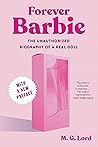
― Forever Barbie: The Unauthorized Biography of a Real Doll
― Forever Barbie: The Unauthorized Biography of a Real Doll
“Scion of a sex toy, Barbie, far more than any human, is equipped to withstand such toxic projections. Age cannot wither her nor custom stale her infinite plasticity. "I think if you look at the silhouette of the Playboy Bunny, it looks like a Barbie doll," retired Mattel designer Joe Cannizzaro told me.”
― Forever Barbie: The Unauthorized Biography of a Real Doll
― Forever Barbie: The Unauthorized Biography of a Real Doll
“Between 1970 and 1971, the feminist movement made significant strides. In 1970, the Equal Rights Amendment was forced out of the House Judiciary Committee, where it had been stuck since 1948; the following year, it passed in the House of Representatives. In response to a sit-in led by Susan Brownmiller, Ladies' Home Journal published a feminist supplement on issues of concern to women. Time featured Sexual Politics author Kate Millett on its cover, and Ms., a feminist monthly, debuted as an insert in New York magazine. Even twelve members of a group with which Barbie had much in common—Transworld Airlines stewardesses—rose up, filing a multimillion-dollar sex discrimination suit against the airline. Surprisingly, Barbie didn't ignore these events as she had the Vietnam War; she responded. Her 1970 "Living" incarnation had jointed ankles, permitting her feet to flatten out. If one views the doll as a stylized fertility icon, Barbie's arched feet are a source of strength; but if one views her as a literal representation of a modern woman—an equally valid interpretation— her arched feet are a hindrance. Historically, men have hobbled women to prevent them from running away. Women of Old China had their feet bound in childhood; Arab women wore sandals on stilts; Palestinian women were secured at the ankles with chains to which bells were attached; Japanese women were wound up in heavy kimonos; and Western women were hampered by long, restrictive skirts and precarious heels. Given this precedent, Barbie's flattened feet were revolutionary. Mattel did not, however, promote them that way. Her feet were just one more "poseable" element of her "poseable" body. It was almost poignant. Barbie was at last able to march with her sisters; but her sisters misunderstood her and pushed her away.”
― Forever Barbie: The Unauthorized Biography of a Real Doll
― Forever Barbie: The Unauthorized Biography of a Real Doll
“It is with an eye toward using objects to understand ourselves that I beg Barbie's knee-jerk defenders and knee-jerk revilers to cease temporarily their defending and reviling. Barbie is too complicated for either an encomium or an indictment. But we will not refrain from looking under rocks.”
― Forever Barbie: The Unauthorized Biography of a Real Doll
― Forever Barbie: The Unauthorized Biography of a Real Doll
“But if feminists had embraced Barbie when she stepped down from her high heels, her seventies persona might have been dramatically different. She was on the brink of a conversion. If they hadn't spurned, slapped, and mocked her, she might have canvassed for George McGovern or worked for the ERA. She might have spearheaded a consciousness-raising group with Francie and Christie, or Dawn and Bizzie Lizzie. But Barbie could not go where she was not wanted. "Living" Barbie lasted only a year. She went back on tiptoe and stayed there. Perhaps because of this bitter legacy, "feminist" seems to be an obscene word at Mattel. "If you asked me to give you fifty words that describe me, it wouldn't be on the list," said Rita Rao, executive vice president of marketing on the Barbie line.”
― Forever Barbie: The Unauthorized Biography of a Real Doll
― Forever Barbie: The Unauthorized Biography of a Real Doll
“The positioning from the very first commercial was that she was a person," said Schneider. "We never mentioned the fact that she was a doll.”
― Forever Barbie: The Unauthorized Biography of a Real Doll
― Forever Barbie: The Unauthorized Biography of a Real Doll
“Barbie is a space-age fertility archetype, Joe a space-age warrior. They are idealized opposites, templates of "femininity" and "masculinity" imposed on sexless effigies—which underscores the irrelevance of actual genitalia to perceptions of gender. What nature can only approximate, plastic makes perfect.”
― Forever Barbie: The Unauthorized Biography of a Real Doll
― Forever Barbie: The Unauthorized Biography of a Real Doll
“So whether the woman is breast- or bottle-feeding, food and mother tend to be one." Abby, a thirty-two-year-old Vassar graduate and recovering anorexic, feels very strongly that family dynamics rather than idealized images of women contributed to her eating disorder. "I grew up in Greenwich Village," she explained. "I was the child of a single mother who was a devout feminist. I wasn't allowed to watch TV until I was thirteen because my mother believed that its patriarchal stereotypes would have a bad influence on the way I identified myself as a woman. Instead, I was given Sisterhood Is Powerful and Ms. magazine. My mother hated Barbie and what she represented. I wasn't allowed to have a Barbie, much less a Skipper or a Midge. And the irony is that I was severely anorexic as a teenager. When I was fifteen, I stopped eating. I'm five foot nine and at my lowest weight, I was just under a hundred pounds. I lost my period for three years. Today, I have come to realize that my anorexia was a reaction to a very controlled and crazy family situation. I became obsessed with being thin because it wasn't something my mother valued. I think overreacting to Barbie—setting her up as the ultimate negative example—can be just as damaging as positing her as an ideal.”
― Forever Barbie: The Unauthorized Biography of a Real Doll
― Forever Barbie: The Unauthorized Biography of a Real Doll
“When Ella King Torrey, a friend of mine and consultant on this book, began researching Barbie at Yale University in 1979, her work was considered cutting-edge and controversial.”
― Forever Barbie: The Unauthorized Biography of a Real Doll
― Forever Barbie: The Unauthorized Biography of a Real Doll
“Consequently, what could be more American than being an unimpeachable citizen with a sordid, embarrassing forebear in Europe?”
― Forever Barbie: The Unauthorized Biography of a Real Doll
― Forever Barbie: The Unauthorized Biography of a Real Doll
“To study Barbie, one sometimes has to hold seemingly contradictory ideas in one's head at the same time—which, as F. Scott Fitzgerald has said, is "the test of a first-rate intelligence.”
― Forever Barbie: The Unauthorized Biography of a Real Doll
― Forever Barbie: The Unauthorized Biography of a Real Doll
“Gilles Brougere, a French sociologist, has conducted an exhaustive study of French women and children to determine how different age groups perceive the doll.”
― Forever Barbie: The Unauthorized Biography of a Real Doll
― Forever Barbie: The Unauthorized Biography of a Real Doll
“Celebrities who in the sixties had led Barbie-esque lives now forswore them. Jane Fonda no longer vamped through the galaxy as "Barbarella," she flew to Hanoi. Gloria Steinem no longer wrote "The Passionate Shopper" column for New York, she edited Ms. And although McCalVs had described Steinem as "a life-size counter-culture Barbie doll" in a 1971 profile, Barbie was the enemy. NOW's formal assault on Mattel began in August 1971, when its New York chapter issued a press release condemning ten companies for sexist advertising. Mattel's ad, which showed boys playing with educational toys and girls with dolls, seems tame when compared with those of the other transgressors. Crisco, for instance, sold its oil by depicting a woman quaking in fear because her husband hated her salad dressing. Chrysler showed a marriage-minded mom urging her daughter to conceal from the boys how much she knew about cars. And Amelia Earhart Luggage—if ever a product was misnamed—ran a print ad of a naked woman painted with stripes to match her suitcases.”
― Forever Barbie: The Unauthorized Biography of a Real Doll
― Forever Barbie: The Unauthorized Biography of a Real Doll
“Barbie has an advantage over all of them. She can never bloat. She has no children to betray her. Nor can she rot, wrinkle, overdose, or go out of style. Mattel has hundreds of people—designers, marketers, market researchers—whose full-time job it is continually to reinvent her. In 1993, fresh versions of the doll did a billion dollars' worth of business. Based on its unit sales, Mattel calculates that every second, somewhere in the world, two Barbies are sold.”
― Forever Barbie: The Unauthorized Biography of a Real Doll
― Forever Barbie: The Unauthorized Biography of a Real Doll
“In Taste: The Secret Meaning of Things, Stephen Bayley tells us that "nothing is as crass and vulgar as instant classification according to hairstyle, clothing and footwear, yet it is . . . a cruelly accurate analytical form." Because Barbie is a construct of class—as well as a construct of gender— this crass, vulgar, and accurate investigation cannot be avoided. "When it comes to the meaning of things, there are no more powerful transmitters than clothes, those quasi-functional devices which, like an inverted fig, put the heart of the matter in front of the skin," Bayley writes. Yet powerful though the transmissions may be, many Americans deliberately ignore them.”
― Forever Barbie: The Unauthorized Biography of a Real Doll
― Forever Barbie: The Unauthorized Biography of a Real Doll
“Nor was Hanson the only budding sex maven to fixate on the dolls. "I definitely lived out my fantasies with them," Madonna told an interviewer. "I rubbed her and Ken together a lot. And”
― Forever Barbie: The Unauthorized Biography of a Real Doll
― Forever Barbie: The Unauthorized Biography of a Real Doll
“The whole idea of woman as temptress, or woman as subordinate to man, is absent from the Barbie cosmology. Ken is a gnat, a fly, a slave, an accessory of Barbie. Barbie was made perfect: her body has not evolved dramatically with time. Ken, by contrast, was a blunder: first scrawny, now pumped-up, his ever-changing body is neither eternal nor talismanic.”
― Forever Barbie: The Unauthorized Biography of a Real Doll
― Forever Barbie: The Unauthorized Biography of a Real Doll
“This thinning down might be of greater alarm if it were without precedent, which it isn't. In the history of art, representations of the figure have often been distorted so that their drapery would fall in a pleasing fashion—and Barbie, like a clothing-store dummy, is a sculpture that exists to display garments.”
― Forever Barbie: The Unauthorized Biography of a Real Doll
― Forever Barbie: The Unauthorized Biography of a Real Doll
“My Barbie stuff was a mirror of her values. She never told me that marriage could be a trap, but she refused to buy my Barbie doll a wedding dress. She didn't say " I loathe housework," but she refused to buy Barbie pots and pans. What she often said, however, is "Education is power." And in case I was too thick to grasp this, she bought graduation robes for Barbie, Ken and Midge.”
― Selfish, Shallow, and Self-Absorbed: Sixteen Writers on The Decision Not To Have Kids
― Selfish, Shallow, and Self-Absorbed: Sixteen Writers on The Decision Not To Have Kids
“To be sure, Barbie is a toy, and in market research sessions, as Barbie's first advertising copywriter Cy Schneider has pointed out, children, presented with choices that can be characterized as "tasteful, gaudy, gaudier, or gaudiest," invariably choose "gaudiest." But Barbie is also a reflection of her times—or a reflection of how market researchers and professional prognosticators interpret them. And perhaps therein lies the paradox.”
― Forever Barbie: The Unauthorized Biography of a Real Doll
― Forever Barbie: The Unauthorized Biography of a Real Doll
“Lui did not get that idea out of the air; though whether it was true or not remains a subject of debate. "The supermom is fading fast—doomed by anger, guilt, and exhaustion," Newsweek reported in 1988. "A growing number of mothers" believe "that they can't have it all." Yet in her book Backlash, Susan Faludi points out that the survey on which Newsweek based the article revealed nothing of the sort. It found that 71 percent of mothers at home would prefer to work and 75 percent of the working mothers would go on working even if their financial needs could be otherwise met. Faludi also reports that Good Housekeeping's 1988 "New Traditionalist" ad campaign, which featured born-again housewives happily recovering from the horrors of the workplace, was based on neither hard facts nor even opinion polls. The two opinion studies by the Yankelovich organization, which had allegedly buttressed Good Housekeeping's position, had, in fact, showed no evidence that women were either leaving work or wanted to leave.”
― Forever Barbie: The Unauthorized Biography of a Real Doll
― Forever Barbie: The Unauthorized Biography of a Real Doll
“Not surprisingly, when Barbie achieved superstar status, her houses became more ostentatious. Yet even Barbie's three-story town house, with its Tara-like pillars and ersatz wrought-iron birdcage elevator, is an outsider's interpretation of upper-class life. Authentic valuables are to Barbie's possessions what a pungent slab of gorgonzola is to "cheese food"; her furniture and artwork would not look out of place in a Ramada Inn. For all her implicit disposable income, her tastes remain doggedly middle- to lower-middle-class. As pictured in the catalogue, the town house also reflects Dynasty thinking. Both Ken and Barbie are absurdly overdressed—he in a parodic "tuxedo," she in a flouncy confection that barely fits into the elevator.”
― Forever Barbie: The Unauthorized Biography of a Real Doll
― Forever Barbie: The Unauthorized Biography of a Real Doll
“TO FIRST-GENERATION BARBIE OWNERS, OF WHICH I WAS one, Barbie was a revelation. She didn't teach us to nurture, like our clinging, dependent Betsy Wetsys and Chatty Cathys. She taught us independence. Barbie was her own woman. She could invent herself with a costume change: sing a solo in the spotlight one minute, pilot a starship the next. She was Grace Slick and Sally Ride, Marie Osmond and Marie Curie. She was all that we could be and—if you calculate what at human scale would translate to a thirty-nine-inch bust—more than we could be. And certainly more than we were . . . at six and seven and eight when she appeared and sank her jungle-red”
― Forever Barbie: The Unauthorized Biography of a Real Doll
― Forever Barbie: The Unauthorized Biography of a Real Doll
“Traditionally, the needs of ethnically diverse consumers had been met by smaller companies—the equivalent, in movie terms, of independent filmmakers. In the seventies, Shindana introduced two Barbie-like fashion dolls: Malaika, taller and stouter than Barbie; and Career Girl Wanda, about three-quarters as tall as Barbie and as proportionately svelte. But in 1991, when Mattel brought out its "Shani" line—three Barbie-sized African-American dolls available with mahogany, tawny, or beige complexions— there could be no doubt that "politically correct" was profitable. "For six years, I had been preaching these demographics—showing pie charts of black kids under ten representing eighteen percent of the under-ten population and Hispanic kids representing sixteen percent—and nobody was interested," said Yla Eason, an African-American graduate of Harvard Business School who in 1985 founded Olmec Corporation, which makes dolls and action figures of color. "But when Mattel came out with those same demographics and said, 'Ethnically correct is the way,' it legitimatized our business." Some say that the toy industry's idea of "ethnically correct" doesn't go far enough, however. Ann duCille, chairman of the African-American Studies Program and an associate professor of English at Wesleyan University, is a severe critic. After studying representations of race in fashion dolls for over a year, she feels that the dolls reflect a sort of "easy pluralism." "I'm not sure I'd go so far as to say I'd rather see no black dolls than see something like Shani or Black Barbie," she told me, "but I would hope for something more—which is not about to happen." Nor is she wholly enamored of Imani and Melenik, Olmec's equivalent of Barbie and Ken. "Supposedly these are dolls for black kids to play with that look like them, when in fact they don't look like them. That's a problematic statement, of course, because there's no 'generic black kid.' But those dolls look too like Barbie for me. They have the same body type, the same long, straight hair—and I think it sends a problematic message to kids. It's about marketing, about business—so don't try to pass it off as being about the welfare of black children." Lisa Jones, an African-American writer who chronicled the introduction of Mattel's Shani dolls for the Village Voice, is less harsh. Too old to have played with Christie—Barbie's black friend, born in 1968—Jones recalls as a child having expressed annoyance with her white classmates by ripping the heads and arms off her two white Barbie dolls. Any fashion doll of color, she thinks, would have been better for her than those blondes. "Having been a little girl who grew up without the images," she told me, "I realize that however they fail to reach the Utopian mark, they're still useful.”
― Forever Barbie: The Unauthorized Biography of a Real Doll
― Forever Barbie: The Unauthorized Biography of a Real Doll
“Charlotte Johnson, Barbie's first dress designer, understood the historical interdependence between the figure and its drapery. She also understood scale: When you put human-scale fabric on an object that is one-sixth human size, a multilayered cloth waistband is going to protrude like a truck tire around a human tummy. The effect would be the same as draping a human model in fabric made of threads that were the thickness of the model's fingers.”
― Forever Barbie: The Unauthorized Biography of a Real Doll
― Forever Barbie: The Unauthorized Biography of a Real Doll
“began. A chief element in positioning the new Barbie was her promotion. In 1984, after a campaign that featured "Hey There, Barbie Girl" sung to the tune of "Georgy Girl," Mattel launched a startling series of ads that toyed with female empowerment. Its slogan was "We Girls Can Do Anything," and its launch commercial, driven by an irresistibly upbeat soundtrack, was a sort of feminist Chariots of Fire. Responding to the increased number of women with jobs, the ad opens at the end of a workday with a little girl rushing to meet her business-suited mother and carrying her mother's briefcase into the house. A female voice says, "You know it, and so does your little girl." Then a chorus sings, "We girls can do anything." The ad plays with the possibility of unconventional gender roles. A rough-looking Little Leaguer of uncertain gender swaggers onscreen. She yanks off her baseball cap, her long hair tumbles down, and—sigh of relief—she grabs a particularly frilly Barbie doll. (The message: Barbie is an amulet to prevent athletic girls from growing up into hulking, masculine women.) There are images of gymnasts executing complicated stunts and a toddler learning to tie her shoelaces. (The message: Even seemingly minor achievements are still achievements.) But the shot with the most radical message takes place in a laboratory where a frizzy-haired, myopic brunette peers into a microscope. Since the seventies, Barbie commercials had featured little girls of different races and hair colors, but they were always pretty. Of her days in acting school, Tracy Ullman remarked in TV Guide that she was the "ugly kid with the brown hair and the big nose who didn't get [cast in] the Barbie commercials." With "We Girls," however, Barbie extends her tiny hand to bookish ugly ducklings; no longer a snooty sorority rush chairman, she is "big-tent" Barbie.”
― Forever Barbie: The Unauthorized Biography of a Real Doll
― Forever Barbie: The Unauthorized Biography of a Real Doll
“Swicord is not a New Age nut; she's a writer. And even after mega-wrangles with Mattel's management—the musical was sketched out but never produced—she is still a fan of the doll. "Barbie," she said, "is bigger than all those executives. She has lasted through many regimes. She's lasted through neglect. She's survived the feminist backlash. In countries where they don't even sell makeup or have anything like our dating rituals, they play with Barbie. Barbie embodies not a cultural view of femininity but the essence of woman." Over the course of two interviews with Swicord, her young daughters played with their Barbies. I watched one wrap her tiny fist around the doll's legs and move it forward by hopping. It looked as if she were plunging the doll into the earth—or, in any event, into the bedroom floor. And while I handle words like "empowering" with tongs, it's a good description of her daughters' Barbie play. The girls do not live in a matriarchal household. Their father, Swicord's husband, Nicholas Kazan, who wrote the screenplay for Reversal of Fortune, is very much a presence in their lives. Still, the girls play in a female-run universe, where women are queens and men are drones. The ratio of Barbies to Kens is about eight to one. Barbie works, drives, owns the house, and occasionally exploits Ken for sex. But even that is infrequent: In one scenario, Ken was so inconsequential that the girls made him a valet parking attendant. His entire role was to bring the cars around for the Barbies.”
― Forever Barbie: The Unauthorized Biography of a Real Doll
― Forever Barbie: The Unauthorized Biography of a Real Doll
“Fans of conspiracy theories will be disappointed to learn that Barbie's proportions were not the result of some misogynistic plot. They were dictated by the mechanics of clothing construction. The doll is one-sixth the size of a person, but the fabrics she wears are scaled for people. Barbie's middle, her first designer explained, had to be disproportionately narrow to look proportional in clothes. The inner seam on the waistband of a skirt involves four layers of cloth—and four thicknesses of human-scale fabric on a one-sixth-human-scale doll would cause the doll's waist to appear dramatically larger than her hips.”
― Forever Barbie: The Unauthorized Biography of a Real Doll
― Forever Barbie: The Unauthorized Biography of a Real Doll
“Barbie's combination of voluptuous body and wholesome image was precisely what Hugh Hefner sought in models for Playboy, which he founded in 1953.”
― Forever Barbie: The Unauthorized Biography of a Real Doll
― Forever Barbie: The Unauthorized Biography of a Real Doll