Goodreads helps you follow your favorite authors. Be the first to learn about new releases!
Start by following Ira Byock.

Showing 1-30 of 42
“A student once asked anthropologist Margaret Mead, “What is the earliest sign of civilization?” The student expected her to say a clay pot, a grinding stone, or maybe a weapon.
Margaret Mead thought for a moment, then she said, “A healed femur.”
A femur is the longest bone in the body, linking hip to knee. In societies without the benefits of modern medicine, it takes about six weeks of rest for a fractured femur to heal. A healed femur shows that someone cared for the injured person, did their hunting and gathering, stayed with them, and offered physical protection and human companionship until the injury could mend.
Mead explained that where the law of the jungle—the survival of the fittest—rules, no healed femurs are found. The first sign of civilization is compassion, seen in a healed femur.”
―
Margaret Mead thought for a moment, then she said, “A healed femur.”
A femur is the longest bone in the body, linking hip to knee. In societies without the benefits of modern medicine, it takes about six weeks of rest for a fractured femur to heal. A healed femur shows that someone cared for the injured person, did their hunting and gathering, stayed with them, and offered physical protection and human companionship until the injury could mend.
Mead explained that where the law of the jungle—the survival of the fittest—rules, no healed femurs are found. The first sign of civilization is compassion, seen in a healed femur.”
―
“The healthiest response to death is to love, honor, and celebrate life.”
― The Best Care Possible: A Physician's Quest to Transform Care Through the End of Life
― The Best Care Possible: A Physician's Quest to Transform Care Through the End of Life
“Nearly everyone who is asked where they want to spend their final days says at home, surrounded by people they love and who love them. That's the consistent finding of surveys and, in my experience as a doctor, remains true when people become patients. Unfortunately, it's not the way things turn out. At present, just over one-fifth of Americans are at home when they die. Over 30 percent die in nursing homes, where, according to polls, virtually no one says they want to be. Hospitals remain the site of over 50 percent of deaths in most parts of the country, and nearly 40 percent of people who die in a hospital spend their last days in ICU, where they will likely be sedated or have their arms tied down so they will not pull out breathing tubes, intravenous lines, or catheters. Dying is hard, but it doesn't have to be this hard.”
―
―
“Often when a physician cannot imagine what else to do for someone who is feeling helpless and hopeless—for whom life has no value—I find that love is the answer.”
― The Best Care Possible: A Physician's Quest to Transform Care Through the End of Life
― The Best Care Possible: A Physician's Quest to Transform Care Through the End of Life
“Basic elements of human care underpin how we regard and respond to others—our ethics as people become sicker and more physically dependent: Shelter from the elements. A caring society metaphorically says to the frail or dying person, “We will keep you warm and dry.” Help with personal hygiene. The community reassures the person who is too frail to care for himself or herself, “We will keep you clean.” Assistance with elimination. Family or, on behalf of society, clinicians (typically nurses or nurse aides), say, “We will help you with your bowels and bladder function.” Provision of food and drink. We can say, “We will always offer you something to eat and drink—and help you to do it.” Keeping company. Society can say to people who are dying, especially those who are “unbefriended,” “We will be with you. You will not have to go through this time in your life entirely alone.” Alleviating suffering. Certainly today, society can say, “We will do whatever we can, with as much skill and expertise as available, to lessen your discomfort.” Yet it is only this final element that is dependent on clinical expertise.”
― The Best Care Possible: A Physician's Quest to Transform Care Through the End of Life
― The Best Care Possible: A Physician's Quest to Transform Care Through the End of Life
“We are at our best when we serve others. Be civilized.”
―
―
“In living with, rather than relentlessly fighting their cancer, they ultimately live longer.”
― The Best Care Possible: A Physician's Quest to Transform Care Through the End of Life
― The Best Care Possible: A Physician's Quest to Transform Care Through the End of Life
“Even at the very end of life, healing a relationship can transform the history of a family. A relationship that is complete need not end; in this context, complete means there is nothing left unsaid or undone. When a dying person and a loved one come to feel complete between themselves, time together tends to be as full of joy and loving affection as sadness.”
― Dying Well: Peace and Possibilities at the End of Life
― Dying Well: Peace and Possibilities at the End of Life
“Some people conflate forgiveness with absolution,”
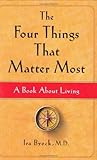
― The Four Things That Matter Most - 10th Anniversary Edition: A Book About Living
― The Four Things That Matter Most - 10th Anniversary Edition: A Book About Living
“some accuse hospice and palliative care clinicians of promoting a “culture of death” when we allow dying people to leave this life gently, without subjecting them to CPR or mechanical ventilation or dialysis or medical nutrition.”
― The Best Care Possible: A Physician's Quest to Transform Care Through the End of Life
― The Best Care Possible: A Physician's Quest to Transform Care Through the End of Life
“for what it is worth, when people have been fighting cancer for a long time, as you have, there often comes a point at which they may live longer if they decide to live with their cancer rather than continue to fight against their cancer.”
― The Best Care Possible: A Physician's Quest to Transform Care Through the End of Life
― The Best Care Possible: A Physician's Quest to Transform Care Through the End of Life
“Sometimes God Calms the Storm…Sometimes He Lets the Storm Rage and Calms His Child.”
― The Best Care Possible: A Physician's Quest to Transform Care Through the End of Life
― The Best Care Possible: A Physician's Quest to Transform Care Through the End of Life
“even a person who decides to forgo treatment does not necessarily choose death. Rather, he chooses life without the burden of disproportionate medical intervention.”
― The Best Care Possible: A Physician's Quest to Transform Care Through the End of Life
― The Best Care Possible: A Physician's Quest to Transform Care Through the End of Life
“Dying doesn’t cause suffering. Resistance to dying does.”
― The Best Care Possible: A Physician's Quest to Transform Care Through the End of Life
― The Best Care Possible: A Physician's Quest to Transform Care Through the End of Life
“Dying is the most universal and arguably most difficult of life events. Pretty much by definition, dying people are as sick as they have ever been.”
― The Best Care Possible: A Physician's Quest to Transform Care Through the End of Life
― The Best Care Possible: A Physician's Quest to Transform Care Through the End of Life
“Reiki looks like touch-less massage. The person performing Reiki holds his or her hands on or just above the surface of a person’s body and, with motions of hand and arms, moves energy to or from places that hurt and places that need healing. As far as I know, Reiki has no scientific basis and is not billed for or paid. But for many people, it works. They feel better after having it and often ask to have it performed again. This may very well be the purest form of the placebo effect: one person’s healing intention causing a therapeutic effect in another. All the more reason to recommend it. People love it and I have yet to hear of any dangerous side effects.”
― The Best Care Possible: A Physician's Quest to Transform Care Through the End of Life
― The Best Care Possible: A Physician's Quest to Transform Care Through the End of Life
“month after Jeanne died, Michelle received a bill for her mother’s twenty-three-hour hospitalization. It totaled $22,402. (Adjusted for inflation, the amount would exceed $27,000 in 2012.) The bill included $6,750 for twenty-two separate blood tests, $1,077 for three electrocardiograms, $4,187 for a CAT scan of her head, $776 for three X-rays of her abdomen, $296 for a chest X-ray, and $3,246 for three ultrasound tests.”
― The Best Care Possible: A Physician's Quest to Transform Care Through the End of Life
― The Best Care Possible: A Physician's Quest to Transform Care Through the End of Life
“He didn’t want anyone to perform CPR because he knew that even in the unlikely event that it restarted his heart, it would just mean that he would die in an ICU.”
― The Best Care Possible: A Physician's Quest to Transform Care Through the End of Life
― The Best Care Possible: A Physician's Quest to Transform Care Through the End of Life
“intentions. If our intentions are good and we are willing to ask for and offer forgiveness and express gratitude and loving feelings for another person, we usually feel better for having made the effort. Sometimes that needs to be enough. If the other person responds warmly, that’s great. But, in matters of this sort, there is intrinsic value in making a good-faith effort. He said that all of this made sense and he would give it some thought.”
― The Best Care Possible: A Physician's Quest to Transform Care Through the End of Life
― The Best Care Possible: A Physician's Quest to Transform Care Through the End of Life
“The Careless Society: Community and Its Counterfeits, sociologist John McKnight”
― The Best Care Possible: A Physician's Quest to Transform Care Through the End of Life
― The Best Care Possible: A Physician's Quest to Transform Care Through the End of Life
“More than 80 percent of participants at these community forums indicated it was very important or extremely important to have their dignity respected, preferences honored, pain controlled, and not to leave family with debt.”
― The Best Care Possible: A Physician's Quest to Transform Care Through the End of Life
― The Best Care Possible: A Physician's Quest to Transform Care Through the End of Life
“she had a life-threatening illness and was too ill to speak for herself, she did not want any invasive measures to prolong her life: no surgery, no CPR, no mechanical ventilation, no artificial nutrition and hydration.”
― The Best Care Possible: A Physician's Quest to Transform Care Through the End of Life
― The Best Care Possible: A Physician's Quest to Transform Care Through the End of Life
“To fully and authentically affirm life, we must affirm all of life, including dying, death, and grief.”
― The Best Care Possible: A Physician's Quest to Transform Care Through the End of Life
― The Best Care Possible: A Physician's Quest to Transform Care Through the End of Life
“there are ways of controlling the discomfort bowel obstructions cause without surgery, but doing so would take palliative care expertise of the sort that a hospice program provides.”
― The Best Care Possible: A Physician's Quest to Transform Care Through the End of Life
― The Best Care Possible: A Physician's Quest to Transform Care Through the End of Life
“hospice care would be assigned to them and while they would see that nurse most frequently, hospice care entailed a team—very much like our palliative care team, which they had come to know—with a physician, chaplain, social worker, and even volunteer visitors.”
― The Best Care Possible: A Physician's Quest to Transform Care Through the End of Life
― The Best Care Possible: A Physician's Quest to Transform Care Through the End of Life
“After his liver transplant in April 2009, visionary Apple CEO Steve Jobs lived two and a half years,”
― The Best Care Possible: A Physician's Quest to Transform Care Through the End of Life
― The Best Care Possible: A Physician's Quest to Transform Care Through the End of Life
“A good working relationship with the doctor and health care team of the person being cared for is probably the single most important thing that caregivers need.”
― The Best Care Possible: A Physician's Quest to Transform Care Through the End of Life
― The Best Care Possible: A Physician's Quest to Transform Care Through the End of Life
“social connections are often as important as medical treatment in preventing physical, mental, and functional decline.”
― The Best Care Possible: A Physician's Quest to Transform Care Through the End of Life
― The Best Care Possible: A Physician's Quest to Transform Care Through the End of Life
“Caring for a dying loved one is a powerful way to express love, devotion, and reverence. Allowing a spouse or grown child to care for one becomes a final gift from the person dying. The physical acts of caring can help family members in their own grief.”
― Dying Well
― Dying Well
“The large majority wanted to be at home at the end of life, only 1 percent said they would prefer being in a hospital, and not a single participant wanted to be in a nursing home at the end of life.”
― The Best Care Possible: A Physician's Quest to Transform Care Through the End of Life
― The Best Care Possible: A Physician's Quest to Transform Care Through the End of Life