Goodreads helps you follow your favorite authors. Be the first to learn about new releases!
Start by following Malcolm Rutherford.

Showing 1-11 of 11
“Veblen’s overall evolutionary framework was one that stressed the cumulative and path-dependent nature of institutional change, the role of new technology in bringing about institutional change (by changing the underlying, habitual ways of living and thinking), and the predominantly “pecuniary” character of the existing set of American institutions (that is, expressing the “business” values of pecuniary success and individual gain by money making, to the virtual exclusion of all other values). For Veblen, as for other institutionalists, institutions were more than merely constraints on individual action, but embodied generally accepted ways of thinking and behaving, and worked to mold the preferences and values of individuals brought up under their sway. Within this framework, Veblen developed his analyses of “conspicuous consumption” and consumption norms; the effect of corporate finance on the ownership and control of firms; the role of intangible property and the ability to capitalize intangibles; business and financial strategies for profit making, salesmanship and advertising; the emergence of a specialist managerial class; business fluctuations; and many other topics (Veblen 1899; 1904).”
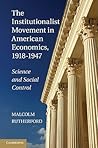
― The Institutionalist Movement in American Economics, 1918–1947: Science and Social Control
― The Institutionalist Movement in American Economics, 1918–1947: Science and Social Control
“Thus, in the hands of institutionalists such as Hamilton, Clark, Mitchell, and Commons, the problem became one of supplementing (rather than replacing) the market with other forms of “social control” or one of “how to make production for profit turn out a larger supply of useful goods under conditions more conducive to welfare” (Mitchell 1923a, p. 148). Although Veblen’s influence made institutionalists somewhat more critical of existing institutions than many of the previous generation of progressives, it does have to be understood that it was not Veblen alone who was the fountainhead for interwar institutionalism, but rather Veblen moderated by pragmatic and progressive views of science and social reform.”
― The Institutionalist Movement in American Economics, 1918–1947: Science and Social Control
― The Institutionalist Movement in American Economics, 1918–1947: Science and Social Control
“One of Clark’s earliest statements on the proper nature of economics argued that economics should be “based on a foundation of terms, conceptions, standards of measurement, and assumptions which is sufficiently realistic, comprehensive, and unbiased” to provide a basis for the analysis and discussion of practical issues (Clark 1919, p. 280). Relevance to practical issues, accuracy of data, and comprehensiveness, in the sense of not excluding any evidence relevant to the problem at hand, were the characteristics of a scientific approach to economics that Clark most frequently stressed (Clark 1924, p. 74).”
― The Institutionalist Movement in American Economics, 1918–1947: Science and Social Control
― The Institutionalist Movement in American Economics, 1918–1947: Science and Social Control
“Veblen’s theory of institutional evolution emphasized the role of new technology bringing about institutional change via a causal process of habituation to new “disciplines” of life. Here rational appraisal of consequences plays no significant role, the process being one whereby new ways of thinking are somehow induced by new patterns of life. In the early years of the twentieth century, both Mitchell and Hoxie attempted to apply Veblen’s theory, but each ran into difficulty. Mitchell’s work on the development of the “money economy” found many more factors at work in institutional evolution than Veblen suggested, and Hoxie came to reject Veblen’s hypothesis, expressed in Business Enterprise (Veblen 1904, pp. 306–360), that the discipline of machine industry would tend to turn the habits of thought of unionized workers in a socialistic direction (Rutherford 1998; see Chapter 5 in this book).”
― The Institutionalist Movement in American Economics, 1918–1947: Science and Social Control
― The Institutionalist Movement in American Economics, 1918–1947: Science and Social Control
“One of Clark’s earliest statements on the proper nature of economics argued that economics should be “based on a foundation of terms, conceptions, standards of measurement, and assumptions which is sufficiently realistic, comprehensive, and unbiased” to provide a basis for the analysis and discussion of practical issues (Clark 1919, p. 280). Relevance to practical issues, accuracy of data, and comprehensiveness, in the sense of not excluding any evidence relevant to the problem at hand, were the characteristics of a scientific approach to economics that Clark most frequently stressed (Clark 1924, p. 74). Clark certainly thought of theory as playing a key role, but he saw the aim of theorizing as that of forming hypotheses “grounded in experience” for further study and inductive verification, rather than the production of a highly abstract system of laws.”
― The Institutionalist Movement in American Economics, 1918–1947: Science and Social Control
― The Institutionalist Movement in American Economics, 1918–1947: Science and Social Control
“Public utilities, including issues relating to the valuation of utility property and the proper basis for rate regulation, were major areas of institutionalist research. Concepts of intangible property and of goodwill were developed within this discussion, again deriving from Veblen. Clark devoted several chapters in The Social Control of Business (1926) to the topic, whereas Commons devoted considerable space to the concept of intangible property, goodwill, and valuation issues in his Legal Foundations (Commons 1924a, pp. 157–215).”
― The Institutionalist Movement in American Economics, 1918–1947: Science and Social Control
― The Institutionalist Movement in American Economics, 1918–1947: Science and Social Control
“Knight has been called a “maverick institutionalist” (Hodgson 2004). Knight had a deep interest in issues of institutional history, but he defended a central analytical role for competitive price theory and rejected the scientism, behaviorism, and reformism that were central parts of the institutionalist program. Although Knight did have close contacts with a number of institutionalists, his role was more that of the perennial critic of the movement.”
― The Institutionalist Movement in American Economics, 1918–1947: Science and Social Control
― The Institutionalist Movement in American Economics, 1918–1947: Science and Social Control
“The central components of the “institutional approach” outlined here – the adoption of a central focus on institutions, process, social control, new psychological foundations, and empirical and instrumental “scientific” investigation – serve as a reference point to identify the movement and its adherents.”
― The Institutionalist Movement in American Economics, 1918–1947: Science and Social Control
― The Institutionalist Movement in American Economics, 1918–1947: Science and Social Control
“it is useful to make a few observations concerning the nature of institutionalism in its early years. Two related characteristics stand out. The first of these is a shared notion of science as involving some form of empirical “realism,” and the second is a view of economic and social arrangements or institutions as in need of significant reform. In Dorothy Ross’s words, “what fuelled the institutionalist ambition was an overflow of realism and new liberal idealism that could not be contained by neoclassical practice” (Ross 1991, p. 411; Rutherford 1997”
― The Institutionalist Movement in American Economics, 1918–1947: Science and Social Control
― The Institutionalist Movement in American Economics, 1918–1947: Science and Social Control
“McMahon made use of Veblen’s conception of emulation in consumption, whereas Kyrk adopted Mitchell’s view that notions of rationality derived from business calculation of profit cannot be applied to households controlled by other standards (1923, p. 144).”
― The Institutionalist Movement in American Economics, 1918–1947: Science and Social Control
― The Institutionalist Movement in American Economics, 1918–1947: Science and Social Control
“There are distinctions to be made between those institutionalists who favored commissions and other similar devices, and those in favor of more comprehensive types of planning (Barber 1994). The greatest emphasis on planning came largely in the context of the Great Depression and from Tugwell, Means, and Ezekiel. Clark argued for countercyclical public works programs, and Mitchell for more modest indicative planning. Such disagreements over specific policy instruments, however, could be accommodated within the general ideal of a pragmatic and experimental approach to social control.”
― The Institutionalist Movement in American Economics, 1918–1947: Science and Social Control
― The Institutionalist Movement in American Economics, 1918–1947: Science and Social Control