Goodreads helps you follow your favorite authors. Be the first to learn about new releases!
Start by following Lee Barron.

Showing 1-5 of 5
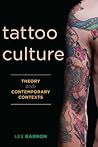
“although the majority of customers had no inkling of the nature of existentialism, nevertheless, their tattoo experience constituted an existential act, a deed carried out in a solitary fashion and which once done was ostensibly irrevocable. Accordingly, Steward reflected of a client’s at the end of a session, ‘I had many times seen them tense at the end of a tattoo, flex the muscles, look at the completed design, and mutter something like: “By God, it’s there for always”’ (1990, p. 59).”
― Tattoo Culture: Theory and Contemporary Contexts
― Tattoo Culture: Theory and Contemporary Contexts
“explore Becker’s concept of the art world but in relation to Henry Jenkin’s use of the idea in relation to fandom and fan conventions. In Jenkins’ view, an art world involves networks of artistic production, distribution, consumption, circulation and the exhibition and forums for the sale of artworks. In this regard, argues Jenkins, fan conventions are not simply events in which fans can interact with fellow fans, but they also perform a key role in the distribution of knowledge about media productions and are one of the modes by which producers promote cultural products such as comic books, science fiction novels, new film and TV releases, or online/game releases (typified by events such as Comic Con). More importantly, Jenkins argues, conventions provide spaces in which producers have the opportunity to communicate directly with the consumers of their cultural products”
― Tattoo Culture: Theory and Contemporary Contexts
― Tattoo Culture: Theory and Contemporary Contexts
“The social and cultural history of tattooing has witnessed the tattoo evolve through symbolic expression of community and personal status, an expression of self-mutilation, an exterior signifier of a deviant or criminal personality, as an individualised symbol, as a major contemporary art form and a sign of gendered self-determination (Mascia-Lees and Sharpe, 1992; Favazza, 1996; Atkinson, 2003a; Adams, 2009; Thompson, 2015). As such, the story of tattoo culture is one that is a chronicle of a human bodily art form characterised by processes of ceaseless flux and transformation, from tattooing techniques to societal attitudes to individuals who wear tattoo designs.”
― Tattoo Culture: Theory and Contemporary Contexts
― Tattoo Culture: Theory and Contemporary Contexts
“As Miliann Kang and Katherine Jones argue in their article, ‘Why do people get tattoos?’, rather than simply being acquired as acts of defiance and sublimated aggression, many tattooed people regard their tattoos as expressions of distinctly unique aspects of themselves, and that tattoos have manifold inspirations that transcend mere provocation or membership of subcultural rebellious groups. As such, [t]he tattoo speaks to the ongoing, complex need for humans to express themselves through the appearance of their bodies. The tattooed body serves as a canvas to record the struggles between conformity and resistance, power and victimization, individualism and membership. (2007, p. 47) Alternatively, tattoos may have no immediate signification beyond the desire for the skin to be marked by the tattooist’s needle, as Christine Braunberger observes, ‘One does not become immanently “knowable” by virtue of being tattooed. Tattoos can be as inexplicable to the selves who wear them as they are to their viewers. Skin cannot so easily speak for the self that inhabits it’ (2000, p. 3).”
― Tattoo Culture: Theory and Contemporary Contexts
― Tattoo Culture: Theory and Contemporary Contexts
“Much classic work on tattooing draws upon postmodernist theory to explain the ways in which social actors ‘take control’ of constant change and social flux through inscribing permanent designs on their skin that ‘freeze’ their identities.”
― Tattoo Culture: Theory and Contemporary Contexts
― Tattoo Culture: Theory and Contemporary Contexts