Goodreads helps you follow your favorite authors. Be the first to learn about new releases!
Start by following J. Richard Middleton.

Showing 1-10 of 10
“Peter makes clear in an early sermon in Acts. You are the descendants of the prophets and of the covenant that God gave to your ancestors, saying to Abraham, “And in your descendants all the families of the earth shall be blessed.” When God raised up his servant, he sent him first to you, to bless you by turning each of you from your wicked ways. (Acts 3:25–26) So before Jesus is the savior of the world, he is the savior of Israel, restoring them to their status and role as God’s elect people.”
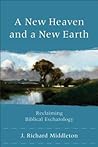
― A New Heaven and a New Earth: Reclaiming Biblical Eschatology
― A New Heaven and a New Earth: Reclaiming Biblical Eschatology
“I believe that the time is ripe for contemporary Christians to engage in serious reflection on the shape of our eschatology. This eschatology must be grounded firmly in the entire biblical story, beginning with God’s original intent for earthly flourishing and culminating in God’s redemptive purpose of restoring earthly life to what it was meant to be—a purpose accomplished through Christ. We especially need to grapple with the robust ethical implications of this biblical eschatology, exploring how a holistic vision of the future can motivate and ground compassionate yet bold redemptive living in God’s world.”
― A New Heaven and a New Earth: Reclaiming Biblical Eschatology
― A New Heaven and a New Earth: Reclaiming Biblical Eschatology
“The important point here is that the idea of “heaven” as the eternal hope of the righteous has no structural place in the story. It is simply irrelevant and extraneous to the plot. Heaven was never part of God’s purposes for humanity in the beginning of the story and has no intrinsic role as the final destiny of human salvation.”
― A New Heaven and a New Earth: Reclaiming Biblical Eschatology
― A New Heaven and a New Earth: Reclaiming Biblical Eschatology
“The Old Testament does not spiritualize salvation, but rather understands it as God’s deliverance of people and land from all that destroys life and the consequent restoration of people and land to flourishing.”
― A New Heaven and a New Earth: Reclaiming Biblical Eschatology
― A New Heaven and a New Earth: Reclaiming Biblical Eschatology
“It is all too common in many churches around the world for believers to have absorbed the view that they must accept all calamities as the will of God, and many think that they must suffer in silence or even affirm God’s role in the calamities. But this stance of absolute submission to the divine, exemplified by Abraham in Genesis 22, is not typical of biblical faith.”
― Abraham's Silence: The Binding of Isaac, the Suffering of Job, and How to Talk Back to God
― Abraham's Silence: The Binding of Isaac, the Suffering of Job, and How to Talk Back to God
“Ethics is lived eschatology. It is, as New Testament scholar George Eldon Ladd put it, “the presence of the future.”4”
― A New Heaven and a New Earth: Reclaiming Biblical Eschatology
― A New Heaven and a New Earth: Reclaiming Biblical Eschatology
“You are worthy to take the scroll and to open its seals, for you were slaughtered and by your blood you ransomed for God saints from every tribe and language and people and nation; you have made them to be a kingdom and priests serving our God, and they will reign on earth. (Rev. 5:9–10)”
― A New Heaven and a New Earth: Reclaiming Biblical Eschatology
― A New Heaven and a New Earth: Reclaiming Biblical Eschatology
“The inner logic of this vision of holistic salvation is that the creator has not given up on creation and is working to salvage and restore the world (human and nonhuman) to the fullness of shalom and flourishing intended from the beginning. And redeemed human beings, renewed in God’s image, are to work toward and embody this vision in their daily lives.”
― A New Heaven and a New Earth: Reclaiming Biblical Eschatology
― A New Heaven and a New Earth: Reclaiming Biblical Eschatology
“Thus we have Jesus’s comment to a Canaanite woman that his mission is to the “lost sheep of the house of Israel” (Matt. 15:24).”
― A New Heaven and a New Earth: Reclaiming Biblical Eschatology
― A New Heaven and a New Earth: Reclaiming Biblical Eschatology
“But he makes a similar comment in one other important place, toward the beginning of his public ministry (Matt. 10:6). After seeing the readiness of the fields for harvest and the scarcity of workers (Matt. 9:37), he commissions the twelve disciples (symbolizing the core of a restored Jewish remnant of the twelve tribes) to aid him in his mission to Israel (Matt. 10:1–16). In this first mention of disciples as apostles (Matt. 10:2)—that is, as “sent ones”—Jesus explicitly enjoins them, Go nowhere among the Gentiles, and enter no town of the Samaritans, but go rather to the lost sheep of the house of Israel. As you go, proclaim the good news, “The kingdom of heaven has come near.” Cure the sick, raise the dead, cleanse the lepers, cast out demons. (Matt. 10:5–8a)”
― A New Heaven and a New Earth: Reclaiming Biblical Eschatology
― A New Heaven and a New Earth: Reclaiming Biblical Eschatology