Goodreads helps you follow your favorite authors. Be the first to learn about new releases!
Start by following Daniel M. Cable.

Showing 1-30 of 97
“This is the new war for talent—not wooing employees away from competitors, but unleashing the enthusiasm that is already there within employees, but dormant.”
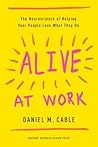
― Alive at Work: The Neuroscience of Helping Your People Love What They Do
― Alive at Work: The Neuroscience of Helping Your People Love What They Do
“The dream of scientific management was that employees’ quirks and self-expression wouldn’t get in the way of standardized processes. And so even today, in big organizations, most people work very specialized jobs.”
― Alive at Work: The Neuroscience of Helping Your People Love What They Do
― Alive at Work: The Neuroscience of Helping Your People Love What They Do
“To accomplish this goal, they built an Action Lab, designed as an intensive five-day experience to help people develop their ideas into compelling venture plans for launching new businesses.”
― Alive at Work: The Neuroscience of Helping Your People Love What They Do
― Alive at Work: The Neuroscience of Helping Your People Love What They Do
“As Janine Dutcher, a psychology professor at University of California, Los Angeles, has found via fMRI studies, when people are prompted to think about their best traits, their seeking systems are activated.”
― Alive at Work: The Neuroscience of Helping Your People Love What They Do
― Alive at Work: The Neuroscience of Helping Your People Love What They Do
“we experience a jolt of dopamine, which feels pleasurable and can be thrilling. And since dopamine regulates our perception of time, we experience time differently, so that we might report that it seems to stand still even as it rushes by. 7 When the seeking system is activated, we experience “persistent feelings of interest, curiosity, sensation seeking, and in the presence of a sufficiently complex cortex, the search for higher meaning.”
― Alive at Work: The Neuroscience of Helping Your People Love What They Do
― Alive at Work: The Neuroscience of Helping Your People Love What They Do
“Research shows that when people identify and use their unique strengths, they report feeling “more alive” or “intensely alive.”
― Alive at Work: The Neuroscience of Helping Your People Love What They Do
― Alive at Work: The Neuroscience of Helping Your People Love What They Do
“Leaders need continuity and control. By this, I mean that they need to be sure that regulations are met and promises made to customers are kept. This is not evil, this is practical. You could even say that’s why managers have their jobs, ever since the Industrial Revolution. Since future changes and challenges are unclear, it often seems safer to have employees behave in pre-specified ways.”
― Alive at Work: The Neuroscience of Helping Your People Love What They Do
― Alive at Work: The Neuroscience of Helping Your People Love What They Do
“When you increase enthusiasm and excitement, you improve problem solving and creativity. This is how most people want to feel in their jobs—not only because these feelings lead to better work outcomes, but because we spend most of our waking hours at work, and positive emotions put more living into life.”
― Alive at Work: The Neuroscience of Helping Your People Love What They Do
― Alive at Work: The Neuroscience of Helping Your People Love What They Do
“When work is not framed as an opportunity to “get it right” on the first try, workers may be more able to learn in the process and ultimately to get it right than when work is framed as an opportunity to perform, to shine, or to execute perfectly.”
― Alive at Work: The Neuroscience of Helping Your People Love What They Do
― Alive at Work: The Neuroscience of Helping Your People Love What They Do
“novel ideas can lead to ridicule, failure, and social rejection.22 It’s hard to be the first one to tell people that the earth is not the center of the universe. Or to tell senior leaders at Kodak that digital will eclipse film.”
― Alive at Work: The Neuroscience of Helping Your People Love What They Do
― Alive at Work: The Neuroscience of Helping Your People Love What They Do
“As Jungkiu said, “I have found that people do not move much by KPIs and reward/penalty. These cause small changes. People move in larger ways by noble purpose, emotional connection, experimenting with new things, and leading by example.”
― Alive at Work: The Neuroscience of Helping Your People Love What They Do
― Alive at Work: The Neuroscience of Helping Your People Love What They Do
“Jungkiu’s approach to branch visits is another example of a wise intervention, which we learned about in chapter 3: small but potent changes, like removing the anxiety around the branch visits and replacing it with serving breakfast and talking about new ideas, led to very large-scale changes, including a culture of ownership and innovation.”
― Alive at Work: The Neuroscience of Helping Your People Love What They Do
― Alive at Work: The Neuroscience of Helping Your People Love What They Do
“Even though we may say we want employee creativity and innovation, we place even greater value on exploiting existing ideas and processes that are tried and true. This makes organizations “highly predictable and increasingly rigid.”
― Alive at Work: The Neuroscience of Helping Your People Love What They Do
― Alive at Work: The Neuroscience of Helping Your People Love What They Do
“during the Industrial Revolution, leadership got entangled with hierarchy—leaders were assigned power that was not earned. Humble leadership is more natural, because humble leaders help other people seek their potential, and experiment toward that potential. This is a gift that makes other people want to give back, and want to follow.6”
― Alive at Work: The Neuroscience of Helping Your People Love What They Do
― Alive at Work: The Neuroscience of Helping Your People Love What They Do
“This is the way we’re meant to live. It’s our biological imperative. Through evolution, we’ve retained our emotional impulses to explore, experiment, and learn.21 Part of our brain urges us to learn new things and find new ways to use our unique skills, instead of performing monotonous generic tasks. And when we follow these urges of the seeking system, we get a dopamine release that not only feels good, it motivates us to explore more.”
― Alive at Work: The Neuroscience of Helping Your People Love What They Do
― Alive at Work: The Neuroscience of Helping Your People Love What They Do
“Our seeking systems urge us to be curious and learn, but because of tight performance measurement and penalties, we can’t exactly play around and try something new. When we get to this point of machine-like repetition with no new learning on the horizon, going to work can feel very aversive—as though it is not real life but just something to get through.”
― Alive at Work: The Neuroscience of Helping Your People Love What They Do
― Alive at Work: The Neuroscience of Helping Your People Love What They Do
“I suggest that Jungkiu’s new approach worked because it tamped down employees’ fear and encouraged ideation and self-expression, which activated their seeking systems.”
― Alive at Work: The Neuroscience of Helping Your People Love What They Do
― Alive at Work: The Neuroscience of Helping Your People Love What They Do
“But say there was a battle between our seeking systems and our fear systems. Which one would win? For evolutionary reasons, fear will win.”
― Alive at Work: The Neuroscience of Helping Your People Love What They Do
― Alive at Work: The Neuroscience of Helping Your People Love What They Do
“This is how KLM balanced the freedom in the frame. Employees were not ordered to use social media, and the approach was not scripted by senior management. A small group of willing employees was given a small budget to experiment with social media, mostly to learn how its audience responds. KLM monitored how recipients reacted to their surprises—whether they tweeted about it or mentioned it on Facebook.33 In this case, the forty gifts created a social media storm: the KLM Twitter feed was viewed more than one million times in three weeks. Not bad for an experiment based on something that the employees found intrinsically interesting and were excited to try. But leaders needed to have the strategy of encouraging freedom within the frame, and also needed to be ready to learn when the experiments did not go exactly as planned.”
― Alive at Work: The Neuroscience of Helping Your People Love What They Do
― Alive at Work: The Neuroscience of Helping Your People Love What They Do
“The fundamental question I discussed with my executive team was whether the job of a business leader is the “emperor”—someone who rules above you—or the “facilitator”—a vision shaper and bottleneck remover. If we define ourselves as the former, the leader should keep the distance and retain mystique. If we define ourselves as the latter, the leader should be humble, close, and open.”
― Alive at Work: The Neuroscience of Helping Your People Love What They Do
― Alive at Work: The Neuroscience of Helping Your People Love What They Do
“a best self is “the cognitive representation of the qualities and characteristics the individual displays when at his or her best.”5 Our concepts of our best selves are not projections of what we think we could become someday. Rather, they’re based on our real-life experiences and actions. They comprise the skills and traits that we’ve developed and discovered over time, and the actions we have taken to affect others in a positive way. The more our colleagues know who we are when we’re at our best, the more likely we can feel like ourselves at work. We suspected that this is the reason why the people who experienced our wise intervention stayed so much longer and made clients happier: because they could express themselves more authentically.”
― Alive at Work: The Neuroscience of Helping Your People Love What They Do
― Alive at Work: The Neuroscience of Helping Your People Love What They Do
“the seeking system prompts an intrinsic urge to explore, rather than giving an extrinsic reward for an action.16 When the seeking system is stimulated, an animal feels the urge to explore and investigate, to find whatever is potentially useful in the environment.”
― Alive at Work: The Neuroscience of Helping Your People Love What They Do
― Alive at Work: The Neuroscience of Helping Your People Love What They Do
“As Gary Hamel once told me: “Show me what you can get done when you have no budget and no authority. That’s how you know you’re a leader.”
― Alive at Work: The Neuroscience of Helping Your People Love What They Do
― Alive at Work: The Neuroscience of Helping Your People Love What They Do
“It’s not enough to hire creative and highly motivated people; that’s the old war for talent. As a leader, you also have to activate people’s seeking systems to ignite their intrinsic motivation and creativity.”
― Alive at Work: The Neuroscience of Helping Your People Love What They Do
― Alive at Work: The Neuroscience of Helping Your People Love What They Do
“one of the cultural expectations of his job was to visit the branches as a “superior commander.” When the previous consumer banking heads made branch visits, they emphasized the organization’s hierarchy and their power. This put a lot of pressure on the branches, as staff would spend weeks anxiously preparing for the visit.”
― Alive at Work: The Neuroscience of Helping Your People Love What They Do
― Alive at Work: The Neuroscience of Helping Your People Love What They Do
“It warms the heart to see the seeking system at work this way. Self-reflective titles aren’t just fun names. Because they encourage self-reflection and self-expression, personalized titles trigger positive emotions and a greater sense of purpose. Most of all, they encourage us to “cognitively reappraise” our work.4 In other words, they nudge us to focus on the more meaningful and intrinsically rewarding elements of our jobs, which we’re prone to lose sight of.”
― Alive at Work: The Neuroscience of Helping Your People Love What They Do
― Alive at Work: The Neuroscience of Helping Your People Love What They Do
“In a series of studies, Julia Lee, a professor at the University of Michigan, found that those who undergo relational best-self activation experience stronger immune responses, enhanced creative problem solving (over 200 percent improvement), and significantly less anxiety and negative physiological arousal.”
― Alive at Work: The Neuroscience of Helping Your People Love What They Do
― Alive at Work: The Neuroscience of Helping Your People Love What They Do
“If you don’t remember how traumatic falling in love is, you probably haven’t done it for a while.”
― Exceptional: Build Your Personal Highlight Reel and Unlock Your Potential
― Exceptional: Build Your Personal Highlight Reel and Unlock Your Potential
“As with the singing, positive emotions improve problem solving because people are better able to marshal their cognitive resources to cope with the task at hand, instead of being encumbered by fear and threat.13 When people try to become calm under physiological arousal, on the other hand, they are telling themselves that the arousal is “bad”—that it is unwelcome. They code the same arousal as threat and anxiety, which activates fear, shuts down creativity, and hinders problem solving.”
― Alive at Work: The Neuroscience of Helping Your People Love What They Do
― Alive at Work: The Neuroscience of Helping Your People Love What They Do
“Encouraging that many people to spend 20 percent of their time in discovery led to “too many arrows with not enough wood behind them,” as Google CEO Larry Page explained.”
― Alive at Work: The Neuroscience of Helping Your People Love What They Do
― Alive at Work: The Neuroscience of Helping Your People Love What They Do