Goodreads helps you follow your favorite authors. Be the first to learn about new releases!
Start by following Gemma Hartley.

Showing 1-30 of 60
“I had been conditioned my whole life to think one step ahead, to anticipate the needs of those around me and care about them deeply. Emotional labor was a skill set I had been trained in since childhood. My husband, on the other hand, hadn’t received that same education. He is a caring person, but he is not a skilled carer.”
― Fed Up: Emotional Labor, Women, and the Way Forward
― Fed Up: Emotional Labor, Women, and the Way Forward
“He restated that all I ever needed to do was ask him for help, but therein lies the problem. I don’t want to micromanage housework. I want a partner with equal initiative.”
― Fed Up: Emotional Labor, Women, and the Way Forward
― Fed Up: Emotional Labor, Women, and the Way Forward
“While women have spent the past few decades being encouraged to reach for the masculine ideal of success, being told they can become anything their hearts desire in the professional realm, they have not been relieved of any of the emotional labor that waits for them when they return home.”
― Fed Up: Emotional Labor, Women, and the Way Forward
― Fed Up: Emotional Labor, Women, and the Way Forward
“Women are fed up because we’ve realized we can’t clock out. Emotional labor is expected from us no matter where we turn. We are fed up with the ongoing demand to be the primary providers of emotional labor in all arenas of life because it is taxing, it is time consuming, and it is holding us back.”
― Fed Up: Emotional Labor, Women, and the Way Forward
― Fed Up: Emotional Labor, Women, and the Way Forward
“Even when my days appeared uneventful, I was in my head all the time but rarely thinking about myself in that bigger, deeper way that used to make my life feel meaningful. What consumed most of my mental effort had minimal emotional rewards. It simply left me feeling drained. I finally understood why so many women said they lost themselves after becoming mothers. I no longer had the mental and emotional capacity to tend to my interior life, my creative life, my meaning-driven life. At the end of the day, I had nothing left in my mind to give.”
― Fed Up: Emotional Labor, Women, and the Way Forward
― Fed Up: Emotional Labor, Women, and the Way Forward
“Men often have a slower timeline or lower standard when it comes to domestic work, so women take it on themselves, choosing to delegate work only when it’s most desperately needed. This may be in part because women tend to associate a clean home with their personal success, whereas men’s success is tied strictly to their work outside the home.”
― Fed Up: Emotional Labor, Women, and the Way Forward
― Fed Up: Emotional Labor, Women, and the Way Forward
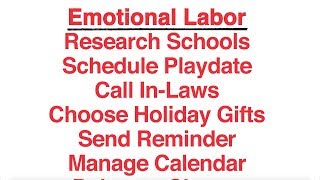
“Emotional labor, as I define it, is emotion management and life management combined. It is the unpaid, invisible work we do to keep those around us comfortable and happy.”
― Fed Up: Emotional Labor, Women, and the Way Forward
― Fed Up: Emotional Labor, Women, and the Way Forward
“This was the perfect moment for women to own that emotional labor isn't just a wellspring of frustrating domestic gripes, but rather a primary source of systematic issues that touch every arena of our lives, in damaging ways that make clear the pervasive sexism in our culture. The deep social expectation that women will shoulder the exhausting mental and emotional work at home--a type of labor that goes largely unnoticed by those it benefits the most--has made it all too easy for such insidious expectations to follow us into the world, as we step gingerly through a culture that has left us little choice in the matter. We alter our speech, our appearance, our mannerisms, our own internal expectations to constantly keep the peace. We have been feeling the toll this work takes, in ways that are too often invisible.”
― Fed Up: Emotional Labor, Women, and the Way Forward
― Fed Up: Emotional Labor, Women, and the Way Forward
“In general, we gender emotions in our society by continuing to reinforce the false idea that women are always, naturally and biologically able to feel, express, and manage our emotions better than men,”
― Fed Up: Emotional Labor, Women, and the Way Forward
― Fed Up: Emotional Labor, Women, and the Way Forward
“emotional labor isn’t just a wellspring of frustrating domestic gripes, but rather a primary source of systemic issues that touch every arena of our lives, in damaging ways that make clear the pervasive sexism in our culture. The deep social expectation that women will shoulder the exhausting mental and emotional work at home—a type of labor that goes largely unnoticed by those it benefits most—has made it all too easy for such insidious expectations to follow us into the world, as we step gingerly through a culture that has left us little choice in the matter.”
― Fed Up: Emotional Labor, Women, and the Way Forward
― Fed Up: Emotional Labor, Women, and the Way Forward
“Hochschild used the term emotional labor to designate the management of feeling to create a publicly observable facial and bodily display that has exchange value and is sold as a commodity, while she used the terms emotion work and emotion management to refer to emotional labor done in a private setting.7 Her study focused on the deep acting and surface acting required of flight attendants to not simply appear warm and friendly on the job but become warm and friendly in order to better manage the emotions and expectations of customers in flight.”
― Fed Up: Emotional Labor, Women, and the Way Forward
― Fed Up: Emotional Labor, Women, and the Way Forward
“The men who pay for sex feel entitled to women’s time and emotional labor, to such an extent that it doesn’t occur to them that they’ve paid for what amounts to a therapy session with a side of blow job. Much of the work, as Petro describes it, is sympathetically listening to men bitch about their ex-girlfriends. “I love to dance, and that part was enjoyable. The physical work of prostitution wasn’t particularly different than nonpaid sexual encounters. It was the emotional labor that was really taxing.”
― Fed Up: Emotional Labor, Women, and the Way Forward
― Fed Up: Emotional Labor, Women, and the Way Forward
“We are told frequently that women are more intuitive, more empathetic, more innately willing and able to offer succor and advice,” Zimmerman writes. “How convenient that this cultural construct gives men an excuse to be emotionally lazy. How convenient that it casts feelings-based work as ‘an internal need, an aspiration, supposedly coming from the depths of our female character.’”9”
― Fed Up: Emotional Labor, Women, and the Way Forward
― Fed Up: Emotional Labor, Women, and the Way Forward
“She finds herself worrying about being "too much work," a problem she says stems from internalized ableism. She knows she lives in a world that isn't set up to accommodate her or even be accessible to her, and she relies on her advanced emotional labor skills to do so.”
― Fed Up: Emotional Labor, Women, and the Way Forward
― Fed Up: Emotional Labor, Women, and the Way Forward
“Tiffany Dufu writes in Drop the Ball, “Until the contributions that women make at work are seen as just as valuable as the contributions women make at home, the contributions that men make at home will never be considered as valuable as the contributions men make at work. Just as women need affirmation on both fronts, so do men.”
― Fed Up: Emotional Labor, Women, and the Way Forward
― Fed Up: Emotional Labor, Women, and the Way Forward
“Perhaps because same-sex or gender-nonconforming partners have already confronted so many gender norms by virtue of their existence, rethinking their roles at home is simply not that big a deal. They don’t subscribe to the gender roles dictating that one person should take on all the emotional labor, so they can challenge the imbalance without challenging their very identity.”
― Fed Up: Emotional Labor, Women, and the Way Forward
― Fed Up: Emotional Labor, Women, and the Way Forward
“She ends her observation with the statement “I can do it all, but all of it is not mine to do.”
― Fed Up: Emotional Labor, Women, and the Way Forward
― Fed Up: Emotional Labor, Women, and the Way Forward
“symptom of larger cultural inequality. “An equalitarian couple in a society that as a whole subordinates women cannot, at the basic level of emotional exchanges, be equal. For example, a woman lawyer who earns as much money and respect as her husband, and whose husband accepts these facts about her, may still find that she owes him gratitude for his liberal views and his equal participation in housework. Her claims are seen as unusually high, his as unusually low. The larger market in alternate partners offers him free household labor, which it does not offer her. In light of the larger social context, she is lucky to have him. And it is usually more her burden to manage indignation at having to feel grateful.”3 We’re lucky to get help at all. Men are entitled to it.”
― Fed Up: Emotional Labor, Women, and the Way Forward
― Fed Up: Emotional Labor, Women, and the Way Forward
“Women are still spending double the time men do on both domestic labor and caring for children.”
― Fed Up: Emotional Labor, Women, and the Way Forward
― Fed Up: Emotional Labor, Women, and the Way Forward
“We are the ones who decide whether to do a task ourselves or to delegate it to someone else, and doing the physical labor is often the easier road.”
― Fed Up: Emotional Labor, Women, and the Way Forward
― Fed Up: Emotional Labor, Women, and the Way Forward
“We are approaching the conversation from two fundamentally different places: intimate knowledge on one side, unintentional ignorance on the other.”
― Fed Up: Emotional Labor, Women, and the Way Forward
― Fed Up: Emotional Labor, Women, and the Way Forward
“It’s an argument which states that our standards don’t matter, that our feelings don’t matter, that our work doesn’t matter. When our identity is so wrapped up in emotional labor, it’s an argument that says you don’t matter.”
― Fed Up: Emotional Labor, Women, and the Way Forward
― Fed Up: Emotional Labor, Women, and the Way Forward
“Changing this dynamic will not hurt men while helping women;”
― Fed Up: Emotional Labor, Women, and the Way Forward
― Fed Up: Emotional Labor, Women, and the Way Forward
“What consumed most of my mental effort had minimal emotional rewards.”
― Fed Up: Emotional Labor, Women, and the Way Forward
― Fed Up: Emotional Labor, Women, and the Way Forward
“I want my sons to be willing and able to carry their own weight in emotional labor. I want my daughter to know that it is not her job to keep everyone around her comfortable and happy. I want us to break the cycle, so all of our children can live better, fuller lives”
― Fed Up: Emotional Labor, Women, and the Way Forward
― Fed Up: Emotional Labor, Women, and the Way Forward
“There are very few things I do for the joy of control or cleanliness. There is a lot I do to avoid dysfunction and tension.”
― Fed Up: Emotional Labor, Women, and the Way Forward
― Fed Up: Emotional Labor, Women, and the Way Forward
“Nor does he seem to understand that when everything else feels like it’s coming apart at the seams, at least having the house tidy somehow helps you breathe.”9”
― Fed Up: Emotional Labor, Women, and the Way Forward
― Fed Up: Emotional Labor, Women, and the Way Forward
“They can make small changes here and there—do a bit more laundry, take on dinner duty, or wash the dishes—but all of the emotional effort still lands on us. We have to do the patient explaining, use the soft tone of voice and the cushioned responses. We have to make sure we don’t come across as ungrateful for the efforts they have put forth. We have to make sure our partners do not feel attacked or blamed.”
― Fed Up: Emotional Labor, Women, and the Way Forward
― Fed Up: Emotional Labor, Women, and the Way Forward
“By adulthood women are already far more skilled at emotional labor, and that disparity in experience makes it seem logical for men to hand over the reins. Whether consciously or not, men tend to perform emotional labor as a means to an end, whereas women perform emotional labor as a way of being. That’s how we get from a happy and equitable relationship at the onset to the simmering resentment that appears years later.”
― Fed Up: Emotional Labor, Women, and the Way Forward
― Fed Up: Emotional Labor, Women, and the Way Forward
“I can do it all, but all of it is not mine to do.”
― Fed Up: Emotional Labor, Women, and the Way Forward
― Fed Up: Emotional Labor, Women, and the Way Forward