Goodreads helps you follow your favorite authors. Be the first to learn about new releases!
Start by following Luce Irigaray.
Showing 1-25 of 25
“Each sex has a relation to madness. Every desire has a relation to madness. But it would seem that one desire has been taken as wisdom, moderation, truth, leaving to the other sex the weight of a madness that cannot be acknowledged or accommodated.”
―
―
“Your silence exists as does my self gathering. But so does the almost absolute silence of the world's dawning. In such suspension, before every utterance on earth, there is a cloud, an almost immobile air. The plants already breathe, while we still ask ourselves how to speak to each other, without taking breath away from them.”
― To Be Two
― To Be Two
“Sexual difference is probably the issue in our time which could be our 'salvation' if we thought it through.”
―
―
“...more than other senses, the eye objectifies and masters. it sets at a distance, maintains the distance. in our culture, the predominance of the look over smell, taste, touch, hearing, has brought about an improverishment of bodily relations...the moment domin ates the look dominates, the body loses its materiality” -luce irigaray”
―
―
“I love to you" is more unusual than "I love you," but respects the two more: I love to who you are, to what you do, without reducing you to an object of my love.”
― The Way of Love
― The Way of Love
“Why only one song, one speech, one text at a time?" - "When Our Lips Speak Together”
―
―
“Your body expresses yesterday in what it wants today. If you think: yesterday I was, tomorrow I shall be, you are thinking: I have died a little. Be what you are becoming, without clinging to what you might have been, what you might yet be. Never settle. Leave definitiveness to the undecided; we don't need it.”
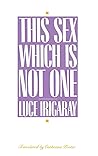
― This Sex Which is Not One
― This Sex Which is Not One
“Between gods and men, territories are set up. At least in the no-man’s land of the heights of heaven, the depths of hell, and inside the boundary traced by the oceans. Dimensions installed by a cosmogonic trilogy that leaves each term in its generic place. There remains the earth ancestress, a fourth term, that was once the most fertile, that has been progressively buried and forgotten beneath the architectonic of patriarchal sovereignty. And this murder erupts in the form of ambivalences that have constantly to be solved and hierarchized, in twinned pairs of more or less good doubles.”
― Marine Lover of Friedrich Nietzsche
― Marine Lover of Friedrich Nietzsche
“The human in what it is objectively ever since its beginning is two, two who are different. Each part of what constitutes the unity of the human species corresponds to a proper being and a proper Being, to an identity of one's own. In order to carry out the destiny of humanity, the man-human and the woman-human each have to fulfill what they are and at the same time realize the unity that they constitute.”
― The Way of Love
― The Way of Love
“Our eyes are not capable of seeing, nor even contemplating, intimacy, at least not directly. They can only imagine something about intimacy from the light, the gestures, the words, that it radiates. But intimacy as such will remain invisible, irreducible to appropriation, and thus strange to the logic of Western discourse, to the logos, except in its delusion its lack, its derelictions and artificial ecstasies. Intimacy allows itself neither to be seen nor to be seized. Nevertheless it is probably the core of our being. And any attempts to appropriate it risks annihilating being itself. However, it is not a question of magic, of irrationality, of madness--it is a question of touch.”
― Sharing the World
― Sharing the World
“Death is the real inspiring genius or Musagetes of philosophy, and for this reason Socrates defined philosophy as thanatou mélétè (preparation for death; Plato, Phaedo, 81a). Indeed, without death there would hardly have been any philosophizing.”
― Between East and West: From Singularity to Community
― Between East and West: From Singularity to Community
“The ultimate reality from which the path of this becoming could start off again will no longer rest on a ground of 'causa sui.' in any case the sense of a God who would alone be capable of giving an account of self. It is rather from the human and from what the human most irreducibly is that it is a question of starting off again. From the human as it objectively is before it starts to construct a language and a thinking which help to distance it from its beginning, from its prematureness without thinking it in the totality of its being.”
― The Way of Love
― The Way of Love
“Our [western] culture cuts us off from our natural roots, instead of contributing toward the cultivation of the natural beings we are. This tradition has, in this way, rendered us extraneous to our environment, extraneous to one another as living beings, en even extraneous to ourselves.”
―
―
“I am only astonished that, while so many women have intelligent things to say and so many men are still unknown, a publisher cared to print such a little book, and at such a price. That confirms what Schopenhauer reveals to us, among other truths: philosophy is a matter of death. A philosopher living and thinking life is a priori suspect in our philosophical culture.”
― Between East and West: From Singularity to Community
― Between East and West: From Singularity to Community
“For example, of sexual energy. An energy that could be unfurled as the horizon of a world built with a view towards a sharing of desire with the other is instead expended in secondary, animalistic, solitary, "shameful" or warring activities ... There where one ought to appeal to freedom in order to accomplish human reality as such, it no longer exists because it is harnessed by ideals of obligations that do not take into account the most demanding human imperative: to cultivate the development of an energy, that is always and already bound to the other, towards the elaboration of a specifically human transcendence.”
― Sharing the World
― Sharing the World
“Kendini varolanı yenilemekle, betimlemekle ve yeniden üretmekle sınırlamamak, aksine henüz olmamış olanı icat etmeyi ya da düşlemeyi bilmek…”
― Je, Tu, Nous: Towards a Culture of Difference
― Je, Tu, Nous: Towards a Culture of Difference
“-the words "female libido" cannot mean anything, since the possibility that they might mean anything would inevitably lead us to question the project and projections of that meaning itself. The "unjustifiable," intolerable nature of those words "female libido," would be one symptom of something outside that threatened the signs, the sense, the syntax, the systems of representation of a meaning and a praxis designed to the precise specifications of the (masculine) "subject" of the story.”
― Speculum of the Other Woman
― Speculum of the Other Woman
“Το "αγαπώ σε σένα" είναι πιο σπάνιο από το "αγαπώ εσένα", αλλά σέβεται περισσότερο τους δύο: αγαπώ σε αυτόν που είσαι, σε αυτό που κάνεις, δίχως να σε ανάγω σε αντικείμενο της αγάπης μου.”
―
―
“Who or what the other is, I never know.”
―
―
“And superimposed upon your skin was always another skin, impalpable, with infinite reserves, in which you would hide me and keep me captive, so that it was not apparent that secretly you had taken me inside you. And could I cry out that I was living inside you? That I spoke through your mouth? That your love was mine just as much as yours? How could I escape from this confusion that loving you had got me into? I was kept in a cradle of eternity that there was never a moment when you could open again to mortal time. I rested in this dwelling where you kept me a prisoner - between you and you , neither man, nor god, and moving from the one to the other without achieving the union of the two. Was I not for you the place where you kept coming back to pass from the one to the other? Reassuring yourself that you were both? But I wanted you to be this path for me as well. And when I called on you to stay in yourself, to bring together and unite these extremes, instead of constantly jumping from the one to the other, letting me be both gap and bridge, what I was asking was to continue my own journey in you. And not risk falling into the abyss with every step I took. Unless renouncing my becoming, I were to be no more than a support for your trajectory." -- Luce Irigaray in "Elemental Passions”
―
―
“Porque si hemos sido valorizadas únicamente dentro de una función de reproducción, aceptar el goce fuera de la función reproductiva significa inventar una sexualidad femenina diferente”
― Le Corps À Corps Avec La Mère
― Le Corps À Corps Avec La Mère
“After which, Freud goes on: "The castration complex of girls is also started the sight of the genitals of the other sex. Etc." Here again the little girl will have to act like the little boy, feel the same urge to see, look in the same way, and her resentment at not having a penis must follow and corroborate the horrified astonishment the little boy feels when faced with the strangeness of the nonidentical, the nonidentifiable. The "reality" of the girl's castration could be summed up as follows: you men can sec nothing, can know nothing of this; can neither discover nor recognize yourselves in this. All that remains, therefore, is for me, for her (or them), to accept this fact. As a biological fact! The girl thus "enters" into the castration complex in the same way as the boy, like a boy. She "comes out" of it feminized by a decision, which she is duty bound to ratify, that there cannot be a nothing to be seen. The idea that a "nothing to be seen," a something not subject to the rule of visibility or of specula(riza)tion, might yet have some reality, would indeed be intolerable to man. It would serve to threaten the theory and practice ofthe representation by which he aims to sublimate, or avoid the ban on, masturbation.”
― Speculum of the Other Woman
― Speculum of the Other Woman
“If we continue to speak in this sameness, speak as men have spoken for centuries, we will fail each other. Again, words will pass through our bodies, above our heads, disappear, make us disappear.”
―
―
“You give me being. But what I love is the fact that you give it to me. Staying there is of little matter to me. I like your giving me a mirror which is not made of ice. Your flowing into me, and me into you. Receiving you melting, molten, and giving that flow back to you. Without end." -- Luce Irigaray in 'Elemental Passions”
―
―
“Bir ilişki her kim tarafından uyarlanırsa uyarlansın, asla sadece birinin kendine ait değildir. İlişki bir ve öteki arasında gerçekleşir, iki aracılığıyla üretilir ve sürdürülür. Bu iki arasındaki, bir ve öteki arasındaki farklılığın açılımında yer alır ancak, ikiden doğduğu için en birine ne de ötekine özgü değildir. Belki de bu ilişki, herhangi muhtemel bir uygunluğun dışında, onu yok etmeden uygunlaştırmanın mümkün olmadığı, varoluşun başka bir tarzda cevhere dönüştüğü biricik yerdir.”
―
―