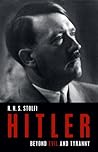
Goodreads helps you follow your favorite authors. Be the first to learn about new releases!
Start by following Russel H.S. Stolfi.

Showing 1-15 of 15
“The Allied governments, for example, with the British as executors, maintained in place the food blockade of Germany that had been in effect since 1917. A British authority would note that “in the last two years of the war, nearly 800,000 noncombatants died in Germany from starvation or diseases attributed to undernourishment. The biggest mortality was among children between the ages of 5 and 1 5, where the death rate increased by 55 percent. . . a whole generation [the one which had been born and lived during Hitler’s rise to power] grew up in an epoch of undernourishment and misery such as we [British] have never in this country experienced.”3 A distinguished American authority on United States foreign policy in the first half of the twentieth century, Stanford University professor Thomas A. Bailey, noted that “the Allied slow starvation of Germany’s civilian population was quiet, unspectacular, and censored.”4 The Englishman Gilbert Murray, writing in 1933, noted that future historians would probably regard the establishment and continuation of the blockade as one of those many acts of almost incredible inhumanity which made World War I conspicuous in history.
-- Hitler: Beyond Evil and Tyranny, p. 122”
―
-- Hitler: Beyond Evil and Tyranny, p. 122”
―
“Hitler initially served in the List Regiment engaged in a violent four-day battle near Ypres, in Belgian Flanders, with elite British professional soldiers of the initial elements of the British Expeditionary Force. Hitler thereby served as a combat infantryman in one of the most intense engagements of the opening phase of World War I. The List Regiment was temporarily destroyed as an offensive force by suffering such severe casualty rates (killed, wounded, missing, and captured) that it lost approximately 70 percent of its initial strength of around 3,600 men. A bullet tore off Hitler’s right sleeve in the first day of combat, and in the “batch” of men with which he originally advanced, every one fell dead or wounded, leaving him to survive as if through a miracle. On November 9, 1914, about a week after the ending of the great battle, Hitler was reassigned as a dispatch runner to regimental headquarters. Shortly thereafter, he was awarded the Iron Cross Second Class.
On about November 14, 1914, the new regimental commander, Lieutenant Colonel Philipp Engelhardt, accompanied by Hitler and another dispatch runner, moved forward into terrain of uncertain ownership. Engelhardt hoped to see for himself the regiment’s tactical situation. When Engelhardt came under aimed enemy smallarms fire, Hitler and the unnamed comrade placed their bodies between their commander and the enemy fire, determined to keep him alive. The two enlisted men, who were veterans of the earlier great four-day battle around Ypres, were doubtlessly affected by the death of the regiment’s first commander in that fight and were dedicated to keeping his replacement alive. Engelhardt was suitably impressed and proposed Hitler for the Iron Cross Second Class, which he was awarded on December 2. Hitler’s performance was exemplary, and he began to fit into the world around him and establish the image of a combat soldier tough enough to demand the respect of anyone in right wing, Freikorps-style politics after the war.
-- Hitler: Beyond Evil and Tyranny, p. 88”
―
On about November 14, 1914, the new regimental commander, Lieutenant Colonel Philipp Engelhardt, accompanied by Hitler and another dispatch runner, moved forward into terrain of uncertain ownership. Engelhardt hoped to see for himself the regiment’s tactical situation. When Engelhardt came under aimed enemy smallarms fire, Hitler and the unnamed comrade placed their bodies between their commander and the enemy fire, determined to keep him alive. The two enlisted men, who were veterans of the earlier great four-day battle around Ypres, were doubtlessly affected by the death of the regiment’s first commander in that fight and were dedicated to keeping his replacement alive. Engelhardt was suitably impressed and proposed Hitler for the Iron Cross Second Class, which he was awarded on December 2. Hitler’s performance was exemplary, and he began to fit into the world around him and establish the image of a combat soldier tough enough to demand the respect of anyone in right wing, Freikorps-style politics after the war.
-- Hitler: Beyond Evil and Tyranny, p. 88”
―
“Hitler derived several things from his experience and achievements in World War I, without which his rise to power in 1933 would have been at the least problematical, and at the most inconceivable. Hitler survived the war as a combat soldier—a rifle carrier—in a frontline infantry regiment. The achievement was an extraordinary one based on some combination of near-miraculous luck and combat skill. The interpretive fussing over whether or not Hitler was a combat soldier because he spent most of the war in the part of the regiment described as regimental headquarters can be laid to rest as follows: Any soldier in an infantry regiment on an active front in the west in World War I must be considered to have been a combat soldier. Hitler’s authorized regimental weapon was the Mauser boltaction, magazine-fed rifle. This gives a basic idea of what Hitler could be called upon to do in his assignment at the front. As a regimental runner, he carried messages to the battalions and line companies of the regiment, and the more important ones had to be delivered under outrageously dangerous circumstances involving movement through artillery fire and, particularly later in the war, poison gas and the omnipresent rifle fire of the skilled British sniper detachments.
--Hitler: Beyond Evil and Tyranny, p. 96”
― Hitler: Beyond Evil and Tyranny
--Hitler: Beyond Evil and Tyranny, p. 96”
― Hitler: Beyond Evil and Tyranny
“The great biographers take excessive liberties in denigrating his person, and, in doing so, they make it difficult to comprehend him."
-- Hitler: Beyond Evil and Tyranny, p. 17”
― Hitler: Beyond Evil and Tyranny
-- Hitler: Beyond Evil and Tyranny, p. 17”
― Hitler: Beyond Evil and Tyranny
“And in contrast to the Communist revolution in Russia and the Communist attempts at revolution in Germany from 1918 through 1923, Hitler's were virtually bloodless."
-- Hitler: Beyond Evil and Tyranny, p. 44”
― Hitler: Beyond Evil and Tyranny
-- Hitler: Beyond Evil and Tyranny, p. 44”
― Hitler: Beyond Evil and Tyranny
“In the well reported Kubizek period from late 1904 through mid-1908, with its additiona data from the circumstances of failure at school, lung ailment, and tragic episode of his mother’s death, the picture remains the same. Hitler’s character is one of bold license for a youngster, but not directed toward dissolute behavior or activity that gives a hint of evil. Hitler devoured grand opera and classical music, painted, sketched, planned a great new Linz; he wrote sonnets, communed with nature, and exuded politeness and reserve. These are activities and qualities that suggest potential, although overblown, aspirations to artistic genius. What we see, like it or not, is morally laudable behavior and aspiration on the part of a young man in his teens. But is there a dark side somewhere in this picture?
If there were a dark side, it probably would have been the light gray of the contempt that he had for many of his school teachers and his resistance to formal education. Hitler’s comments in Mein Kampf support such contempt and are buoyed by his indelible comment, about his tour of the customs office where his father worked, that the clerks and officials squatted about as monkeys in cages.
-- Hitler: Beyond Evil and Tyranny, p. 101”
― Hitler: Beyond Evil and Tyranny
If there were a dark side, it probably would have been the light gray of the contempt that he had for many of his school teachers and his resistance to formal education. Hitler’s comments in Mein Kampf support such contempt and are buoyed by his indelible comment, about his tour of the customs office where his father worked, that the clerks and officials squatted about as monkeys in cages.
-- Hitler: Beyond Evil and Tyranny, p. 101”
― Hitler: Beyond Evil and Tyranny
“Although characterized as uncultured and unread, Hitler comes off in his demands to create a monumental signature for a Greater Germany as historically and artistically gifted."
-- Hitler: Beyond Evil and Tyranny, p. 32”
― Hitler: Beyond Evil and Tyranny
-- Hitler: Beyond Evil and Tyranny, p. 32”
― Hitler: Beyond Evil and Tyranny
“As concerns the question of the psychological engine that drove Hitler, the conventional interpretation of lusting after power is, in final analysis, the refuge of lack of comprehension."
-- Hitler: Beyond Evil and Tyranny, p. 27”
― Hitler: Beyond Evil and Tyranny
-- Hitler: Beyond Evil and Tyranny, p. 27”
― Hitler: Beyond Evil and Tyranny
“(...)it seems more probable that his anti-Semitism was less emotional and more objective than has been assumed to the present."
-- Hitler: Beyond Evil and Tyranny, p. 37”
― Hitler: Beyond Evil and Tyranny
-- Hitler: Beyond Evil and Tyranny, p. 37”
― Hitler: Beyond Evil and Tyranny
“Virtually every literary piece written about Adolf Hitler in more than half a century since 1945 has been based on antipathy.
-- Hitler: Beyond Evil and Tyranny, p. 11”
―
-- Hitler: Beyond Evil and Tyranny, p. 11”
―
“The intellectually-inclined biographers stray from the point that the message is directed through the spoken word at the broad masses and not writing to an inbred, self-adoring intellectual elite."
--Hitler: Beyond Evil and Tyranny, pp. 30-31”
― Hitler: Beyond Evil and Tyranny
--Hitler: Beyond Evil and Tyranny, pp. 30-31”
― Hitler: Beyond Evil and Tyranny
“In his thoughtful and complex style of analysis, Hitler continued on to note the following: “Since the newspapers in question did not enjoy an outstanding reputation ... I regarded them more as the products of anger and envy than the [representation] of a principled, though perhaps mistaken, point of view.” In the lines above, we see Hitler begin to wrestle with anti- Semitism, flatly reject religious anti-Semitism as unworthy of Austrian cultural tradition, and suspect that the arguments of the anti-Semitic press and gutter pamphlets were exaggerated beyond credibility by too much subjective and too little objective and principled argument. The view of virtually every Hitler biographer that he based his anti-Semitism on arguments derived from the gutter press and pamphlets of Vienna does not hold up in the face of the words above. To the contrary, we see Hitler take the measure of that literature.
--Hitler: Beyond Evil and Tyranny, pp. 103-104”
― Hitler: Beyond Evil and Tyranny
--Hitler: Beyond Evil and Tyranny, pp. 103-104”
― Hitler: Beyond Evil and Tyranny
“Hitler took the action of pitiless massacre as a last resort in the face of a perceived irreconcilable enemy."
--Hitler: Beyond Evil and Tyranny, p. 39”
― Hitler: Beyond Evil and Tyranny
--Hitler: Beyond Evil and Tyranny, p. 39”
― Hitler: Beyond Evil and Tyranny
“To comprehend the Hitler of 1919 is to comprehend the Hitler of the entire period from 1919 through 1945."
--Hitler: Beyond Evil and Tyranny, p. 35”
― Hitler: Beyond Evil and Tyranny
--Hitler: Beyond Evil and Tyranny, p. 35”
― Hitler: Beyond Evil and Tyranny
“Politics for Hitler must be seen as a distant, prophetic vision to be fulfilled and not as an exercise in personal power. There was no political theory for Hitler and no necessity for adherence to any political programs. There was only tactical political flexibility in the service of seizure of power and the establishment of a Greater Germany in Europe."
-- Hitler: Beyond Evil and Tyranny, p. 40”
― Hitler: Beyond Evil and Tyranny
-- Hitler: Beyond Evil and Tyranny, p. 40”
― Hitler: Beyond Evil and Tyranny