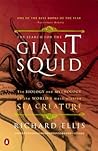
Goodreads helps you follow your favorite authors. Be the first to learn about new releases!
Start by following Richard Ellis.

Showing 1-4 of 4
“There's not that much known, but there's a lot you can write about what's not known, why it isn't known and who doesn't know it.”
―
―
“All food available in the depths of the ocean is animal matter, and the food chain depends upon the constant rain of minuscule particles ('undersea snow') from the surface layers, usually the remains of animals that have died. 'When I think of the floor of the deep sea,' wrote Rachel Carson, 'the single overwhelming fact that possesses my imagination is the accumulation of sediments. I always see the steady, unremitting, downward drift of materials from above, flake upon flake, layer upon layer - a drift that has continued for hundreds of millions of years, that will go on as long as there are seas and continents.' Life in the depths depends upon death in the shallows.”
― Singing Whales and Flying Squid: The Discovery of Marine Life
― Singing Whales and Flying Squid: The Discovery of Marine Life
“waters, and even some that leave the water altogether. The Japanese flying squid (Todarodes pacificus) can take to the air like a flying fish; it builds up speed underwater and then launches itself out of the water and glides until reentry. Flying squid have been observed to cover distances as long as 100 feet above the surface, presumably to avoid predators, or utilizing jet-propelled aerial locomotion to save energy as they migrate. It has been shown that penguins, sea lions, and dolphins save energy by performing low-level leaps over the surface as they swim, which enables them to momentarily avoid the resistance of water and, concurrently, grab a breath of air. Squid don’t need a breath of air—they breathe water through their gills, like fishes—but several squid species can and do leave the water; mariners in all oceans occasionally find little squid on the decks after a night of sailing. The Humboldt squid (Dosidicus) has also been observed to get itself airborne; if a hundred-pound, ink-squirting, beak-snapping squid lands on your deck, you might have a bit of a problem.”
― The Little Blue-Eyed Vampire from Hell
― The Little Blue-Eyed Vampire from Hell
“The hatchlings of most deep-sea octopus species develop directly, without passing through a larval stage.”
― The Little Blue-Eyed Vampire from Hell
― The Little Blue-Eyed Vampire from Hell