Goodreads helps you follow your favorite authors. Be the first to learn about new releases!
Start by following Nicholas Wolterstorff.

Showing 1-30 of 31
“And what of regrets? I shall live with them. I shall accept my regrets as part of my life, to be numbered among my self-inflicted wounds. But I will not endlessly gaze at them. I shall allow the memories to prod me into doing better with those still living. And I shall allow them to sharpen the vision and intensify the hope for that Great Day coming when we can all throw ourselves into each other's arms and say, "I'm sorry.”
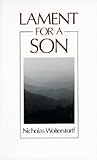
― Lament for a Son
― Lament for a Son
“But we all suffer. For we all prize and love; and in this present existence of ours, prizing and loving yield suffering. Love in our world is suffering love. Some do not suffer much, though, for they do not love much. Suffering is for the loving. This, said Jesus, is the command of the Holy One: "You shall love your neighbor as yourself." In commanding us to love, God invites us to suffer.”
― Lament for a Son
― Lament for a Son
“God is not only the God of the sufferers but the God who suffers. ... It is said of God that no one can behold his face and live. I always thought this meant that no one could see his splendor and live. A friend said perhaps it meant that no one could see his sorrow and live. Or perhaps his sorrow is splendor. ... Instead of explaining our suffering God shares it.”
― Lament for a Son
― Lament for a Son
“Rather often I am asked whether the grief remains as intense as when I wrote. The answer is, No. The wound is no longer raw. But it has not disappeared. That is as it should be. If he was worth loving, he is worth grieving over.
Grief is existential testimony to the worth of the one loved. That worth abides. So I own my grief. I do not try to put it behind me, to get over it, to forget it… Every lament is a love-song.”
― Lament for a Son
Grief is existential testimony to the worth of the one loved. That worth abides. So I own my grief. I do not try to put it behind me, to get over it, to forget it… Every lament is a love-song.”
― Lament for a Son
“Faith is a footbridge that you don't know will hold you up over the chasm until you're forced to walk out onto it.”
― Lament for a Son
― Lament for a Son
“Will my eyes adjust to this darkness? Will I find you in the dark – not in the streaks of light which remain, but in the darkness? Has anyone ever found you there? Did they love what they saw? Did they see love? And are there songs for singing when the light has gone dim? Or in the dark, is it best to wait in silence?
Noon has darkened. As fast as they could say, ‘He’s dead,’ the light dimmed. And where are you in the darkness? I learned to spy you in the light. Here in this darkness, I cannot find you. If I had never looked for you, or looked but never found, I would not feel this pain of your absence. Or is not your absence in which I dwell, but your elusive troubling presence?
It’s the neverness that is so painful. Never again to be here with us – never to sit with us at the table…. All the rest of our lives we must live without him. Only our death can stop the pain of his death.”
― Lament for a Son
Noon has darkened. As fast as they could say, ‘He’s dead,’ the light dimmed. And where are you in the darkness? I learned to spy you in the light. Here in this darkness, I cannot find you. If I had never looked for you, or looked but never found, I would not feel this pain of your absence. Or is not your absence in which I dwell, but your elusive troubling presence?
It’s the neverness that is so painful. Never again to be here with us – never to sit with us at the table…. All the rest of our lives we must live without him. Only our death can stop the pain of his death.”
― Lament for a Son
“I shall look at the world through tears. Perhaps I shall see things that dry-eyed I could not see.”
― Lament for a Son
― Lament for a Son
“How is faith to endure, O God, when you allow all this scraping and tearing on us? You have allowed rivers of blood to flow, mountains of suffering to pile up, sobs to become humanity's song--all without lifting a finger that we could see. You have allowed bonds of love beyond number to be painfully snapped. If you have not abandoned us, explain yourself.
We strain to hear. But instead of hearing an answer we catch sight of God himself scraped and torn. Through our tears we see the tears of God.”
― Lament for a Son
We strain to hear. But instead of hearing an answer we catch sight of God himself scraped and torn. Through our tears we see the tears of God.”
― Lament for a Son
“Why are the photographs of him as a little boy so incredibly hard to look at? Something is over. Now instead of those shiny moments being things we can share together in delighted memories, I, the survivor, have to bear them alone. So it is with all the memories of him. They all lead into blackness. All I can do is remember him, I cannot experience him. Nothing new can happen between us.”
― Lament for a Son
― Lament for a Son
“Don’t say it’s not really so bad. Because it is. Death is awful, demonic. If you think your task as comforter is to tell me that really, all things considered, it’s not so bad, you do not sit with me in my grief but place yourself off in the distance away from me. Over there, you are of no help.”
― Lament for a Son
― Lament for a Son
“THE TEARS ... streamed down, and I let them flow as freely as they would, making of them a pillow for my heart. On them it rested."
-AUGUSTINE,
Confessions IX, i z”
― Lament for a Son
-AUGUSTINE,
Confessions IX, i z”
― Lament for a Son
“Choice is always performed against a background of habit.”
― Until Justice and Peace Embrace
― Until Justice and Peace Embrace
“Many are the scholars who make it their professional occupation to occupy themselves in this towering edifice of culture, exploring its nook and crannies, developing their responses, making their contributions here and there, and helping to hand it on to succeeding generations. For some the temptation proves irresistible to go yet farther and make this the concern of their lives, letting society go its own sorry way while they lock themselves away in this abiding, socially transcendent cultural stronghold, acquiescing in society while pursuing Bildung. As Rotterdam burns, they study Sanskrit verb forms.”
― Until Justice and Peace Embrace
― Until Justice and Peace Embrace
“A friend said, “Remember, he’s in good hands.” I was deeply moved. But that reality does not put Eric back in my hands now. That’s my grief. For that grief, what consolation can there be other than having him back?”
― Lament for a Son
― Lament for a Son
“IT’S THE neverness that is so painful. Never again to be here with us—never to sit with us at table, never to travel with us, never to laugh with us, never to cry with us, never to embrace us as he leaves for school, never to see his brothers and sister marry. All the rest of our lives we must live without him. Only our death can stop the pain of his death. A month, a year, five years—with that I could live. But not this forever. I step outdoors into the moist moldly fragrance of an early summer morning and arm in arm with my enjoyment comes the realization that never again will he smell this. As a cloud vanishes and is gone, so he who goes down to the grave does not return, He will never come to his house again; his place will know him no more. JOB 7:9-10 One small misstep and now this endless neverness.”
― Lament for a Son
― Lament for a Son
“IT’S so WRONG, so profoundly wrong, for a child to die before its parents. It’s hard enough to bury our parents. But that we expect. Our parents belong to our past, our children belong to our future. We do not visualize our future without them. How can I bury my son, my future, one of the next in line? He was meant to bury me!”
― Lament for a Son
― Lament for a Son
“Technology does make possible advance toward shalom; progress in mastery of the world can bring shalom nearer. But the limits of technology must also be acknowledged; technology is entirely incapable of bringing about shalom between ourselves and God, and it is only scarcely capable of bringing about the love of self and neighbour.”
― Until Justice and Peace Embrace
― Until Justice and Peace Embrace
“But the pain of the no more outweighs the gratitude of the once was. Will it always be so? I didn’t know how much I loved him until he was gone. Is love like that?”
― Lament for a Son
― Lament for a Son
“When death is no longer seen as release from this miserable materiality into our rightful immateriality, when death is seen rather as the slicing off of what God declared to be, and what all of us feel to be, of great worth, then death is—well, not friend but enemy. Though I shall indeed recall that death is being overcome, my grief is that death still stalks this world and one day knifed down my Eric. Nothing fills the void of his absence. He’s not replaceable. We can’t go out and get another just like him.”
― Lament for a Son
― Lament for a Son
“Each death is as unique as each life.”
― Lament for a Son
― Lament for a Son
“the Reformed Christian has never believed that America is a Christian nation and that, accordingly, our social institutions and formations, though blemished here and there, are fundamentally in accord with God's will. But neither has she agreed with those Christians who hold that our social institutions and formations are fundamentally corrupt and that the duty of the Christian is to withdraw. Normative discrimination is what she has always regarded as the appropriate stance, coupled with the attempt, once the discrimination has been made, to change what is wrong when that proves possible, to keep discontent alive when change proves not possible, and always to be grateful for what is good. In short, to act redemptively. While praying the prayer, "Thy kingdom come," to join God's cause of struggling against all that resists and falls short of God's will and longing for creation, thus to acknowledge the rightful, and ultimately effective, rule of Jesus Christ over every square inch of creation.”
― Educating for Shalom: Essays on Christian Higher Education
― Educating for Shalom: Essays on Christian Higher Education
“I am at an impasse, and you, O God, have brought me here...From my earliest days, I have believed in you. I shared in the life of your people: in their prayers, in their work, in their songs...For me your yoke was easy. On me your presence smiled. Noon has darkened...And where are you in this darkness?...Or is it not your absence in which I dwell but your elusive troubling presence?”
―
―
“ON THE WAY back I thought about tears. Our culture says that men must be strong and that the strength of a man in sorrow is to be seen in his tearless face. Tears are for women. Tears are signs of weakness and women are permitted to be weak. Of course it’s better if they too are strong. But why celebrate stoic tearlessness? Why insist on never outwarding the inward when that inward is bleeding? Does enduring while crying not require as much strength as never crying? Must we always mask our suffering? May we not sometimes allow people to see and enter it? I mean, may men not do this?”
― Lament for a Son
― Lament for a Son
“Sometimes the reason offered for seeking aesthetic excellence in the music of the church is that thereby one pleases God. I think that is true. But not because we know what music God enjoys-- though I suspect it must be music which is unified, rich, and intense! Rather, because it is in the joy of his people that God finds delight.”
― Art in Action: Toward a Christian Aesthetic
― Art in Action: Toward a Christian Aesthetic
“Suffering is the shout of “No” by one’s whole existence to that over which one suffers—the shout of “No” by nerves and gut and gland and heart to pain, to death, to injustice, to depression, to hunger, to humiliation, to bondage, to abandonment. And sometimes, when the cry is intense, there emerges a radiance which elsewhere seldom appears: a glow of courage, of love, of insight, of selflessness, of faith. In that radiance we see best what humanity was meant to be.”
― Lament for a Son
― Lament for a Son
“What I need to hear from you is that you recognize how painful it is. I need to hear from you that you are with me in my desperation. To comfort me, you have to come close. Come sit beside me on my mourning bench.”
― Lament for a Son
― Lament for a Son
“The tears of God are the meaning of history.”
―
―
“property, they said. If the budget had to be doubled, so be it. Let’s go forward, trusting that the money will come in. We notified the architect of the council’s decision. Within a month or so, he called to say that he had some tentative designs to show us. The designs turned out to be conventional, uninspired. So we offered suggestions. A month or so later, we received a call saying that a new set of designs was ready; but these, too, were uninspired. It was evident what was going on: though our budget had been doubled, it was still low, and the low budget, rather than challenging him to”
― In This World of Wonders: Memoir of a Life in Learning
― In This World of Wonders: Memoir of a Life in Learning
“Well, surely Kant was right in his claim that awareness is normally if not always awareness under concepts. Normally if not always my perception of the table is the perception of it under the concept of table, or the concept of item of furniture, or the concept of brown thing, or whatever. This part of Kant we should most definitely hang on to. We do interpret our experience conceptually. But notice that if we understand perception of an object as awareness of the object—rather than as awareness of a mental representation caused by the object—then it will not make sense to follow Kant in the further step he takes of thinking of concepts as rules for structuring the objects of our awareness. For now the objects of our awareness are not mental states but eagles and dogs. And eagles and dogs are already structured; they don’t await structuring by us...Concepts are not
barriers between mind and reality but links. The concept of eagle is at one and the same time one of the concepts that I possess and one of the concepts that is satisfied by the thing I perceive, namely, an eagle. As I myself see the matter: to possess the concept of table is to grasp the property of being a table. If that is so, then properties are at one and the same time entities that we grasp and entities that external objects possess. They are the links. On this picture, how might God be gotten in mind? Notice that Kant’s use of the metaphor of boundary now no longer has applicability. We no longer have to suppose that the applicability of our concepts is confined to our intuitions. So one way we might get God in mind is by the use of definite descriptions. The expression, 'Creator of the universe' might pick God out; synonymously: 'The one who brought about all that might not have been.' And secondly, it may be that some human beings have had God in mind as that of which they were aware. For a possibility that we now have to take seriously is that human beings might sometimes have awareness of God.”
― Is it Possible and Desirable for Theologians to Recover from Kant?
barriers between mind and reality but links. The concept of eagle is at one and the same time one of the concepts that I possess and one of the concepts that is satisfied by the thing I perceive, namely, an eagle. As I myself see the matter: to possess the concept of table is to grasp the property of being a table. If that is so, then properties are at one and the same time entities that we grasp and entities that external objects possess. They are the links. On this picture, how might God be gotten in mind? Notice that Kant’s use of the metaphor of boundary now no longer has applicability. We no longer have to suppose that the applicability of our concepts is confined to our intuitions. So one way we might get God in mind is by the use of definite descriptions. The expression, 'Creator of the universe' might pick God out; synonymously: 'The one who brought about all that might not have been.' And secondly, it may be that some human beings have had God in mind as that of which they were aware. For a possibility that we now have to take seriously is that human beings might sometimes have awareness of God.”
― Is it Possible and Desirable for Theologians to Recover from Kant?
“Well, surely Kant was right in his claim that awareness is normally if not always awareness under concepts. Normally if not always my perception of the table is the perception of it under the concept of table, or the concept of item of furniture, or the concept of brown thing, or whatever. This part of Kant we should most definitely hang on to. We do interpret our experience conceptually. But notice that if we understand perception of an object as awareness of the object—rather than as awareness of a mental representation caused by the object—then it will not make sense to follow Kant in the further step he takes of thinking of concepts as rules for structuring the objects of our awareness. For now the objects of our awareness are not mental states but eagles and dogs. And eagles and dogs are already structured; they don’t await structuring by us...Concepts are not barriers between mind and reality but links. The concept of eagle is at one and the same time one of the concepts that I possess and one of the concepts that is satisfied by the thing I perceive, namely, an eagle. As I myself see the matter: to possess the concept of table is to grasp the property of being a table. If that is so, then properties are at one and the same time entities that we grasp and entities that external objects possess. They are the links. On this picture, how might God be gotten in mind? Notice that Kant’s use of the metaphor of boundary now no longer has applicability. We no longer have to suppose that the applicability of our concepts is confined to our intuitions. So one way we might get God in mind is by the use of definite descriptions. The expression, 'Creator of the universe' might pick God out; synonymously: 'The one who brought about all that might not have been.' And secondly, it may be that some human beings have had God in mind as that of which they were aware. For a possibility that we now have to take seriously is that human beings might sometimes have awareness of God.”
― Is it Possible and Desirable for Theologians to Recover from Kant?
― Is it Possible and Desirable for Theologians to Recover from Kant?