Goodreads helps you follow your favorite authors. Be the first to learn about new releases!
Start by following Michael Polanyi.

Showing 1-26 of 26
“We do not accept a religion because it offers us certain rewards. The only thing that a religion can offer us is to be just what it, in itself, is: a greater meaning in ourselves, in our lives, and in our grasp of the nature of things...a religion exists for us only if, like a piece of poetry, it carries us away. It is not in any sense a 'hypothesis.”
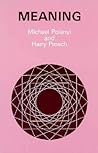
― Meaning
― Meaning
“We know more than we can tell.”
―
―
“We cannot ultimately specify the grounds (either metaphysical or logical or empirical) upon which we hold that our knowledge is true. Being committed to such grounds, dwelling in them, we are projecting ourselves to what we believe to be true from or through these grounds. We cannot therefore see what they are. We cannot look at them because we are looking with them.”
― Meaning
― Meaning
“To try to reform all the power structures at once would leave us with no power structure to use in our project. In any case, we will be able to see that absolute moral renewal could be attempted only by an absolute power and that a tyrannous force such as this must destroy the whole moral life of man, not renew it.”
― Meaning
― Meaning
“So far as we know, the tiny fragments of the universe embodied in man are the only centers of thought and responsibility in the visible world. If that be so, the appearance of the human mind has been so far the ultimate stage in the awakening of the world; and all that has gone before, the striving of myriad centers that have taken the risks of living and believing, seem to have all been pursuing, along rival lines, the aim now achieved by us up to this point. They are all akin to us, for all these centers - those which led up to our own existence and the far more numerous others which produced different lines of which many are extinct - may be seen engaged in the same endeavor towards ultimate liberation. We may envisage then a cosmic field which called forth all these centers by offering them a short-lived, limited, hazardous opportunity for making some progress of their own towards an unthinkable consummation. And that is also, I believe, how a Christian is placed when worshiping God.”
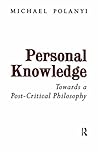
― Personal Knowledge : Towards a Post-Critical Philosophy
― Personal Knowledge : Towards a Post-Critical Philosophy
“as human beings, we must inevitably see the universe from a centre lying within ourselves and speak about it in terms of a human language shaped by the exigencies of human intercourse. Any attempt rigorously to eliminate our human perspective from our picture of the world must lead to absurdity.”
― Personal Knowledge: Towards a Post-critical Philosophy
― Personal Knowledge: Towards a Post-critical Philosophy
“A steady recognition that the evils which prevent the fullness of moral development are precisely the elements which are also the source of the power that gives existence to whatever moral accomplishments we see about us may eventually lead us to a tolerance we grant to the internal-combustion engine: it is noisy and smelly, and occasionally, it refuses to start, but it is what gets us to wherever we get.
We must somehow learn to understand and so to tolerate- not destroy- the free society.”
― Meaning
We must somehow learn to understand and so to tolerate- not destroy- the free society.”
― Meaning
“Christianity sedulously fosters, and in a sense permanently satisfies, man's craving for mental dissatisfaction by offering him the comfort of a crucified God.”
― Personal Knowledge : Towards a Post-Critical Philosophy
― Personal Knowledge : Towards a Post-Critical Philosophy
“It was the merit of Gestalt psychology to make us aware of the remarkable performance involved in perceiving shapes. Take, for example, a ball or an egg: we can see their shapes at a glance. Yet suppose that instead of the impression made on our eye by an aggregate of white points forming the surface of an egg, we were presented with another, logically equivalent, presentation of these points as given by a list of their spatial co-ordinate values. It would take years of labour to discover the shape inherent in this aggregate of figures - provided it could be guessed at all. The perception of the egg from the list of co-ordinate values would, in fact, be a feat rather similar in nature and measure of intellectual achievement to the discovery of the Copernican system.”
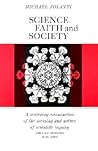
― Science, Faith and Society
― Science, Faith and Society
“Personal Knowledge. The two words may seem to contradict each other: for true knowledge is deemed impersonal, universally established, objective. But the seeming contradiction is resolved by modifying the conception of knowing.”
― Personal Knowledge: Towards a Post-Critical Philosophy
― Personal Knowledge: Towards a Post-Critical Philosophy
“Sartre puts it, value arises simply from our choices. What we choose, we value simply because we have chosen it (and apparently we remain scot-free at any moment to nonvalue it by simply un-choosing it). In other words, we do not choose (in his view) because we see the value of something. We see the value of something because we have chosen it.”
― Meaning
― Meaning
“The downfall of liberty which in every case followed the success of these attacks demonstrates in hard facts what we said before: that freedom of thought is rendered pointless and must disappear wherever reason and morality are deprived of their status as a force in their own right. When a judge in a court of law can no longer appeal to law and justice; when neither a witness, nor the newspapers, nor even a scientist reporting on his experiments can speak the truth as he knows it; when in public life there is no moral principle commanding respect; when the revelations of religion and of art are denied any substance; then there are no grounds left on which any individual may justly make a stand against the rulers of the day. Such is the simple logic of totalitarianism. A nihilistic regime will have to undertake the day-to-day direction of all activities which are otherwise guided by the intellectual and moral principles that nihilism declares empty and void. Principles must be replaced by the decrees of an all-embracing party line.”
― Meaning
― Meaning
“Accordingly, scientific theory is denied all persuasive power that is intrinsic to itself, as theory. It must not go beyond experience by affirming anything that cannot be tested by experience; and above all, scientists. In so far as a theory cannot be tested by experience—or appears not capable of being so tested—it ought to be revised so that its predictions are restricted to observable magnitudes.
This view, which can be traced back to Locke and Hume, and which in its massive modern absurdity has almost entirely dominated twentieth century thinking on science, seems to be the inevitable consequence of separating, in principle, mathematical knowledge from empirical knowledge.”
―
This view, which can be traced back to Locke and Hume, and which in its massive modern absurdity has almost entirely dominated twentieth century thinking on science, seems to be the inevitable consequence of separating, in principle, mathematical knowledge from empirical knowledge.”
―
“This difference between a probability statement on the one hand, and the probability of a statement, or the degree of belief in a statement on the other, may seem elusive, but is actually quite obvious.”
― Personal Knowledge: Towards a Post-Critical Philosophy
― Personal Knowledge: Towards a Post-Critical Philosophy
“Personal knowledge is an intellectual commitment, and as such inherently hazardous. Only affirmations that could be false can be said to convey objective knowledge of this kind. All affirmations published in this book are my own personal commitments; they claim this, and no more than this, for themselves. Throughout this book I have tried to make this situation apparent. I have shown that into every act of knowing there enters a passionate contribution of the person knowing what is being known, and that this coefficient is no mere imperfection but a vital component of his knowledge. And around this central fact I have tried to construct a system of correlative beliefs which I can sincerely hold, and to which I can see no acceptable alternatives. But ultimately, it is my own allegiance that upholds these convictions, and it is on such warrant alone that they can lay claim to the reader’s attention. M. P. Manchester August 1957”
― Personal Knowledge: Towards a Post-Critical Philosophy
― Personal Knowledge: Towards a Post-Critical Philosophy
“The quickest impression on the scientific world may be made not by publishing the whole truth and nothing but the truth, but rather by serving an interesting and plausible story composed of parts of the truth with a little straight invention admixed to it. Such a composition is judiciously guarded by interspersed ambiguities, will be extremely difficult to controvert, and in a field in which experiments are laborious or intrinsically difficult to reproduce may stand for years unchallenged. A considerable reputation can be built and a very comfortable university post be gained before this kind of swindle transpires — if it ever does. If each scientist set to work every morning with the intention of doing the best bit of safe charlatanry, which would just help him into a good post, there would soon exist no effective standards by which such deception could be detected. A community of scientists in which each would act only with an eye to please scientific opinion would find no scientific opinion to please. Only if scientists remain loyal to scientific ideals rather than try to achieve success with their fellow scientists can they form a community, which will uphold these ideals.”
― Science, Faith and Society
― Science, Faith and Society
“The popular conception of the scientist patiently collecting observations, unprejudiced by any theory, until finally he succeeds in establishing a great new generalization, is quite false.”
― Science, Faith and Society
― Science, Faith and Society
“Our native gift of speech enables us to enter on the mental life of man by assimilating our cultural heritage. We come into existence mentally, by adding to our bodily equipment an articulate framework and using it for understanding experience. Human thought grows only within language and since language can exist only in a society, all thought is rooted in society.”
― The Study of Man
― The Study of Man
“No one can appreciate science if he does not live in it.”
― Science, Faith and Society
― Science, Faith and Society
“National greatness depends as much on generosity as on force; the most important gains were achieved by nations when they risked their vital interests by exercising moral restraint in relation to other nations. A nation may indeed have to court disaster in upholding its moral nature if it is to avoid surviving as a kind of people it does not want to be.”
― The Logic of Liberty
― The Logic of Liberty
“Persons and problems are felt to be more profound, because we expect them yet to reveal themselves in unexpected ways in the future, while cobblestones evoke no such expectation. This capacity of a thing to reveal itself in unexpected ways in the future I attribute to the fact that the thing observed is an aspect of a reality, possessing a significance that is not exhausted by our conception of any single aspect of it. To trust that a thing we know is real is, in this sense, to feel that it has the independence and power for manifesting itself in yet unthought of ways in the future. I shall say, accordingly, that minds and problems possess a deeper reality than cobblestones, although cobblestones are admittedly more real in the sense of being tangible. And since I regard the significance of a thing as more important than its tangibility; I shall say that minds and problems are more real than cobblestones. This is to class our knowledge of reality with the kind of foreknowledge which guides scientists to discovery.”
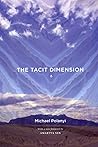
― The Tacit Dimension
― The Tacit Dimension
“I believe that in spite of the hazards involved, I am called upon to search
for the truth and state my findings. This sentence, summarizing my
fiduciary programme, conveys an ultimate belief which I find myself
holding. Its assertion must therefore prove consistent with its content by
practising what it authorizes. This is indeed true. For in uttering this
sentence I both say that I must commit myself by thought and speech, and
do so at the same time. Any enquiry into our ultimate beliefs can be
consistent only if it presupposes its own conclusions. It must be
intentionally circular.”
― Personal Knowledge : Towards a Post-Critical Philosophy
for the truth and state my findings. This sentence, summarizing my
fiduciary programme, conveys an ultimate belief which I find myself
holding. Its assertion must therefore prove consistent with its content by
practising what it authorizes. This is indeed true. For in uttering this
sentence I both say that I must commit myself by thought and speech, and
do so at the same time. Any enquiry into our ultimate beliefs can be
consistent only if it presupposes its own conclusions. It must be
intentionally circular.”
― Personal Knowledge : Towards a Post-Critical Philosophy
“... the damage done by the specification of particulars may be irremediable. Meticulous detailing may obscure beyond recall a subject like history, literature, or philosophy. Speaking more generally, the belief that, since particulars are more tangible, their knowledge offers a true conception of things is fundamentally mistaken.”
― The Tacit Dimension
― The Tacit Dimension
“I regard knowing as an active comprehension of the things known, an action that requires skill. Skilful knowing and doing is performed by subordinating a set of particulars, as clues or tools, to the shaping of a skilful achievement, whether practical or theoretical. We may then be said to become ‘subsidiarily aware’ of these particulars within our ‘focal awareness’ of the coherent entity that we achieve.”
― Personal Knowledge: Towards a Post-Critical Philosophy
― Personal Knowledge: Towards a Post-Critical Philosophy
“If, then, it is not words that have meaning, but the speaker or listener who means something by them, let me declare accordingly my true position as the author of what I have written so far, as well as of what is still to follow. I must admit now that I did not start the present reconsideration of my beliefs with a clean slate of unbelief. Far from it. I started as a person intellectually fashioned by a particular idiom, acquired through my affiliation to a civilization that prevailed in the places where I had grown up, at this particular period of history. This has been the matrix of all my intellectual efforts. Within it I was to find my problem and seek the terms for its solution. All my amendments to these original terms will remain embedded in the system of my previous beliefs. Worse still, I cannot precisely say what these beliefs are. I can say nothing precisely. The words I have spoken and am yet to speak mean nothing: it is only I who mean something by them. And, as a rule, I do not focally know what I mean, and though I could explore my meaning up to a point, I believe that my words (descriptive words) must mean more than I shall ever know, if they are to mean anything at all.”
― Personal Knowledge : Towards a Post-Critical Philosophy
― Personal Knowledge : Towards a Post-Critical Philosophy
“Why do we entrust the life and guidance of our thoughts to our conceptions? Because we believe that their manifest rationality is due to their being in contact with domains of reality, of which they have grasped one aspect. This is why the Pygmalion at work in us when we shape a conception is ever prepared to seek guidance from his own creation; and yet, in reliance on his contact with reality, is ready to re-shape his creation, even while he accepts its guidance. We grant authority over ourselves to the conceptions which we have accepted, because we acknowledge them as intimations—derived from the contact we make through them with reality—of an indefinite sequence of novel future occasions, which we may hope to master by developing these conceptions further, relying on our own judgment in its continued contact with reality.”
― Personal Knowledge : Towards a Post-Critical Philosophy
― Personal Knowledge : Towards a Post-Critical Philosophy