Goodreads helps you follow your favorite authors. Be the first to learn about new releases!
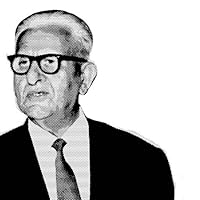
Start by following K.L. Gauba.
Showing 1-9 of 9
“It would be difficult to sum up the status and conditions of Muslim in India better in two words than "Passive Voices".”
― Passive Voices: A Penetrating Study of Muslims in India
― Passive Voices: A Penetrating Study of Muslims in India
“But the unique position of Kashmir was not limited to the terms of its Constitution. Kashmir had become the bivouac of a vast assembly of Indian Military and Air Force personnel, who have now for nearly twenty years constantly and at most street corners stood guard against possible second thoughts by the legislatures and the Government of Kashmir on the integration of the State with the Indian Union. Democracy in Kashmir is thus underlined at all times in form and substance by the arms of the Indian army.”
― Passive Voices: A Penetrating Study of Muslims in India
― Passive Voices: A Penetrating Study of Muslims in India
“It with some sorrow and regret that the work was undertaken as the writer was no believer of the two nation theory, and strongly opposed the partition of the country into two dominions of India and Pakistan.
But after over twenty years in India as an Indian citizen, it must with sorrow be declared that its much proclaimed secularism is hollow and much as the American Negro, though American, cannot rid himself of his colour the Indian Muslim, though Indian is nevertheless by and large unable to survive the inferiority of being a Muslim. It is said he keeps aloof from the “mainstream”. After reading the book the reader will be able to decide for himself whether the Indian Muslim does not join the mainstream or is successfully kept away from it. The Tirana-i-Hind of Sir Mohamed Iqbal with which this book opens may also be read as a postrscript.”
― Passive Voices: A Penetrating Study of Muslims in India
But after over twenty years in India as an Indian citizen, it must with sorrow be declared that its much proclaimed secularism is hollow and much as the American Negro, though American, cannot rid himself of his colour the Indian Muslim, though Indian is nevertheless by and large unable to survive the inferiority of being a Muslim. It is said he keeps aloof from the “mainstream”. After reading the book the reader will be able to decide for himself whether the Indian Muslim does not join the mainstream or is successfully kept away from it. The Tirana-i-Hind of Sir Mohamed Iqbal with which this book opens may also be read as a postrscript.”
― Passive Voices: A Penetrating Study of Muslims in India
“It is time we stopped talking about communal riots” remarked Enayat Habibullah, a retired Major General of the Indian Army. “These are massacres of the Muslims by the Hindus. The aim is to push us back into ghettos.”
That, at least, is the result.”
― Passive Voices: A Penetrating Study of Muslims in India
That, at least, is the result.”
― Passive Voices: A Penetrating Study of Muslims in India
“From the beginning, Kashmir has been the Indian Prime Minister’s special concern. Yet when Sheikh Abdullah was dismissed from the head of the Kashmir Administration and detained, Mr Nehru only happened to know of the event just as any other Indian citizen did–in the newspapers the next day. That is only one example of the incredible manner in which the Kashmir question has been handled.”
― Passive Voices: A Penetrating Study of Muslims in India
― Passive Voices: A Penetrating Study of Muslims in India
“As to the technique employed at Ahmedabad Girish Mathur gave the following description:
“What happened in Ahmedabad was not a communal riot in the ordinary sense. Rachi, Rourkela, Calcutta were put to shame by Ahmedabad. There more people were burnt alive than died of stabbings or as a result of clashes, and they were burnt alive not because they were caught in the fire. The technique was to set fire to a group of houses belonging to the minorities and, as men and women and children rushed out they were caught hold of, their hands and feet were tied and then they were thrown into the fire. This could not have been the spontaneous action of an angry mob. And the largest number of cases of arson and this type of murder took place during the curfew hours, which can mean only one thing, that the curfew was ineffective.”
Prime Minister Indira Gandhi’s shock with pain over what she saw and heard in Ahmedabad could be seen on her face as she stepped out of her plane at Palam on her return to Delhi. A dog feeding on a half-burnt corpse in the midst of the ruins of buildings razed to the ground; five thousand refugees confined without food or even drinking water in a small chawl stinking with human excreta, there being no lavatories nearby; scores of young and old men, women and children rushing towards her crying, some with folded hands–“Indraben, I have lost all my children, I have lost my parents, my wife was cut to pieces, they caught hold of my son and threw him into the burning house; now at least save us, for God’s sake, save us, may you live long.”
― Passive Voices: A Penetrating Study of Muslims in India
“What happened in Ahmedabad was not a communal riot in the ordinary sense. Rachi, Rourkela, Calcutta were put to shame by Ahmedabad. There more people were burnt alive than died of stabbings or as a result of clashes, and they were burnt alive not because they were caught in the fire. The technique was to set fire to a group of houses belonging to the minorities and, as men and women and children rushed out they were caught hold of, their hands and feet were tied and then they were thrown into the fire. This could not have been the spontaneous action of an angry mob. And the largest number of cases of arson and this type of murder took place during the curfew hours, which can mean only one thing, that the curfew was ineffective.”
Prime Minister Indira Gandhi’s shock with pain over what she saw and heard in Ahmedabad could be seen on her face as she stepped out of her plane at Palam on her return to Delhi. A dog feeding on a half-burnt corpse in the midst of the ruins of buildings razed to the ground; five thousand refugees confined without food or even drinking water in a small chawl stinking with human excreta, there being no lavatories nearby; scores of young and old men, women and children rushing towards her crying, some with folded hands–“Indraben, I have lost all my children, I have lost my parents, my wife was cut to pieces, they caught hold of my son and threw him into the burning house; now at least save us, for God’s sake, save us, may you live long.”
― Passive Voices: A Penetrating Study of Muslims in India
“The first Muslims to reach India were not the warriors who followed Mohamed Bin Kasim to Sind (A.D. 712). Muslim sailors and traders had visited India and settled on the coast of Kerala much earlier. The first Muslims in India were the newly converted Arab traders of Muscat and Ormuz who came and made their homes on the Malabar coast.”
― Passive Voices: A Penetrating Study of Muslims in India
― Passive Voices: A Penetrating Study of Muslims in India
“Despite Nehru, the common culture has been under assault since Independence. Books have been written seeking to show that the Taj Mahal, one of India’s glories, was really more Hindu than Muslim.
Indian history is being rewritten from the new point of view to describe the Muslims who ruled India for 700 years, as aliens and foreigners and Muslim rulers by and large as guilty of the worst intolerances, murders, rapes and plunders.”
― Passive Voices: A Penetrating Study of Muslims in India
Indian history is being rewritten from the new point of view to describe the Muslims who ruled India for 700 years, as aliens and foreigners and Muslim rulers by and large as guilty of the worst intolerances, murders, rapes and plunders.”
― Passive Voices: A Penetrating Study of Muslims in India
“The Muslim community over the years has suffered by assuming that secularism in theory and practice means the same thing.”
― Passive Voices: A Penetrating Study of Muslims in India
― Passive Voices: A Penetrating Study of Muslims in India