Goodreads helps you follow your favorite authors. Be the first to learn about new releases!
Start by following Craig Morgan Teicher.

Showing 1-10 of 10
“Though it seems, at first, like an art of speaking, poetry is an art of listening.”
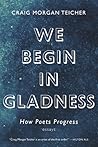
― We Begin in Gladness: How Poets Progress
― We Begin in Gladness: How Poets Progress
“Most poets, in addition to being word fetishists, finally dedicate themselves to poetry -- or find themselves helplessly in its thrall -- in order to answer for something deeper and perhaps darker than their passion for words.”
― We Begin in Gladness: How Poets Progress
― We Begin in Gladness: How Poets Progress
“Poets begin, ideally, in gladness, but often they begin in darker states -- poetry tends to arise as a way forward for those who have something to say that is painful and unutterable by other, more practical, more direct means.”
― We Begin in Gladness: How Poets Progress
― We Begin in Gladness: How Poets Progress
“When poems are working, they are full of discoveries, thoughts poets didn't know they had, thoughts, perhaps, they hadn't had until that moment, which are encoded in the language itself, which poets have trained themselves to hear.”
― We Begin in Gladness: How Poets Progress
― We Begin in Gladness: How Poets Progress
“Poets are word fetishists.”
― We Begin in Gladness: How Poets Progress
― We Begin in Gladness: How Poets Progress
“death must be very precious
or else why carry it
all your life like an egg.”
― Brenda Is in the Room and Other Poems
or else why carry it
all your life like an egg.”
― Brenda Is in the Room and Other Poems
“A poet casts words into the ether to hear what words come back.”
― We Begin in Gladness: How Poets Progress
― We Begin in Gladness: How Poets Progress
“Poetry is speech, cast in written language, that demands a response; it’s part of a conversation.”
―
―
“[The poet] is the mouth through which [their] time is sung.”
― We Begin in Gladness: How Poets Progress
― We Begin in Gladness: How Poets Progress
“[A] basic qualification for a poet [is] the ability to passionately hold two opposing feelings at once. Poets need ambivalence in order to acknowledge the unsayable and speak nonetheless.”
― We Begin in Gladness: How Poets Progress
― We Begin in Gladness: How Poets Progress