Goodreads helps you follow your favorite authors. Be the first to learn about new releases!
Start by following Margaret Heffernan.

Showing 1-30 of 44
“You cannot fix a problem that you refuse to acknowledge.”
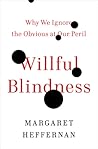
― Willful Blindness: Why We Ignore the Obvious at Our Peril
― Willful Blindness: Why We Ignore the Obvious at Our Peril
“When we care about people, we care less about money, and when we care about money, we care less about people.”
― Willful Blindness: Why We Ignore the Obvious at Our Peril
― Willful Blindness: Why We Ignore the Obvious at Our Peril
“As long as it (an issue) remains invisible, it is guaranteed to remain insoluble.”
― Willful Blindness: Why We Ignore the Obvious at Our Peril
― Willful Blindness: Why We Ignore the Obvious at Our Peril
“The combination of power, optimism and abstract thinking makes powerful people more certain. The more cut-off they are from others, the more confident they are that they are right.”
― Willful Blindness: Why We Ignore the Obvious at Our Peril
― Willful Blindness: Why We Ignore the Obvious at Our Peril
“Silence is the language of inertia.”
― Willful Blindness: Why We Ignore the Obvious at Our Peril
― Willful Blindness: Why We Ignore the Obvious at Our Peril
“Being a critical thinker starts with resisting the urge to be a pleaser.”
― Willful Blindness: Why We Ignore the Obvious at Our Peril
― Willful Blindness: Why We Ignore the Obvious at Our Peril
“We know - intellectually - that confronting an issue is the only way to resolve it. But any resolution will disrupt the status quo. Given the choice between conflict and change on the one hand, and inertia on the other, the ostrich position can seem very attractive.”
― Willful Blindness: Why We Ignore the Obvious at Our Peril
― Willful Blindness: Why We Ignore the Obvious at Our Peril
“money appears to motivate only our interest in ourselves, making us selfish and self-centered...Money makes people feel self-sufficient, which also means they don't need or care about others; it's each man for himself”
― Willful Blindness: Why We Ignore the Obvious at Our Peril
― Willful Blindness: Why We Ignore the Obvious at Our Peril
“Money is just one of the forces that blind us to information and issues which we could pay attention to - but don't. It exacerbates and often rewards all the other drivers of willful blindness; our preference for the familiar, our love for individuals and for big ideas, a love of busyness and our dislike of conflict and change, the human instinct to obey and conform and our skill at displacing and diffusing responsibility. All of these operate and collaborate with varying intensities at different moments in our lives. The common denominator is that they all make us protect our sense of self-worth, reducing dissonance and conferring a sense of security, however illusory. In some ways, they all act like money; making us feel good at first, with consequences we don't see. We wouldn't be so blind if our blindness didn't deliver rewards; the benefit of comfort and ease.”
― Willful Blindness: Why We Ignore the Obvious at Our Peril
― Willful Blindness: Why We Ignore the Obvious at Our Peril
“The sooner we associate long hours and multitasking with incompetence and carelessness the better. The next time you hear boasts of executives pulling an all-nighter or holding conference calls in their cars, be sure to offer your condolences; it's grim being stuck in sweatshops run by managers too ignorant to understand productivity and risk. Working people like this is as smart as running your factory without maintenance. In manufacturing and engineering businesses, everyone learns that the top priority is asset integrity: protecting the machinery on which the business depends. In knowledge-based economies, that machinery is the mind.”
― Willful Blindness: Why We Ignore the Obvious at Our Peril
― Willful Blindness: Why We Ignore the Obvious at Our Peril
“Humans do not have enough mental capacity to do all the things that we think we can do. As attentional load increases, attentional capacity gradually diminishes.”
― Willful Blindness: Why We Ignore the Obvious at Our Peril
― Willful Blindness: Why We Ignore the Obvious at Our Peril
“Dominant people, it appears, use snap judgements and conform to received wisdom more than do the less dominant. Those who need power, and those who have it, think differently.”
― Willful Blindness: Why We Ignore the Obvious at Our Peril
― Willful Blindness: Why We Ignore the Obvious at Our Peril
“Overall, people are about twice as likely to seek information that supports their own point of view as they are to consider an opposing idea.19”
― Willful Blindness: Why We Ignore the Obvious at Our Peril
― Willful Blindness: Why We Ignore the Obvious at Our Peril
“On a voyage of exploration, how can you price what you’ll find before you even set sail?”
― Uncharted: How to Map the Future
― Uncharted: How to Map the Future
“Those who consistently attempt multitasking find it harder to ignore irrelevant information and take longer moving between tasks—in other words, for all their frantic activity, they’re actually wasting time. And”
― Beyond Measure: The Big Impact of Small Changes
― Beyond Measure: The Big Impact of Small Changes
“When we are tired or preoccupied - what psychologists call 'resource-depleted' - we start to economise, to conserve those resources. Higher-order thinking is more expensive. So too is doubt, scepticism, arugment. 'Resource depletion specifically disables cognitive elaboration,' wrote Harvard psychologist Daniel Gillbert...Because it takes less brain power to believe than to doublt, we are, when tired or distracted, gullible. Because we are all biased, and biases are quick and effortless, exhaustion tends to make us prefer the information we know and are comfortable with. We are too tired to do the heavier lifting of examining new or contradictory information, so we fall back on our biases the opinions and the people we already trust”
― Willful Blindness: Why We Ignore the Obvious at Our Peril
― Willful Blindness: Why We Ignore the Obvious at Our Peril
“according to the psychologist irving Janis, is that our sense of belonging (which makes us feel safe) blinds us to dangers and encourages greater risk-taking.”
― Willful Blindness: Why We Ignore the Obvious at Our Peril
― Willful Blindness: Why We Ignore the Obvious at Our Peril
“thinking: a rather prosaic, low-tech concept, easily forgotten and routinely underrated. But”
― Beyond Measure: The Big Impact of Small Changes
― Beyond Measure: The Big Impact of Small Changes
“In treating people as less important than things, work becomes both demoralised and demoralising and we become blind to the moral content of our decisions...Money and wilfful blindness make us act in ways incompatible wiht what believe our ethics to be, and often even with our own self-interest...the problem with money isn't fundamentally about greed, although it can be comforting to think so. The problem with money is that we live in societies in which mutual support and co-operation is essential, but money erodes the relationships we need to lead productive, fulfilling and genuinely happy lives. When money becomes the dominant behavior, it doesn't cooperate with, or amplify, our relationships; it disengages us from them.”
― Willful Blindness: Why We Ignore the Obvious at Our Peril
― Willful Blindness: Why We Ignore the Obvious at Our Peril
“It’s a truism that love is blind; what’s less obvious is just how much evidence it can ignore.”
― Willful Blindness: Why We Ignore the Obvious at Our Peril
― Willful Blindness: Why We Ignore the Obvious at Our Peril
“Was I wilfully blind when I married Michael? Of course I was. I knew about his heart condition - everyone did. But I fell in love with him and decided it didn't matter. We were going to live for ever, somehow. Now I know that the fact that we had the same initials, were both expatriates, had gone to the same university, and were of medium build made the relationship highly determined. But I might have done the research and discovered his short life expectancy or talked to psychologists about the pain of grieving or read books about the sadness of widowhood. But I didn't do any of those things. I looked away from those sad certainties and pretended that they weren't there.
Love is blind, not, as in mythology, because Cupid's arrows are random but because, once struck by them, we are left blind. When we love someone, we see them as smarter, wittier, prettier, stronger than anyone else sees them.”
― Willful Blindness: Why We Ignore the Obvious at Our Peril
Love is blind, not, as in mythology, because Cupid's arrows are random but because, once struck by them, we are left blind. When we love someone, we see them as smarter, wittier, prettier, stronger than anyone else sees them.”
― Willful Blindness: Why We Ignore the Obvious at Our Peril
“Questions are the heart and soul of constructive conflict. They open up the exploration, bring in new information, and reframe debate. When”
― Beyond Measure: The Big Impact of Small Changes
― Beyond Measure: The Big Impact of Small Changes
“Indeed, there seems to be some evidence not only that all love is based on illusion — but that love positively requires illusion in order to endure.”
― Willful Blindness: Why We Ignore the Obvious at Our Peril
― Willful Blindness: Why We Ignore the Obvious at Our Peril
“In business,” Siilasmaa said, “we forget that we are human. Many strong leaders think they should not be friends with their colleagues. I disagree. Business is emotional. I like to be friends with my colleagues. You get through a crisis because you care so much.”
― Uncharted: How to Navigate the Future
― Uncharted: How to Navigate the Future
“It’s when we stop and think that we rediscover the courage, wit, compassion, imagination, delight, frustration, discovery, and devotion that work can provoke—in short, all the things at work that do count, beyond measure.”
― Beyond Measure: The Big Impact of Small Changes
― Beyond Measure: The Big Impact of Small Changes
“The only consequence of their (employee) silence is that the blind (employer) lead the blind.”
― Willful Blindness: Why We Ignore the Obvious at Our Peril
― Willful Blindness: Why We Ignore the Obvious at Our Peril
“Over 100 years of research into productivity has shown that, after about forty hours a week, when we work longer, we make more mistakes – and the extra time goes to cleaning them up, the mess we made. ‘We see it here in England and in the”
― A Bigger Prize: When No One Wins Unless Everyone Wins
― A Bigger Prize: When No One Wins Unless Everyone Wins
“Seventy percent of US companies now use open-plan offices and hot desking in the hope that these free-form physical structures will provoke free-form thinking. This architectural determinism isn’t entirely convincing—there’s plenty of evidence that people find open workspaces noisy, distracting, and impersonal. Walking through several such workspaces recently, I couldn’t help but notice how hard everyone was working to simulate privacy. Plugged into headphones, surrounded by stacks of books and temporary dividers, defensiveness was more evident than openness. Architecture alone won’t change mindsets and tearing down physical walls won’t demolish the mental silos that trap thinking.”
― Beyond Measure: The Big Impact of Small Changes
― Beyond Measure: The Big Impact of Small Changes
“the road to success is littered with mistakes, it matters more to build trust and encourage ambition than to reward obedience. At”
― Beyond Measure: The Big Impact of Small Changes
― Beyond Measure: The Big Impact of Small Changes
“Because it takes less brain power to believe than to doubt, we are, when tired or distracted, gullible.25 Because we are all biased, and biases are quick and effortless, exhaustion makes us favor the information we know and are comfortable with. We’re too tired to do the heavier lifting of examining new or contradictory information, so we fall back on our biases, the opinions and the people we already trust.”
― Willful Blindness: Why We Ignore the Obvious at Our Peril
― Willful Blindness: Why We Ignore the Obvious at Our Peril