
 Sign in with Facebook
Charles Porterfield Krauth’s Followers (2)

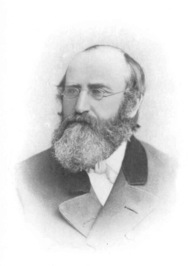
Charles Porterfield Krauth
Born
in Martinsburg, Virginia, The United States
March 17, 1823
Died
January 02, 1883
More books by Charles Porterfield Krauth…


“The Pelagianizing Romanist says, Lust, or concupiscence, brings forth sin, therefore it cannot be sin, because the mother cannot be the child. We reply, Concupiscence brings forth sin, therefore it must be sin, because child and mother must have the same nature. The grand sophism of Pelagianism is the assumption that sin is confined to acts, that guilty acts can be the product of innocent condition, that the effect can be sinful, yet the cause free from sin--that the unclean can be brought forth from the clean.”
―
―
“It is the distinctive position of the Reformation with which, over against Rome, it stands or falls, that that which properly constitutes, defines, and perpetuates in unity a Church, is its doctrine, not its name or organization. While a Church retains its proper identity it retains of necessity its proper doctrine. Deserting its doctrine it loses its identity. The Church is not a body which bears its name like England, or America, which remain equally England and America, whether savage or civilized, Pagan or Christian, Monarchical or Republican. Its name is one which properly indicates its faith--and the faith changing, the Church loses its identity. Pagans may become Mohammedans, but then they are no longer Pagans--they are Mohammedans. Jews may become Christians, but then they are no longer Jews in religion. A Manichean man, or Manichean Church, might become Catholic, but then they would be Manichean no more. A Romish Church is Romish; a Pelagian Church is Pelagian; a Socinian Church is Socinian, though they call themselves Protestant, Evangelical, or Trinitarian. If the whole nominally Lutheran Church on earth should repudiate the Lutheran doctrine, that doctrine would remain as really Lutheran as it ever was. A man, or body of men, may cease to be Lutherans, but a doctrine which is Lutheran once, is Lutheran forever. Hence, now, as from the first, that is not a Lutheran Church, in the proper and historical sense, which cannot ex animo declare that it shares in the accord and unanimity with which each of the Doctrines of the Augsburg Confession was set forth.”
―
―
“In Poland and Hungary, the official title of our communion is “CHURCH OF THE AUGSBURG CONFESSION,” and this Church of the Augsburg confession.is the name which, on the title-page of the Form of Augsburg Concord, and repeatedly within it, is given to our churches.*”
― The Conservative Reformation & Its Theology
― The Conservative Reformation & Its Theology
