
 Sign in with Facebook
Farley Granger’s Followers (4)


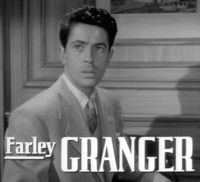
Farley Granger
Born
in San Jose, CA, The United States
July 01, 1925
Died
March 27, 2011
Website
Genre


* Note: these are all the books on Goodreads for this author. To add more, click here.
“Barbara and I had arrived early, so I got to admire everyone’s entrance. We were seated at tables around a dance floor that had been set up on the lawn behind the house. Barbara and I shared a table with Deborah Kerr and her husband. Deborah, a lovely English redhead, had been brought to Hollywood to play opposite Clark Gable in The Hucksters. Louis B. Mayer needed a cool, refined beauty to replace the enormously popular redhead, Greer Garson, who had married a wealthy oil magnate and retired from the screen in the mid-fifties. Deborah, like her predecessor, had an ultra-ladylike air about her that was misleading. In fact, she was quick, sharp, and very funny. She and Barbara got along like old school chums. Jimmy Stewart was also there with his wife. It was the first time I’d seen him since we’d worked for Hitchcock. It was a treat talking to him, and I felt closer to him than I ever did on the set of Rope. He was so genuinely happy for my success in Strangers on a Train that I was quite moved. Clark Gable arrived late, and it was a star entrance to remember. He stopped for a moment at the top of the steps that led down to the garden. He was alone, tanned, and wearing a white suit. He radiated charisma. He really was the King. The party was elegant. Hot Polynesian hors d’oeuvres were passed around during drinks. Dinner was very French, with consommé madrilène as a first course followed by cold poached salmon and asparagus hollandaise. During dessert, a lemon soufflé, and coffee, the cocktail pianist by the pool, who had been playing through dinner, was discreetly augmented by a rhythm section, and they became a small combo for dancing. The dance floor was set up on the lawn near an open bar, and the whole garden glowed with colored paper lanterns. Later in the evening, I managed a subdued jitterbug with Deborah Kerr, who was much livelier than her cool on-screen image. She had not yet done From Here to Eternity, in which she and Burt Lancaster steamed up the screen with their love scene in the surf. I was, of course, extremely impressed to be there with Hollywood royalty that evening, but as far as parties go, I realized that I had a lot more fun at Gene Kelly’s open houses.”
― Include Me Out: My Life from Goldwyn to Broadway
― Include Me Out: My Life from Goldwyn to Broadway
“Loretta Young, a world-class Catholic who kept a “swear box” on the set into which everyone had to make a deposit for their naughty words. Merman saw it, turned to Loretta, and said, “What the hell is this?” Loretta smiled sweetly and said, “Oh, Ethel, I’m afraid now you have to put twenty-five cents into the swear box.” Ethel gave her a look and grinned as she said, “How much will it cost me to tell you to go fuck yourself?”
― Include Me Out: My Life from Goldwyn to Broadway
― Include Me Out: My Life from Goldwyn to Broadway
“With William Wyler off in the Army, the fact that the Goldwyn Studio flourished during the war years was an accomplishment for which a former borscht belt comedian, Danny Kaye, should be given most of the credit. His first film for Goldwyn, Up in Arms, was a mediocre remake of Eddie Cantor’s 1930 hit Whoopee! The film was a big moneymaker for Goldwyn, and made an instant star of Danny Kaye. In 1948, Goldwyn was in danger of losing Danny, who was unhappy with the rehashed scripts he was being asked to do, particularly A Song Is Born, a dismal remake of Ball of Fire, a wonderful film Goldwyn had produced only seven years earlier starring Barbara Stanwyck and Gary Cooper. Goldwyn was smart enough to leave Danny alone, but he forced Virginia Mayo to watch Stanwyck’s performance in the original over and over. Used correctly, as Wyler used her in The Best Years of Our Lives, Virginia could be very effective, but she could never replicate Barbara Stanwyck, who was one of the most unique talents in the history of film.”
― Include Me Out: My Life from Goldwyn to Broadway
― Include Me Out: My Life from Goldwyn to Broadway
