
Discover new books on Goodreads
See if your friends have read any of Jon R. Jordan's books
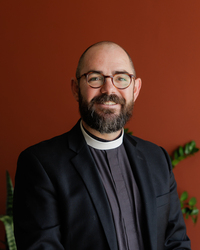
more photos (1)
Jon R. Jordan’s Followers (23)


690 books
|
172 friends

1,102 books
|
352 friends

662 books
|
223 friends

2,123 books
|
266 friends

786 books
|
482 friends

72 books
|
45 friends

1,823 books
|
736 friends

3 books
|
169 friends
More friends…
Jon R. Jordan
Goodreads Author
Website
Genre
Member Since
November 2010
URL
https://www.goodreads.com/jonrjordan
Rhythms of Habit Pre-orders open! Ships in September!
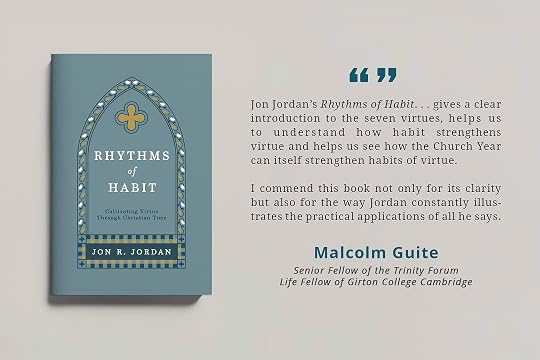
Pre-order today!
Rhythms of Habit proofs are now complete. Pre-orders will begin shipping in the weeks to come!
From the Publisher
In Rhythms of Habit, priest, educator, and headmaster Jon Jordan explores the relationship between virtue, habit, and the Church Year. Drawing from Scripture, classical Christian wisdom, and years of pastoral ministry, he shows how the calendar of the Church serves as a p Read more of this blog post »


|
From Law to Logos: Reading St. Paul's Epistle to the Galatians
|
|

|
Rhythms of Habit: Cultivating Virtue Through Christian Time
|
|
* Note: these are all the books on Goodreads for this author. To add more, click here.

Jon’s Recent Updates
|
Jon Jordan
is currently reading

|
|
|
Jon Jordan
finished reading

|
|
|
Jon Jordan
shared
a
quote

“Whatever humans are, we are a different sort of being than pure animals. As Mortimer Adler, teacher and student of the Great Texts, wrote, “The ultimate questions which man asks about himself are partly answered by the very fact of their being asked.” Dolphins and apes do not have volumes of literature from cultures all around the globe spanning millennia in which they ask what it means to be an animal. Humans do. The ability to reason and the desire to question moral decisions is built into human nature.
Our actions have moral consequences—good or bad—for ourselves and for other beings. A tree does not consciously fall on a house, and thus, it is not a morally bad tree if it does. But we would be very quick to call a man bad if he consciously destroyed a neighbor’s home against the will of that neighbor. Blaise Pascal said that “man must not think that he is on a level either with the brutes or with the angels, nor must he be ignorant of both sides of his nature; but he must know both. ...more Jon R. Jordan |
|
|
Jon Jordan
shared
a
quote
“Any time is a great time for any habit to strengthen any virtue. Some seasons of the church calendar naturally strengthen certain moral muscles. Rather than thinking about the calendar as a ridged straightjacket, I hope you begin to see it as a garden bed, tended by a Good Gardener, who walks through the church seasons of each year with you so that, over time, you might flourish as a human person.
The church calendar cannot make you into the person God made you to be. But the Lord of that calendar will. And by following him throughout each year, you will find a prescription of habits and liturgies that God will use to strengthen your cardinal virtues and theological virtues. My hope is that this book equips you to approach each season with a posture of reflection aimed at growth. The Good Gardener is alive and ready to walk with you through each season.” Jon R. Jordan |
|
|
Jon Jordan
is 54% done with Galahad and the Grail

|
|
|
Jon Jordan
is currently reading
|
|
|
Jon Jordan
finished reading

|
|
|
Jon Jordan
has read

|
|
|
Jon Jordan
has read

|
|
|
Jon Jordan
is currently reading

|
|
“But there is more to growing in justice than simply seeing justice or injustice on display. Since justice is a virtue of desire, we often think that our job is simply to wait for that desire to come. In one of the last prophetic books found in the Old Testament, the prophet Micah shows us another way: “The Lord has shown you, O mortal, what is good. And what does the Lord require of you, but to act justly, love mercy, and walk humbly with your God.”
Act justly. Do something for the good of another person. Doing acts of justice—even on the smallest of scales and when it costs you very little—will strengthen your desire and ability to act justly when it costs you something. Developing a habit of giving regularly to the poor will increase your desire to continue to give more. Dealing honestly with your friend in a board game will increase your ability and desire to deal honestly when you stand to lose something that matters.”
― Rhythms of Habit: Cultivating Virtue Through Christian Time
“Whatever humans are, we are a different sort of being than pure animals. As Mortimer Adler, teacher and student of the Great Texts, wrote, “The ultimate questions which man asks about himself are partly answered by the very fact of their being asked.” Dolphins and apes do not have volumes of literature from cultures all around the globe spanning millennia in which they ask what it means to be an animal. Humans do. The ability to reason and the desire to question moral decisions is built into human nature.
Our actions have moral consequences—good or bad—for ourselves and for other beings. A tree does not consciously fall on a house, and thus, it is not a morally bad tree if it does. But we would be very quick to call a man bad if he consciously destroyed a neighbor’s home against the will of that neighbor.
Blaise Pascal said that “man must not think that he is on a level either with the brutes or with the angels, nor must he be ignorant of both sides of his nature; but he must know both.” We are not mere animals, and we are not pure disembodied spirits. We are more than what we are made of physically, but—unlike angels—we are also bound to the physical world. We live as embodied souls capable of reasoning and acting in this physical world. Our ideas and our actions have moral consequences, big and small, for ourselves and for others.
Humans are, in other words, moral beings. What we think and do, over the course of a lifetime and in small, everyday moments, matters a great deal. The smallest of words or actions can wound or heal those around you. This is part of the weight we bear as human beings.”
― Rhythms of Habit: Cultivating Virtue Through Christian Time
“Any time is a great time for any habit to strengthen any virtue. Some seasons of the church calendar naturally strengthen certain moral muscles. Rather than thinking about the calendar as a ridged straightjacket, I hope you begin to see it as a garden bed, tended by a Good Gardener, who walks through the church seasons of each year with you so that, over time, you might flourish as a human person.
The church calendar cannot make you into the person God made you to be. But the Lord of that calendar will. And by following him throughout each year, you will find a prescription of habits and liturgies that God will use to strengthen your cardinal virtues and theological virtues.
My hope is that this book equips you to approach each season with a posture of reflection aimed at growth. The Good Gardener is alive and ready to walk with you through each season.”
― Rhythms of Habit: Cultivating Virtue Through Christian Time
“But there is more to growing in justice than simply seeing justice or injustice on display. Since justice is a virtue of desire, we often think that our job is simply to wait for that desire to come. In one of the last prophetic books found in the Old Testament, the prophet Micah shows us another way: “The Lord has shown you, O mortal, what is good. And what does the Lord require of you, but to act justly, love mercy, and walk humbly with your God.”
Act justly. Do something for the good of another person. Doing acts of justice—even on the smallest of scales and when it costs you very little—will strengthen your desire and ability to act justly when it costs you something. Developing a habit of giving regularly to the poor will increase your desire to continue to give more. Dealing honestly with your friend in a board game will increase your ability and desire to deal honestly when you stand to lose something that matters.”
― Rhythms of Habit: Cultivating Virtue Through Christian Time
Act justly. Do something for the good of another person. Doing acts of justice—even on the smallest of scales and when it costs you very little—will strengthen your desire and ability to act justly when it costs you something. Developing a habit of giving regularly to the poor will increase your desire to continue to give more. Dealing honestly with your friend in a board game will increase your ability and desire to deal honestly when you stand to lose something that matters.”
― Rhythms of Habit: Cultivating Virtue Through Christian Time
“Any time is a great time for any habit to strengthen any virtue. Some seasons of the church calendar naturally strengthen certain moral muscles. Rather than thinking about the calendar as a ridged straightjacket, I hope you begin to see it as a garden bed, tended by a Good Gardener, who walks through the church seasons of each year with you so that, over time, you might flourish as a human person.
The church calendar cannot make you into the person God made you to be. But the Lord of that calendar will. And by following him throughout each year, you will find a prescription of habits and liturgies that God will use to strengthen your cardinal virtues and theological virtues.
My hope is that this book equips you to approach each season with a posture of reflection aimed at growth. The Good Gardener is alive and ready to walk with you through each season.”
― Rhythms of Habit: Cultivating Virtue Through Christian Time
The church calendar cannot make you into the person God made you to be. But the Lord of that calendar will. And by following him throughout each year, you will find a prescription of habits and liturgies that God will use to strengthen your cardinal virtues and theological virtues.
My hope is that this book equips you to approach each season with a posture of reflection aimed at growth. The Good Gardener is alive and ready to walk with you through each season.”
― Rhythms of Habit: Cultivating Virtue Through Christian Time
“Whatever humans are, we are a different sort of being than pure animals. As Mortimer Adler, teacher and student of the Great Texts, wrote, “The ultimate questions which man asks about himself are partly answered by the very fact of their being asked.” Dolphins and apes do not have volumes of literature from cultures all around the globe spanning millennia in which they ask what it means to be an animal. Humans do. The ability to reason and the desire to question moral decisions is built into human nature.
Our actions have moral consequences—good or bad—for ourselves and for other beings. A tree does not consciously fall on a house, and thus, it is not a morally bad tree if it does. But we would be very quick to call a man bad if he consciously destroyed a neighbor’s home against the will of that neighbor.
Blaise Pascal said that “man must not think that he is on a level either with the brutes or with the angels, nor must he be ignorant of both sides of his nature; but he must know both.” We are not mere animals, and we are not pure disembodied spirits. We are more than what we are made of physically, but—unlike angels—we are also bound to the physical world. We live as embodied souls capable of reasoning and acting in this physical world. Our ideas and our actions have moral consequences, big and small, for ourselves and for others.
Humans are, in other words, moral beings. What we think and do, over the course of a lifetime and in small, everyday moments, matters a great deal. The smallest of words or actions can wound or heal those around you. This is part of the weight we bear as human beings.”
― Rhythms of Habit: Cultivating Virtue Through Christian Time
Our actions have moral consequences—good or bad—for ourselves and for other beings. A tree does not consciously fall on a house, and thus, it is not a morally bad tree if it does. But we would be very quick to call a man bad if he consciously destroyed a neighbor’s home against the will of that neighbor.
Blaise Pascal said that “man must not think that he is on a level either with the brutes or with the angels, nor must he be ignorant of both sides of his nature; but he must know both.” We are not mere animals, and we are not pure disembodied spirits. We are more than what we are made of physically, but—unlike angels—we are also bound to the physical world. We live as embodied souls capable of reasoning and acting in this physical world. Our ideas and our actions have moral consequences, big and small, for ourselves and for others.
Humans are, in other words, moral beings. What we think and do, over the course of a lifetime and in small, everyday moments, matters a great deal. The smallest of words or actions can wound or heal those around you. This is part of the weight we bear as human beings.”
― Rhythms of Habit: Cultivating Virtue Through Christian Time
 Christian Book Reviews
— 3923 members
— last activity 17 hours, 27 min ago
This group is created to help Christian authors get more book reviews. Also, if you’re an avid reader who enjoys getting free books in exchange for ho ...more