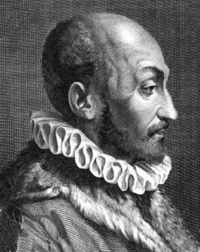
Giambattista della Porta (Italian pronunciation: [dʒambatˈtista ˌdelːa ˈpɔrta]) (1535 – 4 February 1615), also known as Giovanni Battista Della Porta and John Baptist Porta, was an Italian scholar, polymath and playwright who lived in Naples at the time of the Scientific Revolution and Reformation.
Giambattista della Porta spent the majority of his life on scientific endeavors. He benefited from an informal education of tutors and visits from renowned scholars. His most famous work, first published in 1558, was entitled Magiae Naturalis (Natural Magic). In this book he covered a variety of the subjects he had investigated, including the study of: occult philosophy, astrology, alchemy, mathematics, meteorology, and natural philosophy. He was Giambattista della Porta (Italian pronunciation: [dʒambatˈtista ˌdelːa ˈpɔrta]) (1535 – 4 February 1615), also known as Giovanni Battista Della Porta and John Baptist Porta, was an Italian scholar, polymath and playwright who lived in Naples at the time of the Scientific Revolution and Reformation.
Giambattista della Porta spent the majority of his life on scientific endeavors. He benefited from an informal education of tutors and visits from renowned scholars. His most famous work, first published in 1558, was entitled Magiae Naturalis (Natural Magic). In this book he covered a variety of the subjects he had investigated, including the study of: occult philosophy, astrology, alchemy, mathematics, meteorology, and natural philosophy. He was also referred to as "professor of secrets".
Della Porta was the founder of a scientific society called the Academia Secretorum Naturae (Accademia dei Segreti). This group was more commonly known as the Otiosi, (Men of Leisure). Founded sometime before 1580, the Otiosi were one of the first scientific societies in Europe and their aim was to study the "secrets of nature." Any person applying for membership had to demonstrate they had made a new discovery in the natural sciences.
The Academia Secretorum Naturae was compelled to disband when its members were suspected of dealing with the Occult. Della Porta was summoned to Rome by Pope Paul V. Though he personally emerged from the meeting unscathed, the Academia Secretorum Naturae disbanded.
Della Porta was examined by the Inquisition in the years prior to 1578. He was forced to disband his Academia Secretorum Naturae, and in 1592 his philosophical works were prohibited from further publication by the Church. A possible explanation for drawing the ire of the Inquisition lies in Porta's personal relations with Paolo Sarpi after 1579.
The 17 theatrical works that have survived from a total of perhaps 21 or 23 works comprise 14 comedies, one tragicomedy, one tragedy and one liturgical drama.
Although they belong to the lesser-known tradition of the commedia erudita rather than the commedia dell'arte - which means they were written out as entire scripts instead of being improvised from a scenario - della Porta's comedies are eminently performable. While there are obvious similarities between some of the characters in della Porta's comedies and the masks of the commedia dell'arte, it should be borne in mind that the characters of the commedia erudita are uniquely created by the text in which they appear, unlike the masks, which remain constant from one scenario to another. Indeed, the masks of the improvised theatre evolved as stylised versions of recurring character types in the written comedies. By the time Carlo Goldoni started writing new scripts in the 18th century, the "improvised" comedy had become tired and predictable....more