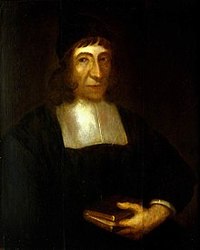
James Guthrie (c.1612 – 1661), was a Scottish Presbyterian minister who was exempted from the general pardon at the Restoration of the Monarchy and hanged in Edinburgh. He was the eldest son of the laird of Guthrie, Forfarshire and was educated at St. Leonard's College, St. Andrews, where he graduated M.A., and became one of the regents, distinguished for his lectures on philosophy.
Guthrie was originally an episcopalian, and is said to have been zealous for prelacy and the ceremonies. Yet in 1638 the strongly antiprelatic assembly at Glasgow put him in the list of those ready for ecclesiastical vacancies. In January 1639 Samuel Rutherford was made divinity professor at St. Andrews, and under his influence Guthrie became a Presbyterian. In 1James Guthrie (c.1612 – 1661), was a Scottish Presbyterian minister who was exempted from the general pardon at the Restoration of the Monarchy and hanged in Edinburgh. He was the eldest son of the laird of Guthrie, Forfarshire and was educated at St. Leonard's College, St. Andrews, where he graduated M.A., and became one of the regents, distinguished for his lectures on philosophy.
Guthrie was originally an episcopalian, and is said to have been zealous for prelacy and the ceremonies. Yet in 1638 the strongly antiprelatic assembly at Glasgow put him in the list of those ready for ecclesiastical vacancies. In January 1639 Samuel Rutherford was made divinity professor at St. Andrews, and under his influence Guthrie became a Presbyterian. In 1642 he was ordained minister of Lauder, Berwickshire, and soon distinguished himself in the cause of the National Covenant. He was a member of the General Assembly from 1644 to 1651. In 1646 he was one of seven commissioners appointed by the Committee of Estates to wait on Charles I at Newcastle-on-Tyne with a letter from the General Assembly.
In 1650 Guthrie treated General John Middleton with a high-handedness which sealed his own fate. Middleton, who joined Charles II immediately on his landing on 23 June, took the lead in a project for a royalist army in the north. On 17 October Guthrie, by the "Western Remonstrance", withdrew from the royalist cause; on 14 December he sent a letter to the General Assembly at Perth denouncing Middleton as an enemy of the Covenant, and proposing his excommunication. Guthrie was appointed to pronounce the sentence next Sunday, and, despite a letter from the assembly bidding him delay the act, carried out the original order. At the next meeting of the commission (2 January 1651) Middleton was loosed from the sentence after public penance. He never forgave the affront.
At the Restoration, Guthrie and nine others met in Edinburgh (23 August 1660) and drew up a "humble petition" to the king setting forth their loyalty, and reminding him of his obligations as a Covenanter. The meeting was ordered to disperse, and as the warning was unheeded arrests were made. Guthrie was imprisoned in Edinburgh Castle. On 25 September his stipend was sequestrated. He was transferred to Dundee on 20 October, and thence to Stirling, where he remained till his trial. On 20 February 1661 he was arraigned for high treason before the parliament, Middleton presiding as commissioner. He was found guilty and on 28 May Parliament ordered him to be hanged at the cross of Edinburgh on 1 June....more

 Sign in with Facebook