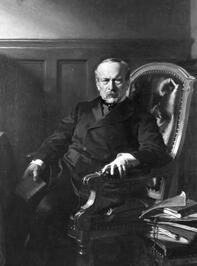
Auguste Baron Lambermont

Auguste Baron Lambermont’s Followers (2)

member photo
member photo

Auguste Baron Lambermont


Born
in Dion-le-Val, United Kingdom of the Netherlands
March 25, 1819

Died
March 07, 1905


François Auguste, Baron Lambermont, was a Belgian statesman. He came of a family of small farmer proprietors, who had held land during three centuries. He was intended for the priesthood and entered the seminary of Floreffe, but his energies claimed a more active sphere. From 1856 to 1863 Lambermont devoted most of his energies to the removal of this impediment. In 1856 he drew up a plan of action, and he prosecuted it with untiring perseverance until he saw it embodied in an international convention seven years later. Twenty-one powers and states attended a conference held on the question at Brussels in 1863, and on 15 July the treaty freeing the Scheldt was signed. For this achievement Lambermont was made a baron. Among other important co ...more

Average rating: 5.0 · 1 rating · 0 reviews · 2 distinct works
Conference Internationale d...

by
it was amazing 5.00 avg rating — 1 rating3 editions
Rate this book
Clear rating
Acte général de la conféren...

by
0.00 avg rating — 0 ratings
Rate this book
Clear rating

* Note: these are all the books on Goodreads for this author. To add more, click here.

Quotes by Auguste Baron Lambermont  (?)
Quotes are added by the Goodreads community and are not verified by Goodreads. (Learn more)

“Mistrust of the foreigner is still at the bottom of the minds of the Chinese. One way if not to destroy, at least to mitigate these prejudices, would be to put the study committee under a neutral banner. The committee would be made up of capitalists and industrialists eager to prepare for the success of lucrative enterprises or of politicians willing to serve the cause of civilization with their help.”
Auguste Baron Lambermont

“When Leopold had an idea in his head, it was impossible to make him quit.”
Auguste Baron Lambermont

“It was no coincidence that dictated my choice. Peace was definitively signed, the country's political constitution in full force, but Belgium was still looking for its ways in the commercial field. That’s where the point was.”
Auguste Baron Lambermont