
Discover new books on Goodreads
See if your friends have read any of Richard Barrios's books
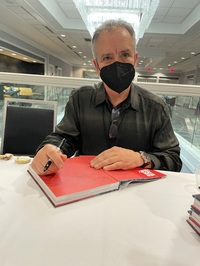
Richard Barrios’s Followers (6)


Richard Barrios
More books by Richard Barrios…


“While timing was only part of the issue with Doris Day, it would be a key reason why, from the mid-1950s onward, good people were unable to appear in good musicals. An original like Never Steal Anything Small was unsuccessful on every level—and heinous in its waste of Jimmy Cagney’s talent—while skillful adaptations like Silk Stockings and Bells Are Ringing flopped resoundingly. As fewer opportunities arose, they were sometimes attended by the questionable notion that dubbing solves all problems. This is why Rossano Brazzi and Sidney Poitier could look great, in South Pacific and Porgy and Bess, and sound ostensibly like the opera singers who were doing the actual vocalizing. While dubbing had been present from the very beginning, it achieved some kind of pinnacle from the mid-fifties to the late sixties. Hiring nonsinging names like Deborah Kerr and Rosalind Russell and Natalie Wood and Audrey Hepburn, even nonsinging non-names like Richard Beymer, was viewed as a form of insurance, conviction be damned.8 Casting for name recognition instead of experience has long been part of the film equation, and it cuts both ways. It may, for example, have seemed more astute than desperate to put Lee Marvin and Clint Eastwood into Paint Your Wagon, despite the equivocal results. Nicole Kidman in Moulin Rouge! was far less a musical player than a photogenic, aurally enhanced artifact, and many people left Mamma Mia! wondering if Pierce Brosnan’s execrable singing was intended as a deliberate joke. In contrast with these are the film people who take the plunge with surprising ease.”
― Dangerous Rhythm: Why Movie Musicals Matter
― Dangerous Rhythm: Why Movie Musicals Matter
“Where Jolson conquered, Bing Crosby convinced and charmed, and like Astaire, Jolson too for that matter, he did not possess the physical gifts of a standard leading man (angles and ears and hair, yet again). Also like Astaire, he made it all seem easy, with the laid-back acting and the unforced way that devastating baritone could pour out and swing out. In one crucial sense he was more beholden to Jolson than Astaire, being primarily a solo performer who sang to people more than he sang with them. Recall: who was Crosby’s only steady partner on film? Bob Hope, in a partnership based in jokey rivalry. Other singers in Crosby films, besides Hope and Dorothy Lamour, seldom counted. Nor did most of Crosby’s films. Paramount, his home studio, was a formula-bound factory for most of the 1930s and ’40s, and the golden goose of the Crosby films did not countenance feather-ruffling. One after another, they were amiable time-passers, relaxed escapism that made a mint and sold tons of records and sheet music. For many then and some now, these vehicles offered unthreatening comfort—few chances taken, little deviation from formula, a likable guy ambling through some minor plot and singing mostly great songs. On occasion there was something as glaring as the ridiculous Dixie: as composer Dan Emmett, Crosby speeds up the title song into an uptempo hit only because the theater’s caught on fire. Generally, his films lacked even that cuckoo invigoration, which is why posterity dotes on Holiday Inn and its splashy, inferior semi-remake, White Christmas, and few of the others. While it would not be accurate to view Crosby as another megalomaniacal Jolson type, he lacked Astaire’s forceful imagination. Greater professional curiosity might have made his films—not simply his singing—transcend time and circumstance.”
― Dangerous Rhythm: Why Movie Musicals Matter
― Dangerous Rhythm: Why Movie Musicals Matter
Topics Mentioning This Author
| topics | posts | views | last activity | |
|---|---|---|---|---|
| Crazy Challenge C...: Oscars Through the Years | 832 | 142 | Mar 22, 2021 08:45PM | |
| Crazy Challenge C...: The Periodic Table - Spell Out | 180 | 84 | Jan 24, 2023 07:21PM | |
| Crazy Challenge C...: 2022 How Many Pages? | 139 | 109 | Feb 22, 2023 05:26PM | |
| Crazy Challenge C...: The Infinity Saga | 507 | 158 | Jul 14, 2023 07:40PM | |
| Crazy Challenge C...: 22x22 Challenge | 196 | 128 | Oct 15, 2023 12:43PM | |
| Crazy Challenge C...: The Periodic Table | 335 | 138 | Feb 07, 2025 12:20PM | |
| Crazy Challenge C...: TV Spell Out - Law & Order | 129 | 93 | Feb 26, 2025 05:36PM |
Is this you? Let us know. If not, help out and invite Richard to Goodreads.