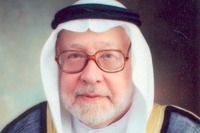
Ezzeddin Ibrahim studied Arabic literature at Cairo University and later took his doctorate at London. He taught and held educational posts in Libya, Syria, and Qatar before becoming Professor of Arabic Literature at Riyadh University in 1967. He is co-author of some twenty text books and is well known as writer and lecturer on Islamic subjects. He is active in Islamic affairs and is chairman or a member of the governing boards of a number of cultural and educational institutions within and outside the Arab world. He has been Cultural Adviser to the President of the United Arab Emirates and was appointed Vice-Chancellor of the UAE University in 1981.
Throughout his life he remained passionate in his call for Islamic-Christian dialogue and wEzzeddin Ibrahim studied Arabic literature at Cairo University and later took his doctorate at London. He taught and held educational posts in Libya, Syria, and Qatar before becoming Professor of Arabic Literature at Riyadh University in 1967. He is co-author of some twenty text books and is well known as writer and lecturer on Islamic subjects. He is active in Islamic affairs and is chairman or a member of the governing boards of a number of cultural and educational institutions within and outside the Arab world. He has been Cultural Adviser to the President of the United Arab Emirates and was appointed Vice-Chancellor of the UAE University in 1981.
Throughout his life he remained passionate in his call for Islamic-Christian dialogue and worked tirelessly articulating his message, both in person as a key speaker at many international conferences and through his varied publications in journals, newspapers and books. During this time he came into contact with numerous distinguished people, and amongst those who had a profound effect on him was Pope Paul Vl who he met at his official residence in the Vatican in 1978 and the Dalai Lama whose philosophical and thoughtful insights left a lasting impression. Dr Ezzeddin Ibrahim fervently believed that dialogue begins by respecting the right of others to their beliefs and by strengthening the religious foundations for coexistence in one nation.
With that in mind and following a recent meeting with Pope Benedict, he worked closely with the ruler of Saudi Arabia, King Abdullah, to organize and participate in dialogue in Madrid in 2008, concentrating on life in human societies, international cooperation, human rights, issues of security, peace, and living together in the world. Besides speakers from the three monotheistic religions, Dr Ezzeddin, with the sincere support of a strong Middle Eastern monarch, was able to include delegates from other religious traditions, faiths and philosophies who he felt were under represented at such conferences. Although previously attempted and partly realised, this had not happened before, as it did so comprehensively in Madrid.