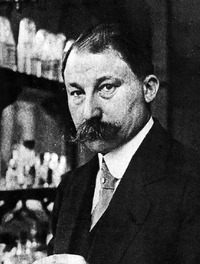
Victor Grignard

more photos (1)

Victor Grignard’s Followers (4)

member photo
member photo
member photo
member photo

Victor Grignard


Born
in Cherbourg, France
May 06, 1871

Died
December 13, 1935

Website

Genre

Influences


François Auguste Victor Grignard (May 6, 1871 in Cherbourg - December 13, 1935 in Lyon) was a Nobel Prize-winning French chemist.

Grignard was the son of a sail maker. After studying mathematics at Lyon he transferred to chemistry and discovered the synthetic reaction bearing his name (the Grignard reaction) in 1900. He became a professor at the University of Nancy in 1910 and was awarded the Nobel Prize in Chemistry in 1912. During World War I he studied chemical warfare agents, particularly the manufacture of phosgene and the detection of mustard gas. His counterpart on the German side was another Nobel Prize winning Chemist, Fritz Haber.

Grignard is most noted for devising a new method for generating carbon-carbon bonds using magnesium to
...more

Average rating: 0.0 · 0 ratings · 0 reviews · 4 distinct works
Sur Les Combinaisons Organo...

0.00 avg rating — 0 ratings2 editions
Rate this book
Clear rating
Histoire Du Concile de Tren...

0.00 avg rating — 0 ratings
Rate this book
Clear rating
Notice sur les titres et tr...

0.00 avg rating — 0 ratings
Rate this book
Clear rating
Traite De Chimie Organique ...

0.00 avg rating — 0 ratings
Rate this book
Clear rating

* Note: these are all the books on Goodreads for this author. To add more, click here.

Quotes by Victor Grignard  (?)
Quotes are added by the Goodreads community and are not verified by Goodreads. (Learn more)

“On the terrace of the Pepiniere, the 150 pupils of the Institut Chemique talk chemistry as they leave the auditoria and the laboratory. The echoes of the magnificent public garden of the city of Nancy make the words reverberate; coupling, condensation, grignardization. Moreover, their clothes stay impregnated with strong and characteristic odours; we follow the initiates of Hermes by their scent. In such an environment, how is it possible not to be productive?”
Victor Grignard