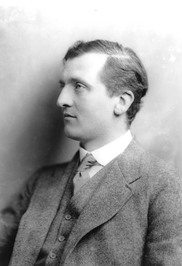
,
T.E. Hulme

T.E. Hulme’s Followers (14)

member photo
member photo
member photo
member photo
member photo
member photo
member photo
member photo
member photo
member photo
member photo
member photo
member photo
member photo

T.E. Hulme


Born
in Endon, The United Kingdom
September 16, 1883

Died
September 28, 1917

Genre


Thomas Ernest Hulme was an English critic and poet who, through his writings on art, literature and politics, had a notable influence upon modernism. He was an aesthetic philosopher and the 'father of imagism'. ...more

Average rating: 3.72 · 1,534 ratings · 175 reviews · 27 distinct worksSimilar authors
Speculations

by
3.70 avg rating — 27 ratings — published 1924 — 35 editions
Rate this book
Clear rating
T. E. Hulme: Selected Writings

by
3.72 avg rating — 25 ratings — published 1998 — 4 editions
Rate this book
Clear rating
Complete Poems

3.33 avg rating — 6 ratings2 editions
Rate this book
Clear rating
The Collected Writings of T...

by
3.67 avg rating — 3 ratings — published 1994 — 3 editions
Rate this book
Clear rating
Lecture on Modern Poetry

3.67 avg rating — 3 ratings
Rate this book
Clear rating
Modlitba za úsměv luny: Bás...

by
it was amazing 5.00 avg rating — 2 ratings
Rate this book
Clear rating
Further Speculations

by
liked it 3.00 avg rating — 3 ratings — published 1955 — 8 editions
Rate this book
Clear rating
Notes on Language & Style

it was amazing 5.00 avg rating — 1 rating — published 1974 — 6 editions
Rate this book
Clear rating
La arcilla extendida: Notas...

by
it was amazing 5.00 avg rating — 1 rating
Rate this book
Clear rating
Imagens de Modernidade: Ens...

by
really liked it 4.00 avg rating — 1 rating — published 1995
Rate this book
Clear rating
More books by T.E. Hulme…
Quotes by T.E. Hulme  (?)
Quotes are added by the Goodreads community and are not verified by Goodreads. (Learn more)

“Old houses were scaffolding once and workmen whistling.”
T.E. Hulme

“All clear cut ideas turn out to be wrong.”
T.E. Hulme

“A poem is good if it contains a new analogy and startles the reader out of the habit of treating words as counters.”
T. E. Hulme