
 Sign in with Facebook
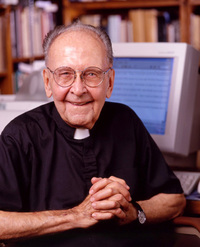
Walter J. Ong’s Followers (81)


Walter J. Ong
Born
in Kansas City, The United States
November 30, 1912
Died
August 12, 2003


|
Orality and Literacy: The Technologizing of the Word
—
published
1982
—
26 editions
|
|

|
The Presence of the Word: Some Prolegomena for Cultural and Religious History (The Terry Lectures Series)
—
published
1967
—
12 editions
|
|

|
Ramus, Method, and the Decay of Dialogue: From the Art of Discourse to the Art of Reason
by
—
published
1975
—
6 editions
|
|

|
Interfaces of the Word: Studies in the Evolution of Consciousness and Culture
—
published
1977
—
8 editions
|
|

|
Fighting for Life: Contest, Sexuality, and Consciousness
—
published
1981
—
9 editions
|
|

|
Rhetoric, Romance, and Technology: Studies in the Interaction of Expression and Culture
—
published
1971
—
10 editions
|
|

|
Language as Hermeneutic: A Primer on the Word and Digitization
by |
|

|
An Ong Reader: Challanges for Further Inquiry (Hampton Press Communication Series Media Ecology)
—
published
2002
—
3 editions
|
|

|
Hopkins, the Self, and God
—
published
1986
—
6 editions
|
|

|
In the Human Grain
—
published
1967
—
4 editions
|
|
“Sight isolates, sound incorporates. Whereas sight situates the observer outside what he views, at a distance, sound pours into the hearer. Vision dissects, as Merleau-Ponty has observed (1961). Vision comes to a human being from one direction at a time: to look at a room or a landscape, I must move my eyes around from one part to another. When I hear, however, I gather sound simultaneously from every directions at once; I am at the center of my auditory world, which envelopes me, establishing me at a kind of core of sensation and existence... You can immerse yourself in hearing, in sound. There is no way to immerse yourself similarly in sight.
By contrast with vision, the dissecting sense, sound is thus a unifying sense. A typical visual ideal is clarity and distinctness, a taking apart. The auditory ideal, by contrast, is harmony, a putting together.
Interiority and harmony are characteristics of human consciousness. The consciousness of each human person is totally interiorized, known to the person from the inside and inaccessible to any other person directly from the inside. Everyone who says 'I' means something different by it from what every other person means. What is 'I' to me is only 'you' to you...
In a primary oral culture, where the word has its existence only in sound... the phenomenology of sound enters deeply into human beings' feel for existence, as processed by the spoken word. For the way in which the word is experienced is always momentous in psychic life.”
― Orality and Literacy: The Technologizing of the Word
By contrast with vision, the dissecting sense, sound is thus a unifying sense. A typical visual ideal is clarity and distinctness, a taking apart. The auditory ideal, by contrast, is harmony, a putting together.
Interiority and harmony are characteristics of human consciousness. The consciousness of each human person is totally interiorized, known to the person from the inside and inaccessible to any other person directly from the inside. Everyone who says 'I' means something different by it from what every other person means. What is 'I' to me is only 'you' to you...
In a primary oral culture, where the word has its existence only in sound... the phenomenology of sound enters deeply into human beings' feel for existence, as processed by the spoken word. For the way in which the word is experienced is always momentous in psychic life.”
― Orality and Literacy: The Technologizing of the Word
“Print encourages a sense of closure, a sense that what is found in a text has been finalized, has reached a state of completion.”
― Orality and Literacy
― Orality and Literacy
“Most persons are surprised, and many distressed, to learn that essentially the same objections commonly urged today against computers were urged by Plato in the Phaedrus (274–7) and in the Seventh Letter against writing. Writing, Plato has Socrates say in the Phaedrus, is inhuman, pretending to establish outside the mind what in reality can be only in the mind. It is a thing, a manufactured product. The same of course is said of computers. Secondly, Plato's Socrates urges, writing destroys memory. Those who use writing will become forgetful, relying on an external resource for what they lack in internal resources. Writing weakens the mind.”
― Orality and Literacy: The Technologizing of the Word
― Orality and Literacy: The Technologizing of the Word
Topics Mentioning This Author
| topics | posts | views | last activity | |
|---|---|---|---|---|
| The Sword and Laser: Do Audiobooks count as reading? | 44 | 458 | Oct 05, 2010 09:55AM | |
| Book Nook Cafe: Exit the Actress ~ October 2011 | 112 | 54 | Oct 31, 2011 07:18AM | |
| Weekly Short Stor...: Poetry Clinic | 23 | 60 | Jan 30, 2013 02:22PM | |
| Libri dal mondo: Missouri | 2 | 36 | Mar 06, 2021 02:10AM | |
| Book Nook Cafe: Quotes ~~ 2022 | 669 | 49 | Jan 04, 2023 08:24PM |
