
Gestalt Therapy In A Nutshell -- As Seen By Its Founder And Most Flamboyant Practitioner
In and Out the Garbage Pail
by Frederick S. Perls
From Fritz Perls himself comes this deceptively "simple," breezy, and brashly personal account in later life on how his work and thinking developed over time.
He sketches a broad-stroke portrait from his childhood in Berlin, Bar Mitzvah and puberty crisis ("I am a very bad boy and cause my parents plenty of trouble"), on through his military service in World War I, into the period that followed in Frankfurt during the time when the Institute for Social Research was being founded (sharing the same intellectual ethos of the neurological clinic in which Gestalt psychology was begun in earnest), up to his actual break in both theory and practice with Freud's traditional psychoanalytic method and circle, followed by his own subsequent individual development of Gestalt Therapy, starting in South Africa and then later carrying it to the United States, eventually landing him at Esalen Institute in Big Sur, California -- which became the closest thing to a spiritual home he ever found.
Part autobiography, part theoretical elaboration and summing up, part off-the-cuff philosophizing and qualifying commentary, part painful personal admission, true confession, and a clearing of the air, part playful peacock parading and pleasurable pontificating of an iconic figure and public paragon, this work is woefully misunderstood and seriously distorted if it is either taken too lightly or made too much of. It must be seen in the context of all his other writings and serious work with clients, workshops led and lectures given, and ever-animated and sometimes slightly animalistic encounters (and he would be the first to admit when this was true -- as, indeed, he does in these pages) -- with the actual acquaintances, close friends, and yes, the enemies too, that made up the unusually rambunctious life that was his.
A member of my doctoral committee, Dr. Vincent F. O'Connell, then also teaching on the Psychiatric Faculty of the Medical School at the University of Florida, had heard Perls deliver the very first lecture on Gestalt Therapy ever given in the United States (attended by three people!). The two became close friends and collaborating colleagues from that point on until Perls's eventual death, March 14, 1970. "Vinnie" is referred to by Perls at a few places in this book. Among the many elaborations he shared with me about Perls's specific views on select topics -- always highly original, provocative, and enlightening -- was an intriguing one about Perls's having once written a paper entitled, "Interpretation is a hostile act." He was given to making such remarks. When working with the Human Development Institute in Atlanta, we filmed both Perls and Eric Berne in action before the American Psychological Association convention in San Francisco, near the end of their lives. Lamentably, these rich and revealing films on the two colorful figures were both withdrawn from circulation as part of a legal dispute and are no longer available for public or even private viewing. -G.R.)
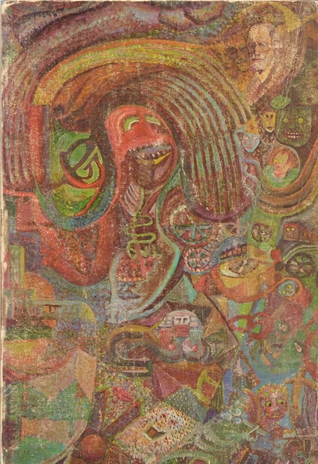
(Cover painting: One of Perls's own entitled "Eyeglass in Gaza." If you look closely in the top right corner of this painting, you can plainly make out the famous face of Sigmund Freud. -G.R.)


date newest »
newest »
message 1:
by
Dorothy
(new)
Feb 08, 2017 06:50PM
 Vincent F O'Connell was an amazing Gestalt Therapist, Mystic, Man, and Scholar - with a big, open heart. I was blessed to study with Vinnie for a number of years and to stay in touch until his death. Prior to meeting Vinnie, he and April O'Connell's textbook, Choice & Change (specifically the 1973 version - as it changed greatly over the years) was a profound catalyst at the beginning of my journey to find my authentic self. It was that book that led me to Vinnie. It is hard to imagine how my life might have turned out without Vinnie's deep, intuitive insights and teachings. His guidance was essential. Rest In Peace Dear Vinnie!
reply
|
flag
 That's great to hear, Dorothy. Both of us knew Vinnie and April personally over the many intervening years. I still have much of the correspondence to this day. They were both so fully and completely themselves -- and such benevolent souls in their distinct and very different ways! If you're on Facebook, we could also connect through our sites there. Also, I have a site at www.generuyle.net, with a brand new overall network site opening this coming weekend at www.thehumanrealm.com. Best to you in all now unfolding in your own life. -Gene
Profile at Google+
My site at Google+ for stand-alone media clips that speak for themselves . . . and are designed for each viewer to quietly see, feel, and take in by themselves.
plus.google.com/+GeneRuyle/posts
-G.R. ...more
plus.google.com/+GeneRuyle/posts
-G.R. ...more
- Gene Ruyle's profile
- 5 followers

