
2026 Q2: Debt of Honor by Tom Clancy > Likes and Comments
date newest »
newest »
 Started it.
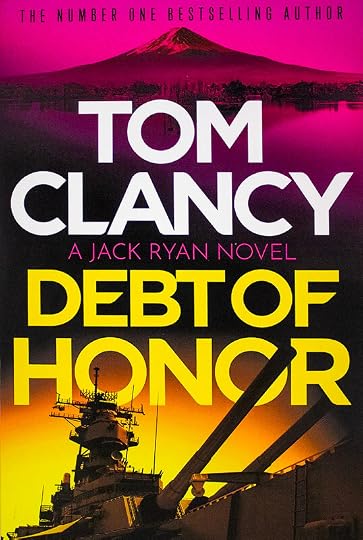
Latest Cover Design
 Not my favorite Clancy/Jack Ryan novel. The only think I really liked about it was the very end which spring boards it into the next book.
Yes, the ending was epic. That is the only thing I remember about reading it back then. Then … something happened later … and the ending was even more remarkable in hindsight.
Not my favorite Clancy/Jack Ryan novel. The only think I really liked about it was the very end which spring boards it into the next book.
Yes, the ending was epic. That is the only thing I remember about reading it back then. Then … something happened later … and the ending was even more remarkable in hindsight.Maybe Chris is reading this too. Not many of us, though not everyone populates their status.
I’d say it was miserably slow and plodding until about chapter 20, 42% of the way in on a monster book. 42%! Damn this guy. Then, it starts rolling. The plausibility of the plot leaves me disappointed, but I remember thinking the ending was worth it in the 90’s. I’m determined to get through Clancy’s primary works, rereading some of them for continuity sake.
I think today’s standards … and/or my personal taste … prefers better pacing. That being said, I remember positively bitching about this one in the 90’s. It came up short by my standards 30 years ago, in terms of getting underway, not the finish.
My dad used to just inhale Clancy books. He didn’t read much, but he read Tom Clancy (probably because Ronald Reagan recommended it), Rush Limbaugh, and Louie L’Amour who wrote a ton of western novels like The Sacketts. He’d bang out a book like this in 2 days. I still can’t believe it. How can a human being read that fast? I swear he must have been skimming or something. No way he could retain any of it. He’d have a huge smile and say he loved it. I can’t remember him ever recounting a single thing that indicated retention or learning of anything he read, but he was happy nonetheless. I have grumbled through the first half of most Clancy books I’ve read.
 Steve wrote: "Maybe Chris is reading this too"
I'm at the two thirds mark.
I'm enjoying the read, although perhaps not as much as 'back in the day', when I'd get the latest Tom Clancy as it came out as a matter of course (and a vacation wasn't a vacation without a Tom Clancy).
My perspective back then was that, with Debt of Honour, he was approaching a peak that he hit with his next novel, Executive Orders. After that, from The Bear and The Dragon onwards, I felt he was in slow decline, ending with Red Rabbit, which was truly execrable, and which marked the point that Clancy and I parted company.
So I did very much enjoy it first time around, but I think that's because I had a preference for his complex geo-politics behemoths over the more personal and tactical stuff, such as Without Remorse. YMMV, and all that.
Looking at it now, as well as stretching credulity to breaking point, it is of course deeply unfair to Japan (the US seemed to be going through a phase of anti-Japanese paranoia back then. See also Michael Crichton's Rising Sun, although it was a brilliant novel). There's also a great deal of explication, 'telling' instead of 'showing', that might have been better handled in dialogue (which, in my view, Clancy excelled at).
I didn't really mind the slow start, though. There's a lot going on and a fairly large cast, so it helped me get familiar with them.


Debt of Honor by Tom Clancy (1994)
Pages: 990 | Rated: 4.11 | Ratings: 52K
Debt of Honor features an intricate multi-pronged attack on America (circa 1990s), lead by a Japanese tycoon acting on a seething desire to avenge his parents death in WWII. Somehow he escalates to something of a puppet master pushing his nation back on the path to an empire. America contests the war on all fronts with vigor and cunning. The iconic finale is without a doubt the most memorable ending ever in the techno-thriller genre. It was a shocking flourish at the time, that was since seared in our memory for its chilling prescience.
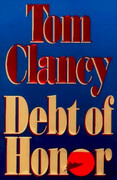
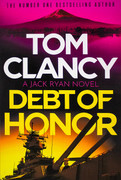
Below is the original book cover, and a newer design. As of 2026, I haven't seen this newer design in the US yet.

Is Debt of Honor a good book ... worthy of that 4.11 rating? Yes and no.
If you're a Clancy fan: Yes. Just read it. You’ll like it.
If you’re not an avowed Clancy fan: No. You'll abandon before it gets going. He beats around the bush and gives excessive detail. It's that simple.
I’m a Clancy fan. I personally give it 4 stars, or more specifically maybe a 3.90.
Is this Clancy’s best book? No. I've seen a few reviewers say this is their favorite. Eh, ... hell no. Don't put any stock in that. Where does it rank in the Clancy pantheon? It's middle of the pack. But, it's not middling through and through. This is a mixed bag—both hot and cold.
THE COLD:
The first 42% of the book—yes 42 f@%@ing percent—is a plodding bore! Clancy reserves himself the f@$*ing right to use half the book for exposition—as in Sum of All Fears. Yeah, remember that? How challenging was it—even as a Clancy fan—not to abandon that book? This one’s not quite that rough, but ... damn. This is a bestseller?! You might find yourself incredulous. At about 40% in, it is tough to stay engaged, and now inspired by all the Japanese notions you are reading, you are sharpening up the tanto (“short knife” … really a “short sword” or “long knife”), preparing for seppuku. But hang in there (can’t tell you to “gut it out” when speaking of a tanto in hand). This is a multifaceted plot, and he introduces all these separate plot elements and characters. It takes time. His editor fell asleep on the job again. You've got many of the usual characters like Jack, Clark, Chavez, Mancuso, and Jonesy. But Clancy's writing isn't Larry McMurtry, who is sometimes scintillating even describing mundane stuff. Clancy is often accused of over explaining things. Guilty as charged if I’m on the jury. He takes he sweet time here. And, ... I'm going to say this plot is rather far-fetched. I bought into the plot in Sum of All Fears, but this seems a little crazy here. Clancy was getting his groove on with a bit of Japanese on the brain as was the fashion at the time. All the electronics manufacturing of TVs and radios evaporated from America and moved to Japan. Sony was killing it. Honda and Toyota were cleaning up with the best selling cars in America. The movie Gung Ho with Michael Keaton was tapping into that fear of losing jobs overseas. Michael Crichton was writing Rising Sun, his thriller about the Japanese in America and a movie with Sean Connery and Wesley Snipes was made. The movie Black Rain with Michael Douglas tapped into the same ethos. This book gets in on the same phobia. The exposition is too long, but the pain will fade in time, and the upside of this story will stick with you a bit.
THE HOT:
Then—at 42% in or so—stuff starts to hit the fan. It starts to get interesting. Now, ... not everyone is equally interested in all the details of every missile, plane, radar, ship, communications system, and so on. But, all that is certainly a little more interesting in the thick of battle. We have B-2 stealth bombers, ICBMs, F-22 stealth fighters, Comanche helicopters, Apache helicopters, laser designated smart bombs, Hellfire missiles, submarines, destroyers, aircraft carriers, Patriot missile defense systems, and at least one wiz-bang thing you've never heard of. You get the sense of the calculus with all these weapons, the surprises, and defeats.
THE END:
The dust has settled, and he’s going through the happily ever after epilogue stuff—it seems like time to run the credits—and then holy moly. Stuff goes down. Honestly, this is likely just an author having his way ... trying not to be too deus ex machina about tweaking the playing field, so he does something that is crazy and yet seems plausible. Thank you, Mr. Clancy. I don't like just crazy. So, he moves the chess pieces around somethin' fierce, and sets the stage for the next book he wants to write. But in hindsight, the end is quite a thing, especially if you read it in the 90s. Not that it's great writing. It isn't. It's just eventful. You'll see. It will stick with you. It will be an ending you’ll remember. They didn’t make a movie of this one. If they had … oh, man! People would have been shaking their heads staggering out of the theaters and into the parking lot. And, there would have been no denying its influence. As it stands, … people have written denying it had the influence that … it seems like it did. I will honestly say—though I expect no one to believe me—that I had long thought of such a scenario before I read this book, and had even told a couple people. I didn’t have exactly this in mind. Something less Earth shattering … and yet even more unnerving. At any rate, the ending is noteworthy. No two ways about it.
If you are tracking along, let use know how you're doing on lifetime Clancy books here:https://www.goodreads.com/topic/show/...
Weigh in on your ranking of Clancy books here:
https://www.goodreads.com/list/show/4...
Weigh in on your ranking of 1990s technothrillers here:
https://www.goodreads.com/list/show/2...
 I finished! I agree about the plodding in the first third or more of the story. Here's a few comments I have about the story.
First, there's a few themes that are triggering to women, and there's the potential as you read they might get graphic. None did, I'm glad to say.
Second: Where the heck was Jack Ryan in most of this story???? I mean, I read this story for his character. That disappointed me no end, with nothing but tasters of his situation and certainly no action in most of it. I get it, he's at the strategic level now. Even so...
However, there were a few characters that I also enjoyed from previous Jack Ryan stories (televised) and some new ones to me. Keeping the plot straight was tricky as I counted multiple plot strands that seem miles apart, that kind of come together.
I think the start of this book is somewhere in the middle.
The end and I mean the last 15 minutes of the 36 hour book are the best! Man I cried! Seriously, it reached out and made that emotional connect through family and national love of ones home country. It worked because Ryan is the epitome of the reluctant hero. And aren't we all in some shape or form?
Would I recommend this book? Not really, but then I wouldn't want anyone to miss that HEA followed by 15 minutes of emotional hell yeah, we're doing it anyway!
Do I want the next in series? I almost bought it and just stopped myself. Heck, I've got the other June book to buy first and that's my credits gone. Boo!
That ending lifts this story to a three star. I'm generally a 4/5 star gal. Without that ending this would have been my first two star. And what a save!
Listen to it on a higher speed and when you're redecorating is my advice.
Glad you made it through. It was a long and slow for much of it.
I got this finished last night. I don't really have much to add to my earlier comment. The ending didn't really change my opinion, simply because I could remember the gist of it from when I first read the book.There's a certain kind of Tom Clancy story that looks as though it was put together by playing a simulation wargame with a mate, and then writing it up as a novel. Debt of Honour falls squarely into that category. My own preference is for this type of 'strategic' novel (to use Helena's term) over his more character driven stories, but I can certainly see why others would take the opposite view.
Back in the day I would have five starred this. Nowadays I'd drop that to four. I didn't mind the slow start, thought the plot complexity and technical detail had great merit (I'd freely acknowledge I'm not a 'literary' reader) and, of course, the ending is undoubtedly very strong. On the other hand, it strains credulity in parts, it's very unfair to the Japanese, and the US forces have it far too easy when they do actually decide to fight back (having told us earlier that it's probably a hopeless cause).
Clancy once described himself as the minstrel of the US armed forces. Like many of his books, Debt of Honour is, first and foremost, a celebration of the US military and of US governance. There's really nothing wrong with that. Were I a US reader, I'm sure I'd be cheering him along (and, back in the day, I did anyway). It does perhaps jar a little against some of the more humbling experiences of warfare and geopolitics since the book was written though.
Glad you made it to the finish line. I need a break before I take on Executive Orders.I agree with your thought that his books are celebration of the US military. I do feel like Clancy seems to follow the path of say a John Wayne western movie. He is “the good guy” and he will come out on top every time. John Wayne often won a fight against Indians. It seems to reassure the white man that he is good or superior to the … others. Whatever he did was “good”. The movies didn’t really delve into the moral or ethical dilemma. It seemed to avoid that as if to reassure viewers that always going with your gut is just fine and manly and right. If you don’t like others, go with it. Clancy seems to reassure Americans during a Cold War era that we are strong victors with superior … everything … technology, education, religion, morality, weapons, cleverness, strategy, and tactics. The “bad guys” are always dirty fighters who treat women and children wrong and so on. The VP in this one being bad was just necessary for his plot objective, as was the ending.
These books are always morally simplistic and the US always wins, more or less “easily” … though there is tension. There isn’t anything like Lone Survivor, Black Hawk Down, 13 Hours, or How Men Win Glory, where Krakauer details how NFL football player Pat Tillman was killed by friendly fire … and many similar incidents.
The Aggressor also has American winning in a similar manner … usually. Interesting given that it’s an Australian author … allegedly. He did have more of a mix of outcomes.
Debt of Honor by Tom Clancy (1994)
Pages: 990 | Rated: 4.11 | Ratings: 52k
Publisher’s Summary
Razio Yamata is one of Japan's most influential industrialists, and part of a relatively small group of authority who wield tremendous authority in the Pacific Rim's economic powerhouse.
He has devised a plan to cripple the American greatness, humble the US military, and elevate Japan to a position of dominance on the world stage.
Yamata's motivation lies in his desire to pay off aDebt of Honor to his parents and to the country he feels is responsible for their deaths—America. All he needs is a catalyst to set his plan in motion.
When the faulty gas tank on one Tennessee family's car leads to their fiery death, an opportunistic U. S. congressman uses the occasion to rush a new trade law through the system. The law is designed to squeeze Japan economically. Instead, it provides Yamata with the leverage he needs to put his plan into action.
As Yamata's plan begins to unfold, it becomes clear to the world that someone is launching a fully-integrated operation against the United States. There's only one man to find out who the culprit is—Jack Ryan, the new President's National Security Advisor.