
June 2026- Lifted Veil Spoilers > Likes and Comments
date newest »
newest »
message 1:
by
Charlene
(new)
Jun 01, 2026 05:59AM
 Please realize that if you have not finished the book yet, there could be spoilers
reply
|
flag
 & finished! It was originally publisherd in a magazine so is a very quick read.
I didn't like the beginning but this is partly because for me this was so unexpected. This was beautifully written.
I'll wait for everyone to catch up.
 I enjoyed it for the things that I like about Eliot’s writing—wit, insight, the occasional counterintuitive metaphor. The story itself didn’t do a lot for me, though. I didn’t like Latimer much as a protagonist, that’s probably most of why. But the writing was also a bit heavy, I thought.
 After finishing it, my first thought was, "is that it"? Then I remembered it was a short story and from another era and decided it was not bad as a story. However, the prose was so purple. It is never necessary to have 100 word sentences.
This was my first work by George Eliot. I learned I do not like her writing style and I do not need to read her again
I would definitely not judge her writing style from this example.
Thanks, Spoke. That is good to know. Perhaps I will try one of her shorter novels before I commit to a tome like Middlemarch.
 Jan wrote: "I learned I do not like her writing style and I do not need to read her again..."
I found this, from an article by Kate Flint.
"The Lifted Veil, written in the earlyIt has been considered the cuckoo in the nest of Eliot's writing. She was definitely influenced by Lewes' (her partner's) work at the time. It's the first thing she publishes with the male pseudonym.
months of 1859 and first published in Blackwood 's Magazine in June of that year, has long been a work that critics have not known quite what to do with. It has been seen as a Tale of Mystery and Imagination, in the style of Edgar Allan Poe; a short novel dealing with moral problems; an early example of the sensation fiction that was to become so popular in England during the 1 86os. It has stimulated questions concerning the
part it plays in George Eliot's career as a writer-particularly in relation to the fact that in this work she conspicuously and deliberately adopts a first-person male persona.
What was she thinking? All of the paranormal stuff are possibly Latimer's hallucinations and imaginings, except for the blood transfusion piece. Flint goes on to explain the the source for this creepy bit. It is very likely that Meunier is based on a real person named Charles-Edouard Brown-Sequard .
...Brown-Sequard attempted an experiment on a dog suffering from peritonitis-the same ailment from which Mrs. Archer expires. He waited until all movement had stopped, the dog had emptied itself of fecal matter and urine, its pupils had dilated, and he could no longer hear the heart beat. At this point he made a transfusion of blood from another, live dog into the right carotid artery. The first sign of temporary recovery was the recommencement of the heart-beat, and then, albeit aided at first by artificial respiration, the dog began to breathe again, and eventually "all the main functions of animal and organic life returned to it. Although feeble,the animal raised itself on its forepaws and wagged its tail whenSo it was not all that far-fetched.
stroked." Four or five hours later it died: "I almost said, died again." Brown-Sequard wrote up this experiment in an article of 1858, "Research into the possibility of temporarily bringing
back to life individuals dying from illness," ...
Latimer is the classic unreliable narrator. Can we believe anything of what he says?
This story is nothing like any of her other fiction, although she is very intellectual and often passages improve upon re-reading. In his autobiography, Anthony Trollope has this to say.
It is, I think, the defect of George Eliot that she struggles too hard to do work that shall be excellent. She lacks ease. Latterly the signs of this have been conspicuous in her style, which has always been and is singularly correct, but which has become occasionally obscure from her too great desire to be pungent. It is impossible not to feel the struggle, and that feeling begets a flavour of affectation. In Daniel Deronda, of which at this moment only a portion has been published, there are sentences which I have found myself compelled to read three times before I have been able to take home to myself all that the writer has intended.Trollope had not read Middlemarch when he wrote this. For me, Middlemarch is actually an easier and more compelling read than any of her other books I have read.
I was wondering what the significance of the title was, so I googled.The “veil” in George Eliot's novella “The Lifted Veil” symbolizes the boundary between the natural world and the world of the supernatural, which in this story includes the realm of the spirit and of death.
I guess Bertha also had a lot of her true character 'veiled' as well.
After the protagonist has (I think?) his first vision—the detailed, intense daydream of Prague—he introduces the metaphor.I could not believe that I had been asleep, for I remembered distinctly the gradual breaking-in of the vision upon me, like the new images in a dissolving view, or the growing distinctness of the landscape as the sun lifts up the veil of the morning mist.So I just took it that the “veil” is the way most human minds work, conscious only of the things they physically experience in linear time, and the “lifting” is the removal of that constraint for our protagonist, allowing (forcing) him to be fully aware of things he hasn’t yet experienced corporeally.
He does also mention the veil around Bertha, though, which mostly remains un-lifted. “. . . the veil which had shrouded Bertha’s soul from me—had made me find in her alone among my fellow-beings the blessed possibility of mystery, and doubt, and expectation . . .”
I agree that the lifted veil is all of the above. It also refers to the climax, where the veil of death drops for Mrs. Archer (For across those hard features there came something like a flash when the last hour had been breathed out, and we all felt that the dark veil had completely fallen.) Then, the transfusion lifts it briefly.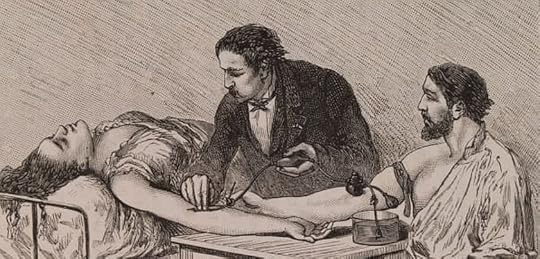 Wonderful picture, Ginny.
& great analysis from both of you!
 I enjoyed this story a lot and thought it was very effective. Whether you take Latimer’s abilities as intended to be literally true or as a literary device, they worked for me. The comings and goings of his abilities were a bit preposterous, but preposterous twists are surely an element of the horror genre.
 I see in this early work that Eliot’s gifts of characterization are in full evidence. I know no equal for her in teasing out the fine details of someone’s personality and motivations, taking the time to paint every shade. It’s one of my favorite things about her work and why Daniel Deronda is one of my favorite novels. There were fewer gorgeous, quotable sentences here, but the story held me riveted. I don’t read much horror, but this seems like a very respectable entry in the field.
I reviewed it here: https://www.goodreads.com/review/show....
 Finally started this yesterday (I know, with one day left in the month). Will read through all the above comments in due course, but first impression: the opening reminded me strongly of Frankenstein, both interms of tone/style and content.
 Finished. Thanks everyone here for the insights on the context for this short piece, so different from Middlemarch, as if she were trying something on. I liked reading it because I didn't know where the tale was going (always exciting). Otherwise, it makes sense that it was a sensational trendy kind of first-publication win in a magazine setting.
Elizabeth wrote: "first impression: the opening reminded me strongly of Frankenstein, both in terms of tone/style and content...."
Finished. Thanks everyone here for the insights on the context for this short piece, so different from Middlemarch, as if she were trying something on. I liked reading it because I didn't know where the tale was going (always exciting). Otherwise, it makes sense that it was a sensational trendy kind of first-publication win in a magazine setting.
Elizabeth wrote: "first impression: the opening reminded me strongly of Frankenstein, both in terms of tone/style and content...."I found this observation so interesting, that I embarked on a bit of a research rabbit hole. I found this (quite possibly pirated) from an introduction to a World Classics Paperback, 1999, by Helen Small.
Eliot’s friend and acolyte Edith Simcox replied less tactfully when Lewes quizzed her about the story in Eliot’s presence: ‘I was put out by things that I didn’t quite know what to do with––it was a shame to give such things a moral, but––’.It's been a few years since I read Frankenstein, but I can see the similarities. If I remember correctly, Frankenstein is a first person narrator like Latimer, and their characters are somewhat similar.
Until the early 1980s, when Beryl Gray published first a ground-breaking essay on ‘The Lifted Veil’ and Victorian ‘pseudo-science’, followed by a Virago edition of the story, Simcox’s view seems to have been shared by the great majority of critics. The story was in the main neglected, on occasion frankly disparaged. In the past decade, however, it has come to be one of Eliot’s most widely read and discussed works.
Not least, it is now celebrated as the nearest Victorian successor
to that more famous horror-story about scientific experimentation
with death and life, Mary Shelley’s Frankenstein. The young Latimer, like Frankenstein, travels to Geneva––once the home of Rousseauean Romanticism and in the 1850s still one of Europe’s great centres for physiological research. Like Shelley, Eliot portrays philosophical conflicts but also, more deeply, an alliance between art and science. ‘The Lifted Veil’ is also the nearest nineteenth-century English parallel to Edgar Allan Poe’s macabre tale of mesmeric revivification, ‘M. Valdemar’ (1839).
But however much Eliot’s story shares with these and other Gothic fantasies, it remains, centrally, a work of mid-Victorian realism, its power stemming largely from Eliot’s recognition that scientific inquiry was making available in the 1850s a radical extension of what ‘the real’ might be seen to include.
In ‘The Lifted Veil’ Eliot takes more risks with narrative voice, with narrative structure, and with the taste of her readership,
than she ever would again. The story deserves admiration for the
scope and power of its writing.
 Definitely the opposite of Happily Ever After. The second chapter held my interest better than the first. Latimer was too full of self pity for me to be entirely sympathetic,
I've had a ridiculously busy couple of weeks with almost no time at all to read, but finished The Lifted Veil this morning and hoping to start Cluny Brown tonight or tomorrow (looking forward to the change of tone, although I did enjoy this despite finding the narrator insufferable). I'll write more later when I've got access to my computer, because I struggle to quote and reply in my phone and you have all said some really interesting things! But two thoughts while they are fresh in my mind:
Definitely the opposite of Happily Ever After. The second chapter held my interest better than the first. Latimer was too full of self pity for me to be entirely sympathetic,
I've had a ridiculously busy couple of weeks with almost no time at all to read, but finished The Lifted Veil this morning and hoping to start Cluny Brown tonight or tomorrow (looking forward to the change of tone, although I did enjoy this despite finding the narrator insufferable). I'll write more later when I've got access to my computer, because I struggle to quote and reply in my phone and you have all said some really interesting things! But two thoughts while they are fresh in my mind:1. Despite the supernatural elements and the engagement with contemporary experimental science, at its core, this story felt to me like a metaphor for how misogynistic men see women. Either an object of desire - so beautiful, so ~mysterious~. Reading their own desires into our thoughts. Or if they can't put us in that category, we are shallow, prosaic, worldly, repulsive. No concept that our internal lives might be as complex and rich and important as their own (or more so, frankly).
2. I did kind of know that Bertha and Mrs. Archer must be plotting to kill Latimer, but before the reveal about the poison, did anyone else kind of get the vibe that their secret might be that they were lovers? Actually even with the poison, I kind of still feel like they might have been.
Interesting, the misgyny angle! I’ll have to reread the story with that in mind, it hadn’t occurred to me.